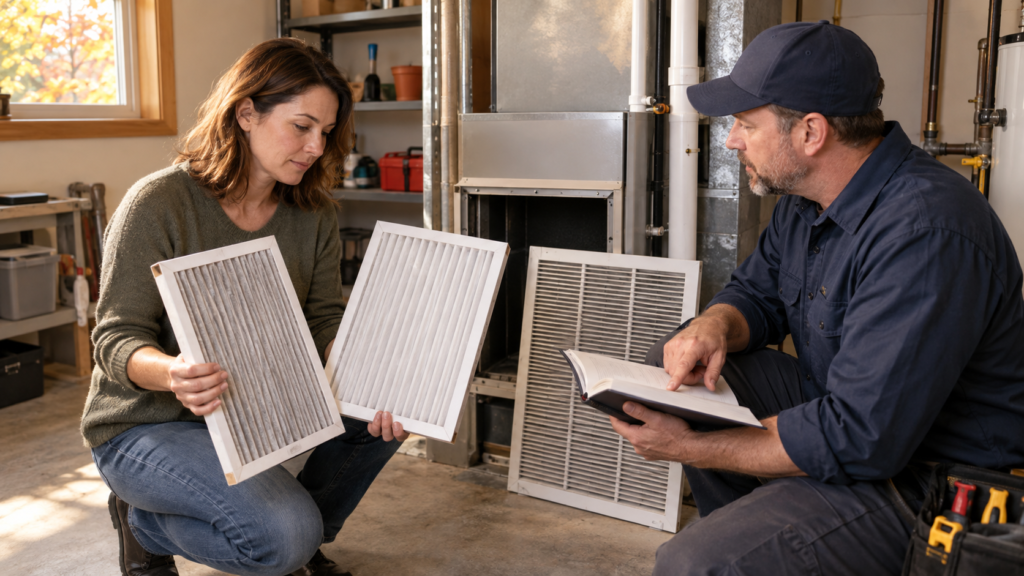
Choose a furnace filter MERV rating by checking your equipment manual first, then selecting the highest rating your system fan and filter slot can accommodate. EPA lists MERV 8 at at least 70% capture and MERV 13 at at least 90% capture for particles from 3 to 10 microns, but a denser filter needs a compatible system.
Key takeaways
- MERV compares a filter’s particle-capture performance from 0.3 to 10 microns.
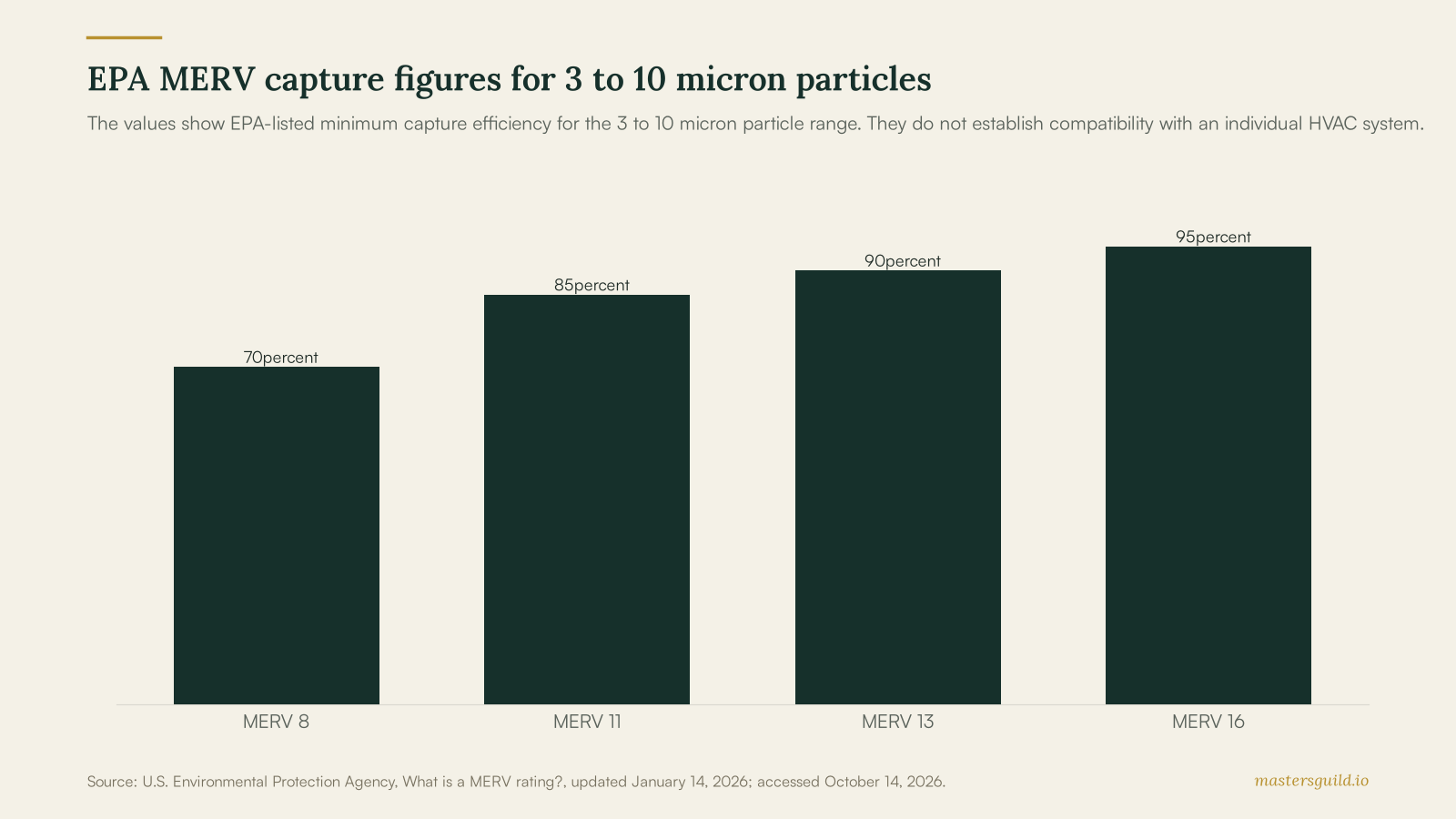
- EPA lists MERV 8 at at least 70% capture for particles from 3 to 10 microns.
- EPA lists MERV 13 at at least 90% capture for particles from 3 to 10 microns.
- Check the equipment manual or ask an HVAC technician before moving to a denser filter.
The MERV number describes particle capture
The U.S. Environmental Protection Agency defines Minimum Efficiency Reporting Value, or MERV, as a rating for a filter’s ability to capture particles between 0.3 and 10 microns. The number gives you a comparison point; it does not replace the furnace manufacturer’s filter specification. EPA’s MERV table lists separate capture results for different particle sizes.
For the 3 to 10 micron range, the EPA table reports at least 70% capture for MERV 8, 85% for MERV 11, 90% for MERV 13, and 95% for MERV 16. Use those figures to compare filters in the same particle-size range. A MERV 13 label does not mean that each furnace can use that filter without a compatibility check.
| Filter rating | EPA minimum capture for 3 to 10 micron particles | Homeowner action |
|---|---|---|
| MERV 8 | 70% | Check the printed size and the manual’s approved range |
| MERV 11 | 85% | Confirm that the filter sits flat and the cabinet closes |
| MERV 13 | 90% | Check system compatibility before upgrading |
| MERV 16 | 95% | Ask a qualified HVAC technician to assess the system |
A denser filter needs a system check
EPA advises homeowners who want a higher-efficiency filter to choose MERV 13 or the highest rating that the system fan and filter slot can accommodate. The agency also says that homeowners may need an HVAC technician to determine the highest-efficiency filter that works for the system. Start with the manual, the filter’s actual dimensions, and the model number instead of choosing by the largest number on the package.
Do the safe checks yourself: turn the system off if the manual directs you to do so, confirm the filter size, note the airflow arrow, and make sure the access panel closes after replacement. Do not modify the filter rack, force a filter into place, open electrical panels, or diagnose airflow problems. Masters’ Guild HVAC services can help you describe a compatibility or airflow concern before you request offers.
The filter change is a useful maintenance record
Write the installation date, filter size, MERV rating, and any comfort or noise issue on the filter frame or in a home-maintenance note. That record gives a technician a useful timeline if the system begins short cycling, the rooms heat unevenly, or the cabinet will not close. A replacement filter cannot diagnose a furnace problem; use the record to make a clearer service request.
If your furnace already has a heating problem, review the symptoms and repair scope in our furnace repair cost guide. If wildfire smoke affects your area, our wildfire smoke home guide explains where a MERV 13 discussion fits into a broader indoor-air plan.
Post the filter size, furnace model, and any airflow concern to get comparable help from local pros. Get HVAC help on Masters’ Guild.