

More than 1 in 5 renovating homeowners now use AI in home renovation planning, and the contractors they hire are further along still. Houzz’s 2026 State of AI in Construction and Design report, released September 1, surveyed 601 US construction and design firms and, for the first time, 3,149 renovating homeowners. The short version: 22% of homeowners used AI on their project, 52% of construction firms use it for everyday tasks, and 80% of homeowners still hired a pro to do the work. AI is changing how renovations get imagined and quoted. It is not replacing the person holding the tools.
Key takeaways
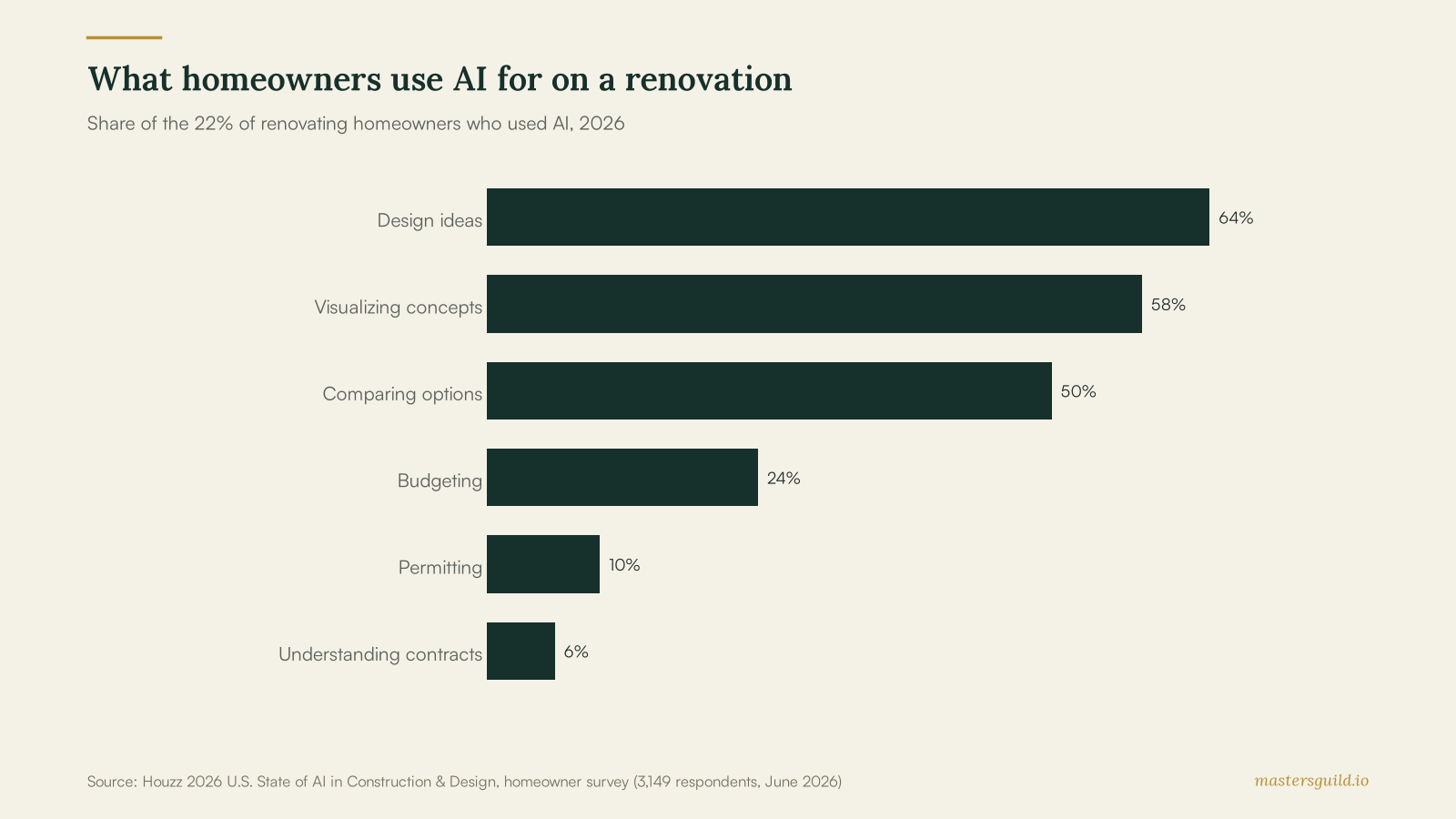
- 22% of renovating US homeowners used AI on their project in 2026, mostly to get design ideas (64%), visualize concepts (58%) and compare options (50%)
- Homeowners rarely use AI for the parts that cost money: budgeting (24%), permits (10%) and understanding the contract (6%)
- 52% of construction firms now use AI for everyday business tasks, up 20 points in a year, saving an average of 4.7 hours a week
- Visualization is both the most popular homeowner use and the top disappointment: 26% said the AI picture fell short of expectations
- 80% of homeowners still hired a pro; among non-users, 38% simply preferred professional expertise
Contractors Adopted AI Faster Than Their Clients
The supply side moved first. Across all construction and design firms, 41% now use AI for business tasks, up from 34% a year ago. Construction firms jumped the most: 52% use AI, up from 32% in 2025, and another 34% are exploring it, leaving just 14% with no plans. Once a firm adopts, it sticks: 80% of construction adopters use AI daily.
| Segment | Using AI, 2025 | Using AI, 2026 | Weekly hours saved |
|---|---|---|---|
| Construction firms | 32% | 52% | 4.7 |
| Design firms | 31% | 39% | 3.6 |
| All firms surveyed | 34% | 41% | 3+ for 52% of users |
| Renovating homeowners | not surveyed | 22% | n/a |
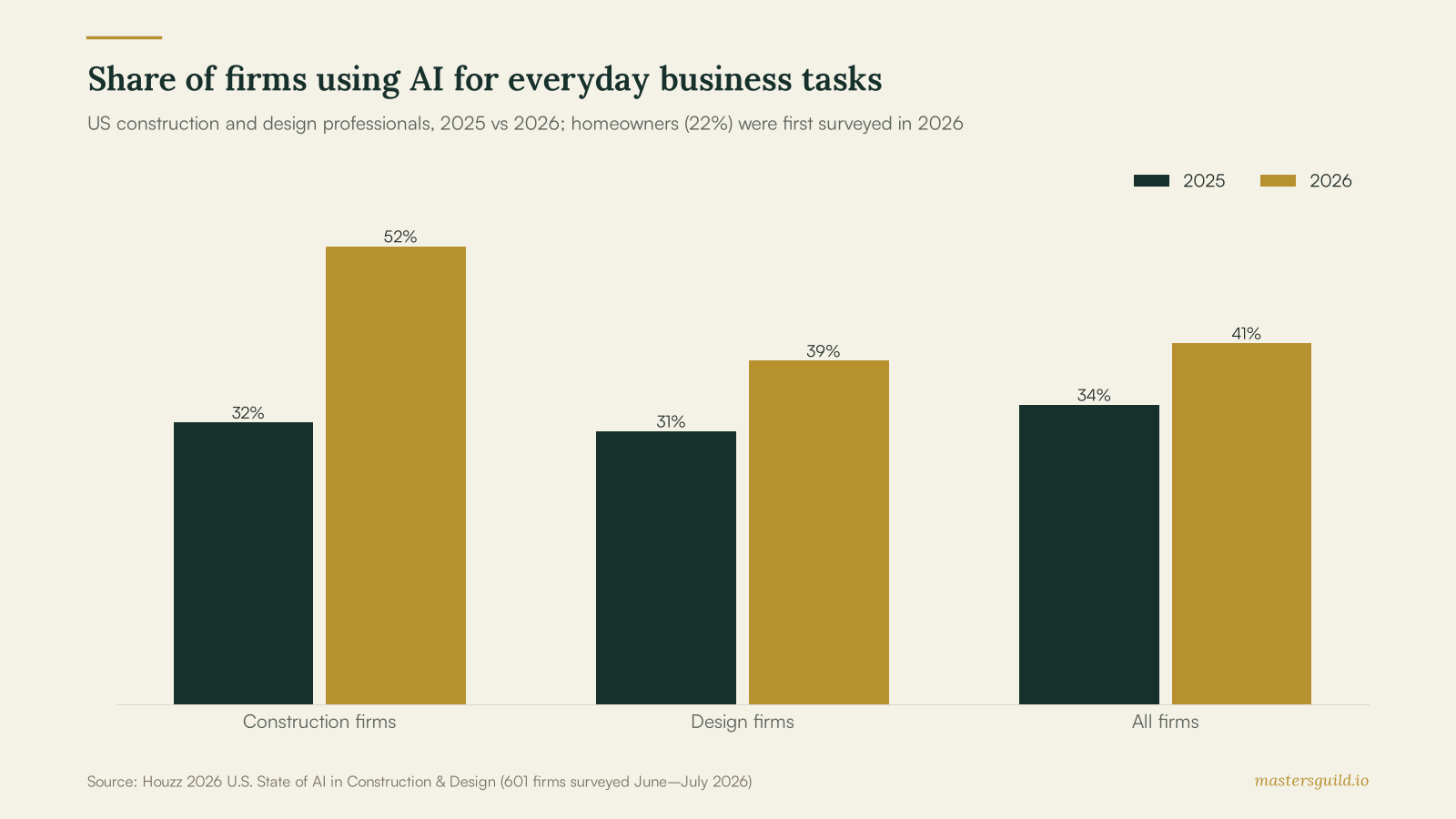
Where do firms use it? Sales and marketing leads (64%), planning and design (61%), project and client management (59%), admin (52%) and operations (45%). Inside those buckets, the fastest-growing tasks are the ones that land on your kitchen table: estimates and proposals (87% of AI-using firms, up from 80%), pre-project visuals (70%, up from 42%) and contracts or permits (69%, up from 60%). Houzz’s CEO says AI now generates more than half the estimates sent through its platform, 60% faster than manual ones.
Keep that in mind when a quote arrives the same evening you asked for it. Fast is fine. But 37% of pros say they worry about the accuracy of AI output, up from 33% last year, so a quick estimate still deserves a slow read.
What Homeowners Actually Use AI For
Homeowners reach for AI to imagine a project, not to manage it. Most of the 22% wanted ideas and pictures, not help with money or paperwork.
| Homeowner AI use | Share of AI users |
|---|---|
| Getting renovation or design ideas | 64% |
| Visualizing concepts | 58% |
| Comparing options | 50% |
| Budgeting | 24% |
| Permitting | 10% |
| Understanding contracts | 6% |
Adoption splits sharply by age: 41% of millennial homeowners used AI versus 7% of seniors. Satisfaction is lukewarm rather than glowing: 27% of users were very satisfied, 50% somewhat, 5% dissatisfied. And the most popular use is also the one that disappoints most. Visualization topped the list of uses and the list of letdowns, with 26% saying the AI rendering fell short of expectations. A generated picture of your kitchen does not know where the plumbing stack is, what the load-bearing wall is doing, or what a kitchen remodel actually costs in your city.
The Gap That Costs Money
Put the two halves together and a mismatch appears. Contractors use AI most heavily on estimates, proposals and contracts. Homeowners use it least on budgets, permits and contracts. The paperwork is getting faster on one side of the table and no better understood on the other.
That matters because the money side is where renovations go wrong. Our over-budget post covered how often projects blow past their number; Houzz’s own data says 37% of homeowners exceeded their 2025 budget. A rendering will not fix that. Reading the estimate line by line, asking what each allowance covers, and confirming the permit is in the contractor’s name will.
There is good news for pros who use AI in front of clients. Among homeowners whose contractor used AI, 76% said it helped them visualize the project, 49% said it helped them understand the pro’s ideas, and 35% said the pro seemed better prepared. Used openly, AI reads as competence. A Toronto kitchen remodeler who shows three AI concepts before demolition day is selling clarity, and clients reward it.
How to Use AI on Your Renovation Without Getting Burned
The survey is US-only, but the tools and the traps are the same in Canada. A sensible split:
- Use AI for the imagining. Ideas, mood boards, layouts, the list of questions to ask a contractor. It costs nothing, and 64% of users found value here.
- Treat renderings as sketches. One in four users found the picture did not match reality. Ask the pro whether what you generated is buildable before you fall in love with it.
- Keep humans on the money. Get at least three written quotes, compare them against a published price range, and have a person explain anything AI drafted, including the contract.
- Verify the pro, not the pitch. A polished AI proposal says nothing about a license or a track record. Check the license with your state or provincial board, and run the scam red flags that take ten minutes.
Our Take
Masters’ Guild is our platform, so weigh this accordingly. The Houzz numbers say AI has won the planning stage and, for now, lost the trust stage: 38% of non-users skipped it because they wanted a professional’s judgment, and 80% of everyone hired one. That is the right instinct. A polished estimate is easier to produce than ever, which makes the person behind it more important, not less. On Masters’ Guild every pro is identity-verified with government ID and a live selfie check, you post the job with your budget and receive offers, and payment is held until the work is done. Generate the rendering, then find an identity-verified kitchen remodeler near you to tell you whether it can be built.