
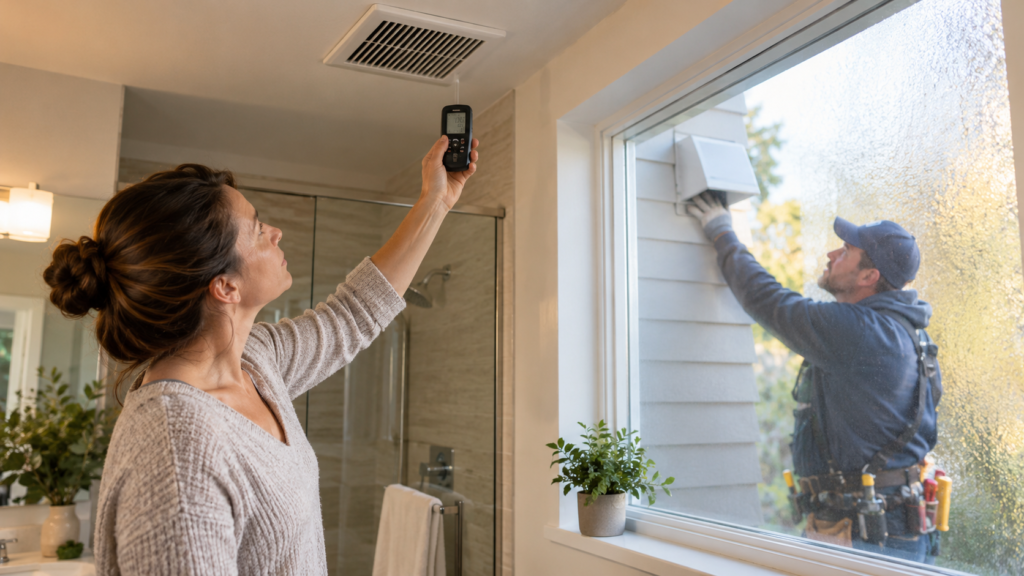
Use this bathroom exhaust fan checklist to confirm that your fan moves shower moisture outdoors, provides enough airflow, and has a safe path for repair before winter. A fan that hums but sends air into an attic leaves the moisture problem in the house.
Key takeaways
- Run the fan during a shower and check that its duct terminates outdoors.
- Treat persistent window condensation, musty odor, or weak airflow as a reason to inspect the system.
- Use the fan’s airflow and sound ratings to compare replacement models.
- Leave new wiring, duct routing, roof or wall penetrations, and code decisions to a qualified pro.
Outdoor venting removes bathroom moisture
Start outside. Find the wall or roof termination for the bathroom fan, then make sure air has a route from the bathroom to that point. The U.S. Environmental Protection Agency says bathroom exhaust should vent directly outdoors rather than into an attic or another space. The agency also advises using a bathroom fan that vents outdoors during and after a shower to remove moisture. EPA’s moisture-control guidance supports the same check.
Do not remove a roof cap, enter an attic, or disconnect ductwork for this inspection. Look for obvious clues from the bathroom: a fan that changes pitch, a grille coated with lint, condensation on windows, peeling paint, or a musty smell. A plumbing leak can create similar signs, so a pro should separate a ventilation fault from a water leak before quoting repairs.
Airflow targets help you compare fan options
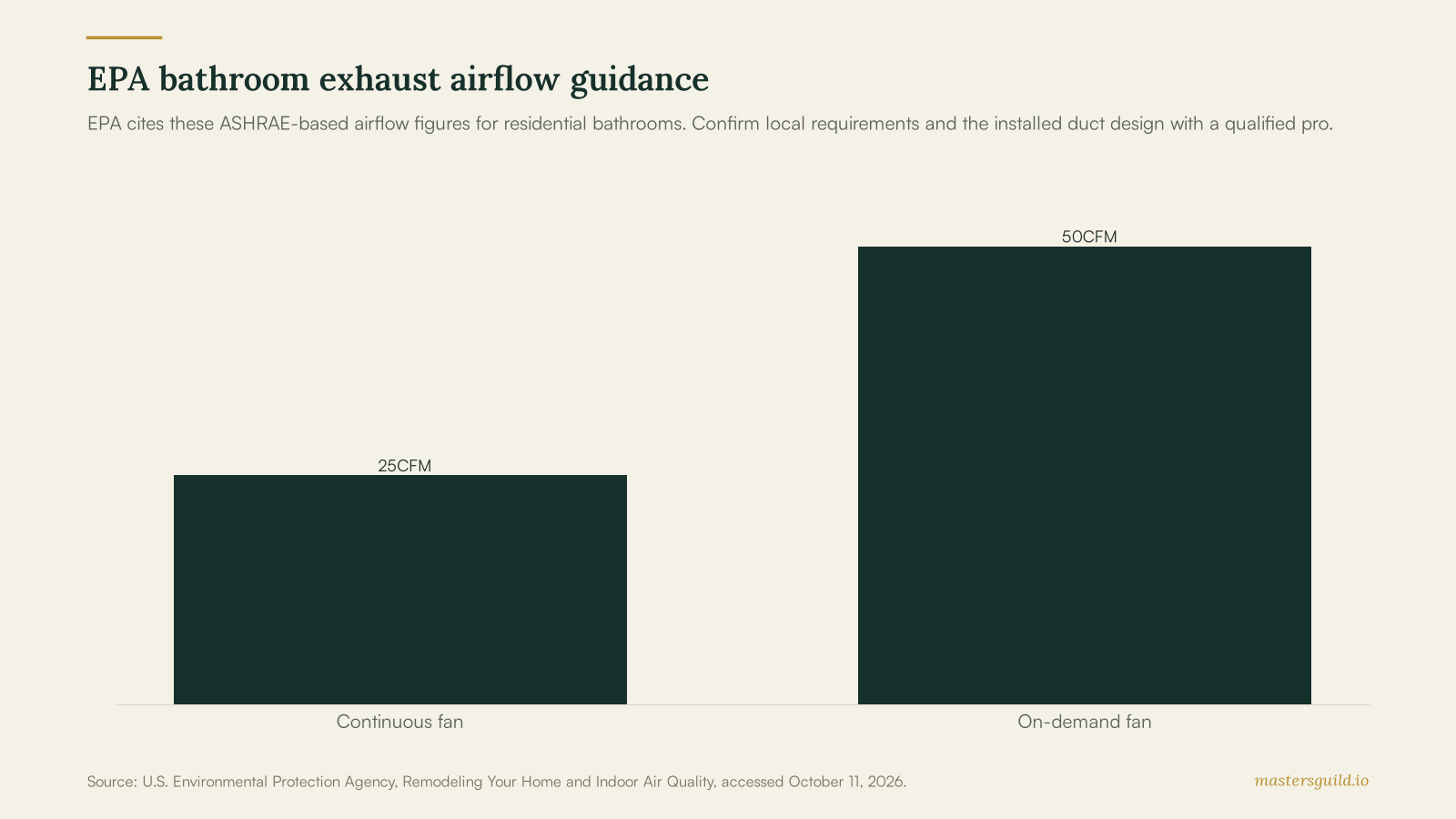
The EPA’s home-remodeling guidance cites 25 CFM for a continuously operating bathroom fan and 50 CFM for a fan used on demand. CFM means cubic feet of air per minute. Those figures help you compare options, but they do not replace local code, the manufacturer’s instructions, or a pro’s assessment of the room and duct route.
| What to check | What you can do | When to hire a pro |
|---|---|---|
| Fan operation | Turn it on during a shower and note noise, vibration, and weak airflow | The fan will not start, trips a breaker, or makes grinding sounds |
| Exterior route | Identify the exterior termination from ground level | The duct ends in an attic, is inaccessible, or needs a new exterior opening |
| Moisture signs | Photograph window condensation, peeling paint, or staining | Stains, odor, or damp materials persist after normal fan use |
| Replacement selection | Record the existing model and room dimensions | The project needs wiring, a larger fan, duct changes, or permit guidance |
Humidity and noise ratings make the choice clearer
The EPA advises keeping indoor relative humidity below 60%, with 30% to 50% as the ideal range where possible. A small hygrometer can help you notice a repeated humidity pattern, but it cannot diagnose a fan or mold issue by itself. EPA’s indoor-air checklist provides those humidity figures and also recommends using an exhaust fan or opening a window during a shower.
Noise affects whether a household uses the fan. ENERGY STAR sets a maximum sound level of 2.0 sones for certified bathroom and utility-room fans from 10 through 200 CFM. Its criteria also require certified models to deliver at least 70% of their lower-pressure airflow when tested at a higher pressure. ENERGY STAR’s ventilation-fan criteria explain the test and rating limits. Compare models with the same airflow range, then ask the installer whether the planned duct route can support the selected fan.
A repair scope keeps the quote focused
Give each pro the fan’s model number, photos of the grille and accessible duct, the location of the exterior termination, and notes on the symptom. Ask whether the quote includes the fan, electrical connection, duct repairs, exterior cap, sealing, cleanup, and an airflow or operation test. Ask the pro to state which work requires a permit in your area.
You can clean the grille, replace a removable cover, and record symptoms after checking the manufacturer’s instructions. Bring in a qualified pro for electrical changes, new duct runs, exterior penetrations, roof work, or evidence of moisture damage. If the work connects to a larger project, compare the scope with our bathroom remodel cost guide. For circuit or switch work, use our electrician cost guide to prepare questions. A home with broader cold-weather moisture concerns can use our fall weatherization checklist to plan related work.
Post your bathroom ventilation job on Masters’ Guild and compare offers from identity-verified local pros. Describe the fan, duct route, exterior termination, and moisture signs so each pro can price the same scope.
Frequently Asked Questions
Should a bathroom exhaust fan vent into the attic?
No. The EPA says bathroom exhaust should vent outdoors, rather than into an attic or another interior space. A qualified pro can assess the existing route and determine the safe correction.
How much airflow does a bathroom exhaust fan need?
EPA guidance cites 25 CFM for a continuously operating bathroom fan and 50 CFM for an on-demand fan. Your local requirements, room conditions, and duct design can require a different approach, so confirm the installed plan with a qualified pro.
Can I replace a bathroom exhaust fan myself?
You can clean the grille and collect model information. Hire a qualified pro when replacement involves electrical wiring, a new duct route, an exterior opening, roof work, permits, or moisture damage.
Why does the bathroom still feel damp when the fan runs?
The fan may have weak airflow, a blocked or disconnected duct, an indoor termination, or a separate plumbing leak. Record the conditions and ask a qualified pro to inspect the fan and moisture source.