

Commercial HVAC maintenance for a small business starts with a filter check, a review of heating schedules, an after-hours walkthrough, and a qualified fall tune-up. Give each task an owner and record what the technician finds before your building depends on heat every day.
Key takeaways
- ENERGY STAR calls for monthly HVAC filter checks during peak heating or cooling season.
- An annual HVAC maintenance contract can schedule pre-season tune-ups before heating and cooling seasons.
- ENERGY STAR recommends an after-hours walkthrough every six months to spot equipment running when it should be off.
- EPA provides HVAC checklists for public and commercial building owners and managers.
A fall work order prevents vague HVAC service calls
Start your commercial HVAC maintenance plan with a short record for each unit: location, filter size, last service date, thermostat or building-control schedule, and reported comfort problem. A café owner might note a cold seating area before opening. An office manager might note a unit running after the staff leave. Those details give a qualified technician a defined starting point.
ENERGY STAR’s commercial-building checklist says building staff should change or clean HVAC filters every month during peak heating or cooling season. It also recommends an annual maintenance contract that provides pre-season tune-ups. Use the equipment manual and the technician’s recommendation for the right filter and service steps for each unit.
| Fall check | Owner’s record | Bring in a qualified pro when |
|---|---|---|
| Filter | Filter size, condition, and change date | The filter rack, cabinet, or airflow needs repair |
| Controls | Heating schedule, set points, and occupied hours | Controls fail, schedules do not hold, or zones do not match use |
| Equipment | Unit location, service date, noise, leaks, or comfort complaint | The unit has a fault, combustion concern, electrical issue, or refrigerant issue |
| Walkthrough | Areas with unexpected heat, noise, or equipment run time | You find equipment operating outside the planned schedule |
Filter, schedule, walkthrough, and tune-up follow different clocks
The work does not happen on one date. ENERGY STAR sets out three useful cadences for commercial buildings: monthly filter attention during peak heating or cooling, an after-hours walkthrough every six months, and an annual HVAC tune-up. The chart turns those intervals into a planning reminder rather than a substitute for a manufacturer schedule or a technician’s assessment.
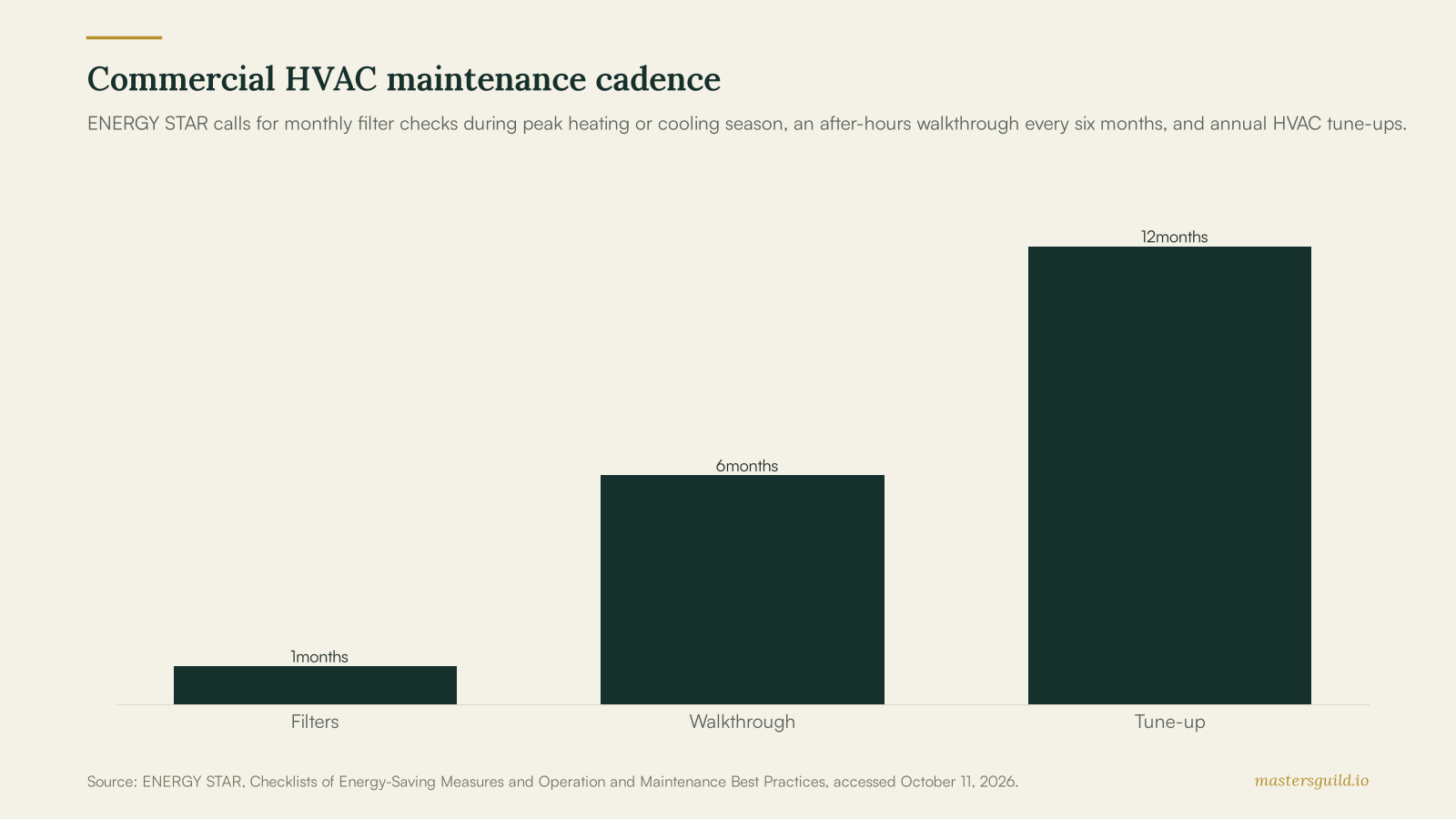
An after-hours walk gives a manager a chance to hear unexpected equipment and find lights, computers, or HVAC systems running outside the planned schedule. ENERGY STAR’s operations guidance recommends that building staff perform this walkthrough once every six months. Record the date, the area, the equipment, and the person who will follow up.
The maintenance record supports indoor-air questions
Comfort complaints need a record before they need a guess. Ask staff to note the room, time, odor or condition, and whether the issue changes when the HVAC system runs. Keep that note with the service history, filter changes, and any control adjustments. Do not ask staff to open panels or diagnose electrical, combustion, refrigerant, or ventilation problems.
The EPA Building Air Quality Guide provides building owners and facility managers with HVAC and indoor-air-quality checklists. EPA’s related action plan uses eight steps and a 100-item checklist to help organizations verify their indoor-air-quality management work. A qualified HVAC professional can assess the equipment while you keep the building record current.
If your business has a persistent comfort complaint, request a service visit with the unit location, the operating hours, staff notes, and recent maintenance record. You can use Masters’ Guild’s HVAC services page to describe the service you need, then compare the scope and timing in offers from local pros.
A clear service request makes quotes easier to compare
Send each contractor the same information: building type, unit count, equipment locations, access rules, operating hours, filter details, recent work, and the specific concern. Ask the contractor to separate inspection, maintenance, repairs, parts, and any follow-up recommendation in the scope. That format helps you compare work instead of comparing one total price.
For a business moving into a new space, add the heating schedule and equipment contacts to the same handover file as your office relocation checklist. If the project also needs recurring cleaning around the workplace, keep those tasks separate from HVAC work and define them through a commercial building cleaning request.
Post the unit details and your fall checklist on Masters’ Guild to compare offers from identity-verified local pros. Get commercial HVAC maintenance help on Masters’ Guild.