Wildfire home hardening is the one home-maintenance job where the calendar is working against you. The 2026 season is already the busiest in years — the US has burned 7.65 million acres across more than 50,200 fires, about 185% of the 10-year average, with an extreme fire-weather warning posted over the Columbia Basin and eastern Washington this week. Canada’s August federal update counts 4.1 million hectares burned, 582 active fires and 31 out of control, with evacuations still under way in British Columbia and northwestern Ontario.
And the season isn’t over. Late August through October is historically when the most destructive fires reach the wildland-urban interface, because fuels are at their driest and fall wind events haven’t started to bring rain. If you live anywhere near grass, brush or forest — from Spokane to Kelowna to the Colorado Front Range — the next two weekends are the ones that matter.
Why embers, not flames, are the real threat
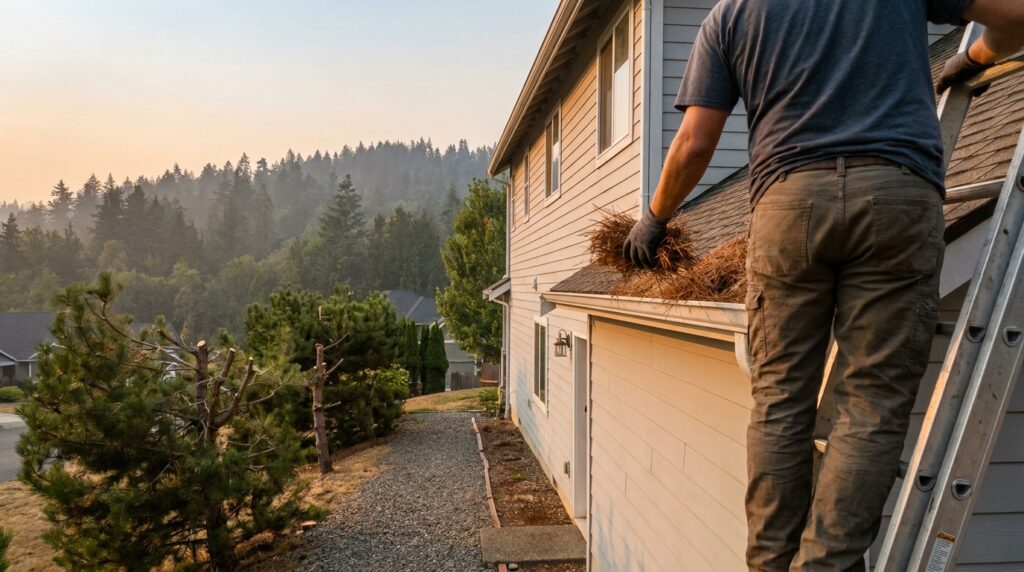
The mental picture of a house burning in a wildfire is a wall of flame arriving at the siding. The reality, documented by post-fire investigations from the Insurance Institute for Business & Home Safety (IBHS), is that most homes are ignited by embers blown a kilometre or more ahead of the fire front. They land in gutters full of dry needles, on a deck under a woodpile, or get sucked through an attic vent and ignite from the inside.
That’s the good news hidden in the bad: the things that actually save a house are cheap, local and mostly doable in a weekend. It’s the reason we covered keeping wildfire smoke out of your house in July and the outside of the house now.
The late-August wildfire home hardening checklist
Fire agencies on both sides of the border (CAL FIRE, FireSmart Canada, IBHS) converge on the same priorities, ranked from the house outward.
Zone 0: the first 5 feet (1.5 m)
This is the highest-impact zone and the one most people skip. Nothing combustible should touch the house: no bark mulch against the foundation, no woodpile under the deck, no wheelie bins, doormats, or propane tanks against the wall. Replace mulch with gravel or pavers, move the woodpile 30 feet (10 m) out, and cut back any shrub that touches siding or eaves. California now mandates a non-combustible Zone 0 for insurance-designated homes; expect other jurisdictions to follow.
Roof, gutters and vents
- Clean gutters, roof valleys and behind chimneys — dry needles here are the number-one ember catch. A pro roof cleaning or gutter clean runs about $120–$250 for a typical house (US and Canada similar in local currency); see our roof cleaning cost guide.
- Swap attic, soffit and crawlspace vents for ember-resistant versions with 1/16-inch metal mesh. Parts run $400–$1,200 for a whole house; a handyman installs them in a few hours.
- Check that roof edges are sealed and that no bird stops are missing under tile or metal roofing.
Zone 1: 5–30 feet (1.5–10 m)
Limb trees up 6–10 feet from the ground, remove dead branches and “ladder fuels” (shrubs under tree canopies), and keep grass mowed to 4 inches. An arborist limb-up visit runs $150–$400; a full yard cleanup that hauls the brush away is typically $200–$600, more with a lot of green waste — our yard cleanup cost guide has the breakdown. Big removals are a separate line item; see tree removal costs.
Decks, fences and the weak links
A wood fence that connects to the house is a fuse. Replace the last 5 feet with a metal gate or non-combustible section. Enclose the underside of decks with 1/8-inch mesh, clear everything stored under them, and use metal — not plastic — screens on windows so radiant heat doesn’t melt them out of the frame.
What it costs, and what insurance gives back
| Job | Typical price (USD / CAD similar) | DIY-able? |
|---|---|---|
| Gutter and roof debris cleaning | $120–$250 | Yes, with a safe ladder |
| Ember-resistant vent retrofit (parts) | $400–$1,200 | Handyman, half day |
| Tree limb-up and ladder-fuel removal | $150–$400 per visit | Partly; arborist for anything over 10 ft |
| Yard cleanup with brush haul-away | $200–$600 | Yes, minus disposal |
| Fence-to-house non-combustible section | $300–$900 | Handyman |
| Full IBHS Wildfire Prepared Home retrofit | $8,000–$25,000 | No — mostly roof-driven |
The payback is increasingly written into the policy. IBHS’s Wildfire Prepared Home designation earns insurer discounts of roughly 5–35% depending on carrier; the California FAIR Plan offers hardening discounts of up to 24.5%, and most Western US insurers now give 10–30% for documented defensible space and ember-resistant features. In Canada, FireSmart assessments are free through many BC and Alberta municipalities and are starting to appear on insurers’ application forms. Given how much home insurance premiums have climbed, a weekend’s work can pay for itself in a year.
What this means for local pros
For landscapers, arborists, gutter cleaners, roofers and handymen in fire-prone regions, hardening is a repeatable seasonal service — the Zone 0 and vent work needs re-checking every year, and the insurance paperwork (photos, checklists, a signed assessment) is a value-add clients will pay for. Homeowners in Spokane and Vancouver are booking these visits now, and the crews who advertise a “wildfire-ready” package are the ones getting the calls.
If you’d rather not be up a ladder in 35°C heat, find a tree and brush pro near you — vetted, identity-verified, and paid only when the job is done.