
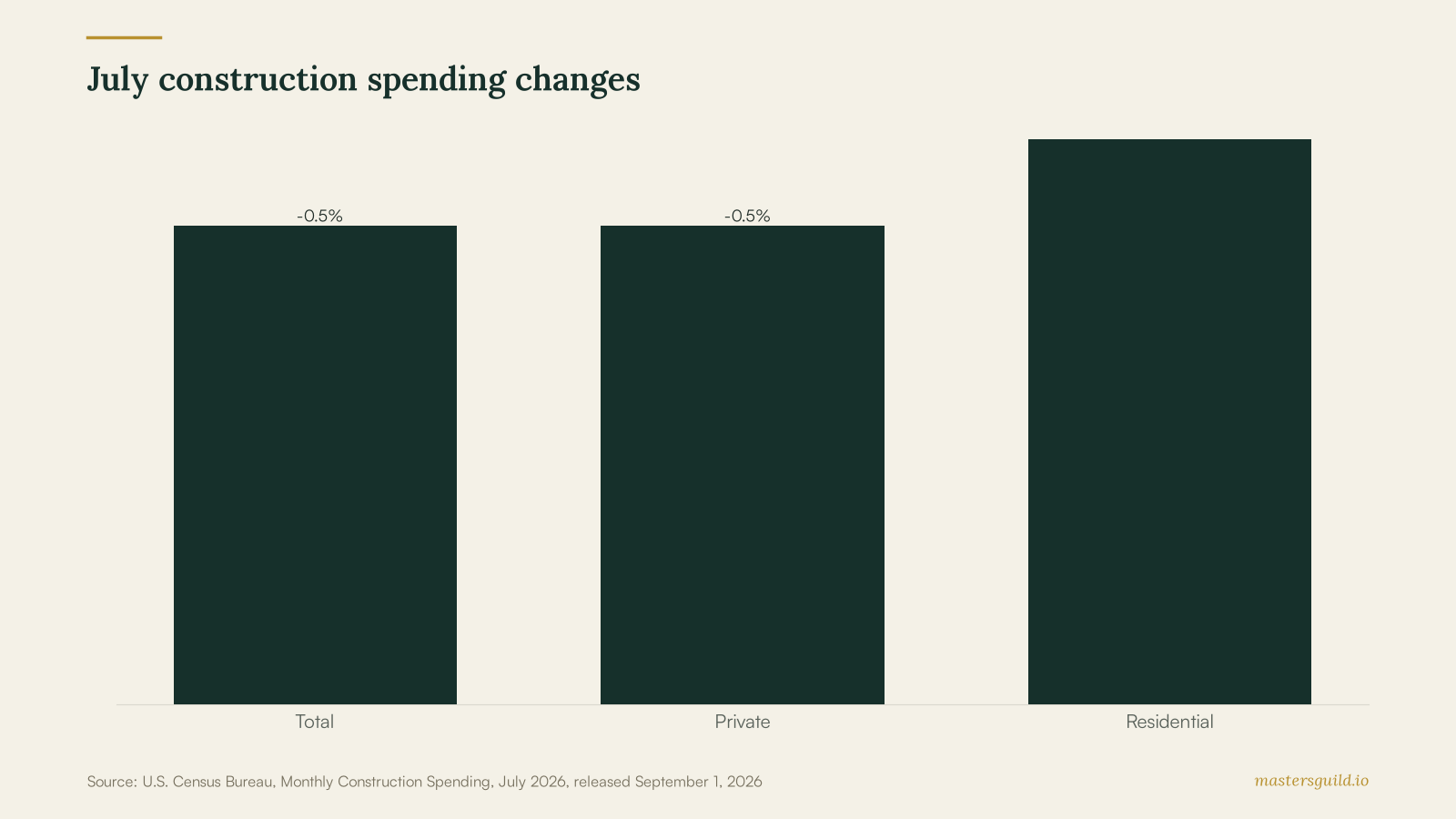
Residential construction spending fell 1.3% in July 2026 to a seasonally adjusted annual rate of $859.0 billion, according to the U.S. Census Bureau’s September 1 release. Homeowners with a repair or renovation on the list can use a softer construction signal to prepare a clear scope and compare complete offers, while local service pros can win trust by showing the work behind the price.
Key takeaways
- Residential construction spending reached a $859.0 billion annual rate in July, down 1.3% from June.
- Total construction spending reached a $2.158 trillion annual rate, down 0.5% from June and 3.8% from July 2025.
- Private construction reached a $1.614 trillion annual rate, also down 0.5% from June.
- A defined scope still matters most: compare labour, materials, permits, disposal, and change-order terms before choosing a provider.
July Data Shows a Smaller Construction Market
The Census Bureau estimated total construction spending at a $2,157.6 billion annual rate in July, down 0.5% from the revised June estimate of $2,167.7 billion. The agency estimated private construction at a $1,614.2 billion annual rate, down 0.5%, and residential construction at a $859.0 billion annual rate, down 1.3%.
Those estimates cover construction work done on new structures and improvements to existing homes. They do not price a kitchen repair, roof patch, or service call on their own. They do give homeowners a useful prompt: bring enough detail to each estimate that a pro can price the same job instead of guessing at the scope.
| July 2026 construction measure | Annual rate | Change from June | Change from July 2025 |
|---|---|---|---|
| Total construction | $2,157.6B | -0.5% | -3.8% |
| Private construction | $1,614.2B | -0.5% | Not stated in release |
| Residential construction | $859.0B | -1.3% | Not stated in release |
Homeowners Can Turn a Slower Signal Into Better Quotes
The release does not promise a discount, and no national series can replace a local quote. A homeowner can still make the pricing conversation more useful. Share photos, measurements, the finish level you expect, site-access details, and a budget range. Ask each pro to separate labour, materials, permits, disposal, and any allowance for hidden conditions.
That preparation helps when a project has choices. A worn floor may need a repair, a partial replacement, or a full installation. Our flooring installation cost guide helps frame those options, while the home service price trends report explains why a vague scope can produce quotes that are hard to compare.
Urgent work follows a different rule. A leaking pipe, an unsafe electrical issue, or roof damage needs prompt attention. Define the immediate repair, ask the contractor to document any added work, and approve a change order before the crew expands the job.
Local Pros Can Make the Estimate the Advantage
Homeowners reviewing a tighter budget want to know what each line item buys. Local pros can answer that need with a written scope, a realistic start date, licence and insurance details where required, and a change-order process. That clarity reduces callbacks and keeps a small repair from becoming a dispute over assumptions.
The repair-versus-replace guide offers another useful starting point for the conversation. A provider can explain the condition that supports repair, the condition that points to replacement, and the cost of each path before asking a homeowner to choose.
Post your project details and budget on Masters’ Guild to receive offers from identity-verified local pros. Compare local service offers