

Warehouse organization work averages $34 per hour in Taskrabbit’s US data, while Canada’s material-handler wage range is C$16.55 to C$30.29 per hour. Use the US figure as an organizing-service benchmark and the Canadian figure as a labor benchmark, then ask each provider for a written scope because neither number is a universal warehouse-service quote.
Key takeaways
- Taskrabbit reports a $34 US average hourly rate for organization services.
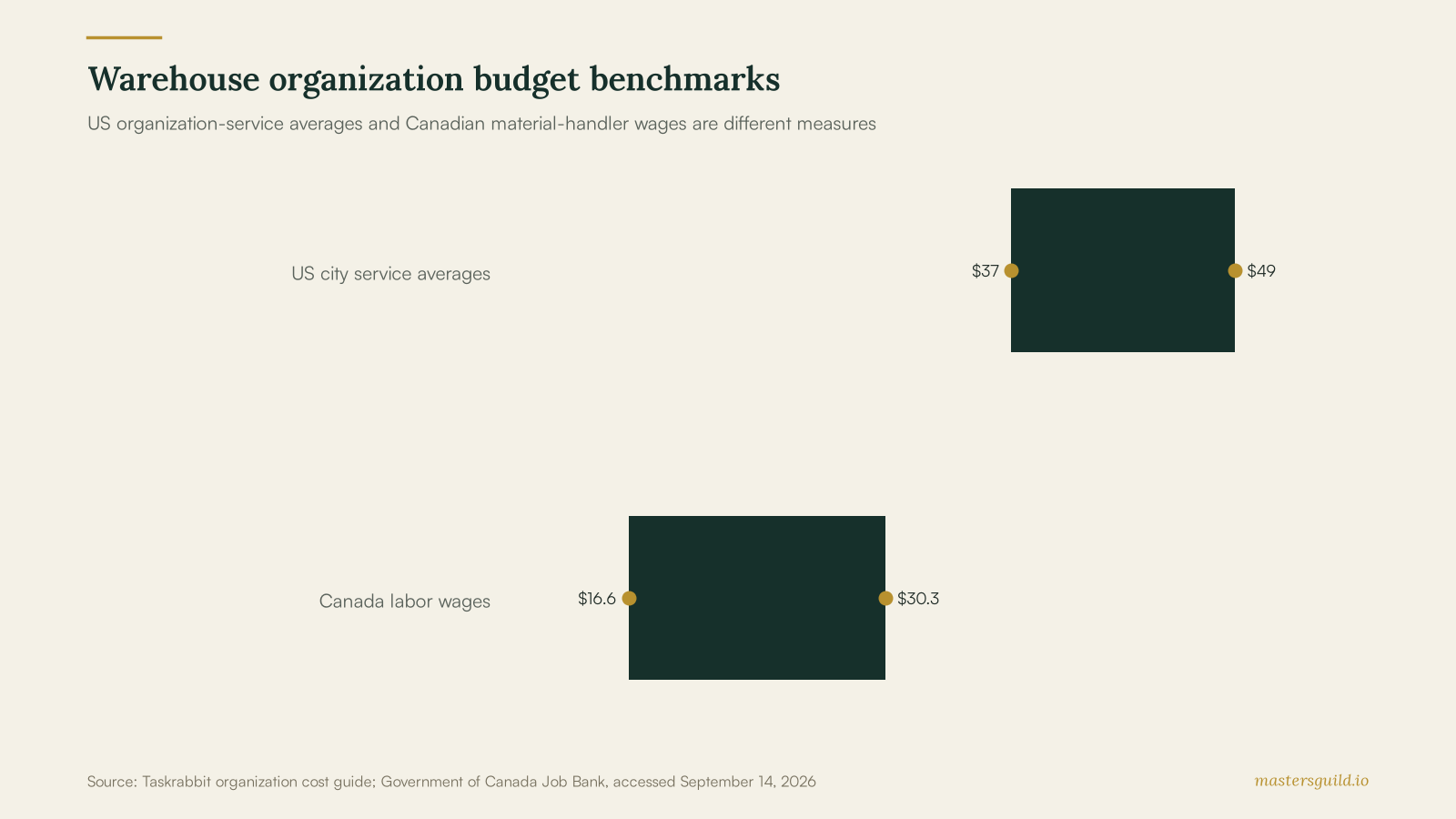
- Major US city averages in Taskrabbit’s data range from $37 in Los Angeles and Orange County to $49 in Washington, DC.
- Canada’s Job Bank lists material-handler wages from C$16.55 to C$30.29 per hour nationwide.
- A useful quote separates sorting, lifting, labeling, storage products, disposal, and follow-up training.
Public benchmarks frame the first warehouse organization budget
Public benchmarks can help you start the conversation, but they do not replace an onsite or video walkthrough. Taskrabbit’s organizing cost guide reports a US average of $34 per hour. Its listed city averages run from $37 in Los Angeles and Orange County to $49 in Washington, DC. Those figures describe organization services, so a warehouse with pallet racks, stock movement, or a new labeling system can require a different scope.
Canada’s Job Bank lists national material-handler wages of C$16.55 at the low end, C$22.00 at the median, and C$30.29 at the high end. Those are employee wages from Statistics Canada’s Labour Force Survey for 2023-2024, not customer prices. A provider’s quote can also include supervision, insurance, travel, tools, and profit.
| Benchmark | Figure | Use it for |
|---|---|---|
| US organization services | $34 USD per hour | A starting hourly benchmark |
| Los Angeles and Orange County | $37 USD per hour | A lower listed major-market example |
| Washington, DC | $49 USD per hour | A higher listed major-market example |
| Canada material-handler wages | C$16.55-C$30.29 per hour | A labor-cost reference, not a service quote |
For a second US labor reference, the Bureau of Labor Statistics reports a 2025 median annual wage of $38,220 for hand laborers and material movers. The agency describes work in warehouses as physically demanding and reports that workers move, sort, pack, and track materials. That work profile explains why lifting plans and inventory rules belong in the quote.
Scope items set the final warehouse organization cost
Ask the provider to price each workstream. Sorting and zoning need staff time. Rack changes, bin purchases, labels, barcode work, disposal, and after-hours access can add separate costs. A project that includes inventory counts needs a count method, an owner for discrepancies, and a handoff format.
Give each bidder the same information: floor plan, rack and shelf count, item types, estimated inventory volume, equipment on site, load weights, receiving schedule, target zones, and photos. State whether your team will move stock or whether the provider must supply the labor. This turns vague offers into comparable scopes.
Small businesses that need ongoing site work can also compare providers for commercial building cleaning. For equipment-heavy moves within the same facility, use the details in our heavy lifting cost guide to define crew size, carry distance, and protection needs.
DIY works for a simple reset with safe loads
Your staff can handle a small reset when they know the inventory, have approval to discard or relocate stock, and can work without interrupting receiving or fulfillment. Start with one zone. Remove obsolete items, count live stock, assign each product family a location, and label the result before moving to the next zone.
Hire a pro when the work needs layout design, heavy stock movement, new rack configuration, cross-team inventory decisions, or a deadline that your staff cannot absorb. Do not ask workers to improvise around unstable storage or unfamiliar lifting equipment. The job should specify who controls traffic, who approves changes, and how the team records inventory adjustments.
Written deliverables protect the operator and the provider
- Define the finish line. Name the zones, inventory groups, labels, storage products, and documents the team must deliver.
- Set safe work limits. List load weights, equipment, access rules, and the person who can stop unsafe work.
- Price changes before work continues. Agree on the hourly rate, minimum booking, materials, disposal, travel, and approval process for extra scope.
- Plan the handoff. Ask for an updated zone map, label convention, inventory-discrepancy list, and a walk-through with the person who runs the space.
- Compare verified offers. Post the scope as a quest on Masters’ Guild’s warehouse organization service and compare offers from identity-verified local pros.
Frequently Asked Questions
How much does warehouse organization cost?
Taskrabbit reports a US organization-service average of $34 per hour. Treat that figure as a planning benchmark, then request a warehouse-specific quote that lists labor, materials, inventory work, disposal, and after-hours access. Canadian material-handler wages of C$16.55 to C$30.29 measure employee pay; a local provider sets service pricing in its quote.
What should a warehouse organization quote include?
A useful quote names the zones, work hours, crew size, lifting needs, inventory-count method, labels, storage products, disposal, travel, and handoff documents. It should also state who approves extra work.
Can staff organize a warehouse without a contractor?
Staff can complete a small, safe reset when they control the inventory and can pause work without harming daily operations. Bring in a pro for layout changes, heavy loads, rack work, or a deadline that needs dedicated labor.
How do I hire a warehouse organizer?
Share a floor plan, photos, rack count, item types, estimated volume, target zones, equipment, load weights, and deadline. Request the same written deliverables from each provider so you can compare offers fairly.
Post your floor plan, target zones, and deadline as a quest to get warehouse organization offers on Masters’ Guild. Identity-verified local pros can respond with a scope that fits your operation.