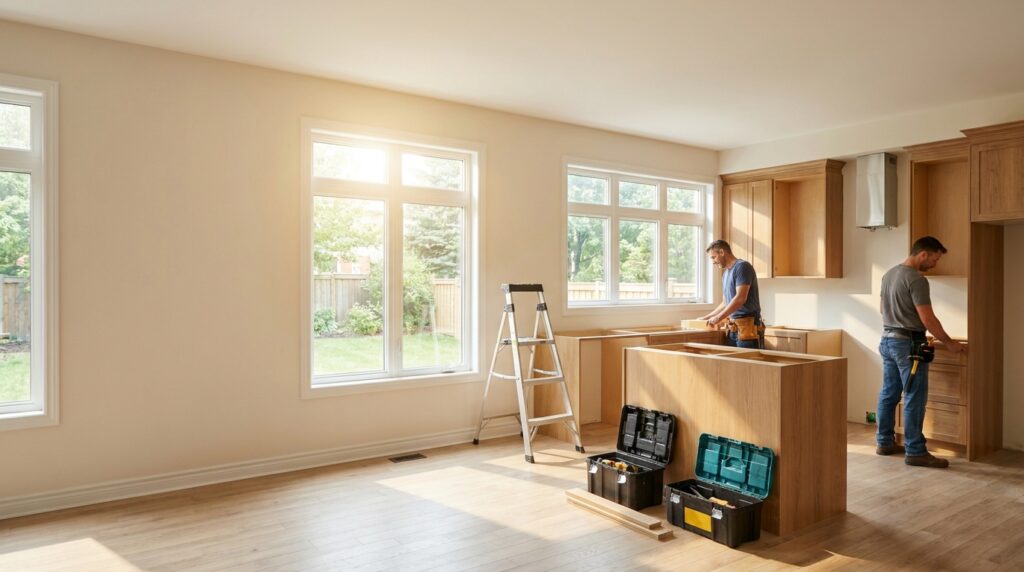

If your renovation wish list feels bigger than your wallet this year, the data says you’re not alone: the average home renovation budget is shrinking in 2026. The newly released Houzz & Home Study puts the median planned renovation spend at $15,000 — down sharply from $20,000 in 2025. Yet half of homeowners still plan to take on a project this year. Renovation isn’t dying; it’s downsizing. Here’s what’s behind the squeeze, and how to make a smaller budget go further.
The Numbers Behind the Shrinking Renovation Budget
Two trends are pulling in opposite directions, and homeowners are caught in the middle.
Budgets down, costs up
While the median planned budget dropped 25%, the actual cost of completing a project went the other way: average spending per project jumped roughly 36% year over year, from about $3,957 to $5,368, driven by material prices and labour. In other words, $15,000 buys noticeably less renovation than $20,000 bought two years ago. We broke down one big reason in our look at how tariffs are raising renovation costs — imported materials from lumber to fixtures are still carrying a surcharge.
Canada tells a similar story from the other direction: the expected average renovation cost there has climbed to about $19,000 — nearly double pre-pandemic levels — so Canadian homeowners are trimming scope, too.
Fewer whole-home projects, more single rooms
Harvard’s Joint Center for Housing Studies still projects US remodeling spending near a record $518 billion in 2026, but with growth slowing to about 1% and expected to downshift further late this year. The money hasn’t vanished — it’s being split into smaller pieces: one bathroom instead of two, cabinet refacing instead of a gut kitchen, repairs instead of replacements. That echoes the shift we covered in why homeowners are fixing instead of replacing.
More projects going on plastic
One quieter stat worth watching: 34% of renovating homeowners now fund part of the work with credit cards, up five points in a year. Savings still lead (84%), but stretched budgets are increasingly borrowing the gap — a good reason to right-size the project before the first quote.
How to Renovate Well on a Smaller Budget
A tighter budget doesn’t have to mean a worse result. It rewards planning.
Phase the project
Split a big renovation into stages that each stand on their own — counters and cabinets this year, flooring next spring. You’ll spread the cost, and each phase gets its own competitive quotes. A kitchen remodeling pro can tell you which sequence avoids paying twice for the same tear-out.
Spend on labour-heavy items first
Prices on materials fluctuate; skilled labour only gets scarcer. If you must defer something, defer the parts you can DIY later (paint, hardware) and lock in the trades work — plumbing, electrical, tile — while you have a pro on site.
Get more quotes, not fewer
When budgets shrink, quote spreads widen: the gap between the highest and lowest bid on the same job is often 30–50%. Three quotes minimum, in writing, with the same scope for each — it’s the highest-return hour of the whole project. If you’re starting with a single room, comparing a few bathroom remodeling pros near you is the fastest way to find where your $15,000 actually goes furthest.
What It Means for the Pros
For contractors and trades pros, the shrinking-budget headline is really a re-mixing of demand. The $50,000 whole-floor jobs are rarer; the $5,000–$15,000 single-room jobs are everywhere. Pros who quote fast, offer good-better-best material options, and welcome phased work are winning this market — a theme straight out of our piece on why the fastest contractor wins the job.
The Bottom Line
Renovation budgets are shrinking in 2026, but renovation intent isn’t. Homeowners are doing fewer things, better — and the ones who plan phases, protect the labour-heavy work, and compare multiple quotes are getting the most from every dollar. Whether your project is $5,000 or $50,000, the first step is the same: see real prices from real pros near you.