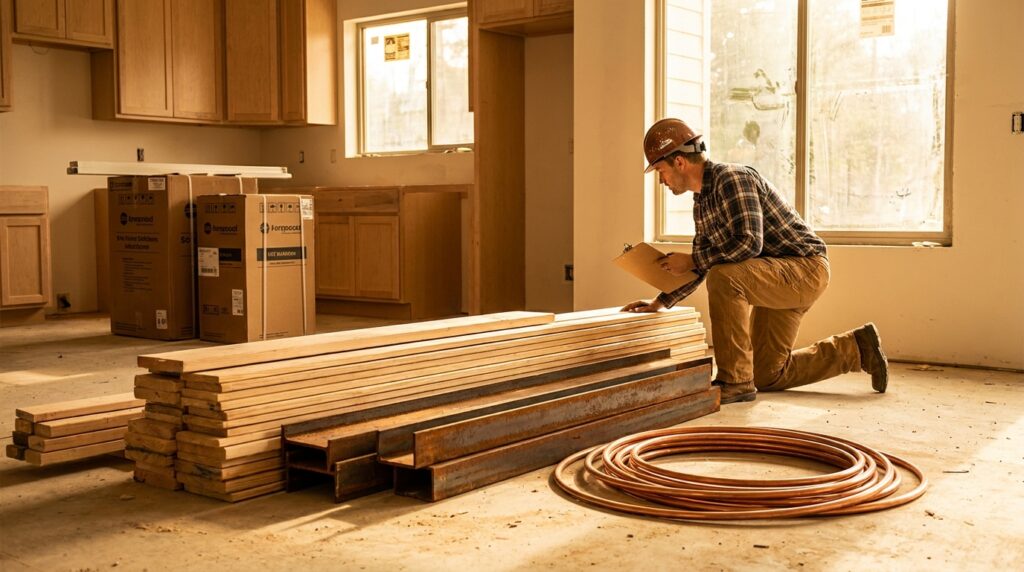
If your contractor’s quote came in higher than you expected this summer, you’re not imagining it — tariffs are now one of the biggest forces pushing home renovation costs up in 2026. Builders on both sides of the border say import duties on steel, aluminum, copper, lumber, cabinets, and appliances are quietly adding thousands of dollars to ordinary projects. The National Association of Home Builders estimates current tariffs add roughly $10,900 to the cost of a typical home build, and more than 60% of builders report higher costs directly attributable to tariffs. Here’s where that money is going, and what you can do about it.
Where the tariff money shows up in your quote
Tariffs don’t appear as a line item on your estimate. They show up upstream — at the mill, the port, and the supply house — and arrive at your door folded into material prices.
Metals: the biggest driver
Steel, aluminum, and copper currently face 50% US tariffs, with 25% duties on derivative products — everything from structural beams and rebar to ductwork, wiring, gutters, and fasteners. That touches almost every project: a fence, a roof, an HVAC replacement, an electrical panel upgrade. Industry cost trackers report metal-bearing mechanical and electrical components are the top contributors to year-over-year construction cost increases.
Cabinets and appliances
A 25% tariff hit imported kitchen cabinets and bathroom vanities in October 2025 (a planned jump to 50% was delayed to 2027). Appliances made in Mexico or containing Chinese components are up roughly 16–18% on common items like dishwashers, ranges, and microwaves. If a kitchen remodel is on your list, cabinets and appliances are where you’ll feel it most.
Lumber
A 10% US tariff on imported softwood lumber took effect in October 2025, stacking on duties on Canadian lumber that already exceeded 35%. Deck builders are quoting 8–15% higher material costs than early 2025.
The Canadian side of the ledger
Canadian homeowners aren’t watching from the sidelines. Canada’s counter-measures — including a 25% tariff on steel-derivative imports that took effect in late December 2025 — combined with US duties have pushed total project costs up an estimated 8–12% depending on the material mix. Statistics Canada’s building construction price index shows the squeeze clearly, and the Canadian Construction Association reports that roughly one in six construction businesses has felt major negative effects from the counter-tariffs. The trade file remains fluid — a US surcharge on non-CUSMA-compliant Canadian goods is set to expire in late July unless extended — so quotes can shift within a single season.
Homeowners are feeling it — and adapting
The demand picture explains why this stings. Harvard’s Joint Center for Housing Studies projects US renovation and repair spending will reach about $518 billion in 2026, but growth is slowing to under 2% — and recent surveys find half of homeowners say there are necessary renovations they simply can’t afford right now.
The response looks a lot like the repair economy we covered earlier this week: fix instead of replace, phase instead of gut, and prioritize the projects that protect the house. Tariffs are accelerating that shift, because they hit replacement hardest — new appliances, new equipment, new structures — while labor-heavy repairs are relatively insulated.
Five ways to protect your renovation budget
- Get quotes with price-protection language. Ask how long the materials price is locked. Some contractors now include tariff-escalation clauses; better to know upfront.
- Buy materials early. If your project starts in the fall, purchasing appliances and cabinets now can beat scheduled increases — the delayed cabinet tariff jump is a real deadline.
- Choose domestic or tariff-exempt materials. Ask your pro about locally made cabinets, domestic steel, or alternative materials; the gap has narrowed or reversed on many products.
- Phase the project. Do the labor-intensive scope now and defer the import-heavy pieces. Labor rates are rising too — the skilled trades shortage hasn’t gone away — but they aren’t jumping 25% in a season.
- Repaint, refinish, refresh. Cosmetic work like exterior painting delivers visible value with minimal exposure to tariffed goods.
The bottom line
Tariffs have become a structural part of renovation math in 2026, not a blip. The homeowners doing best right now are the ones getting multiple detailed quotes, asking pros directly how duties affect their materials, and timing purchases around known tariff dates. A good local pro is tracking this daily — lean on that knowledge before you sign.
Ready to compare quotes from vetted local pros who can price your project in today’s market? Get quotes on MastersGuild.