

Ontario hospital construction helped lift Canadian institutional building investment 7.4% in July, according to Statistics Canada. Homeowners planning repairs and renovations can use a written scope and early bid requests to give local pros the details needed to assess the work.
Key takeaways
- Canadian institutional construction investment rose 7.4% in July 2026.
- Ontario contributed $151.0 million of that institutional increase, led by hospital construction.
- Homeowners can protect a project schedule by requesting bids early and comparing written scopes.
- Trades pros can qualify residential jobs faster when homeowners provide photos, timing, and a defined scope.
Large public projects make scope and timing more useful
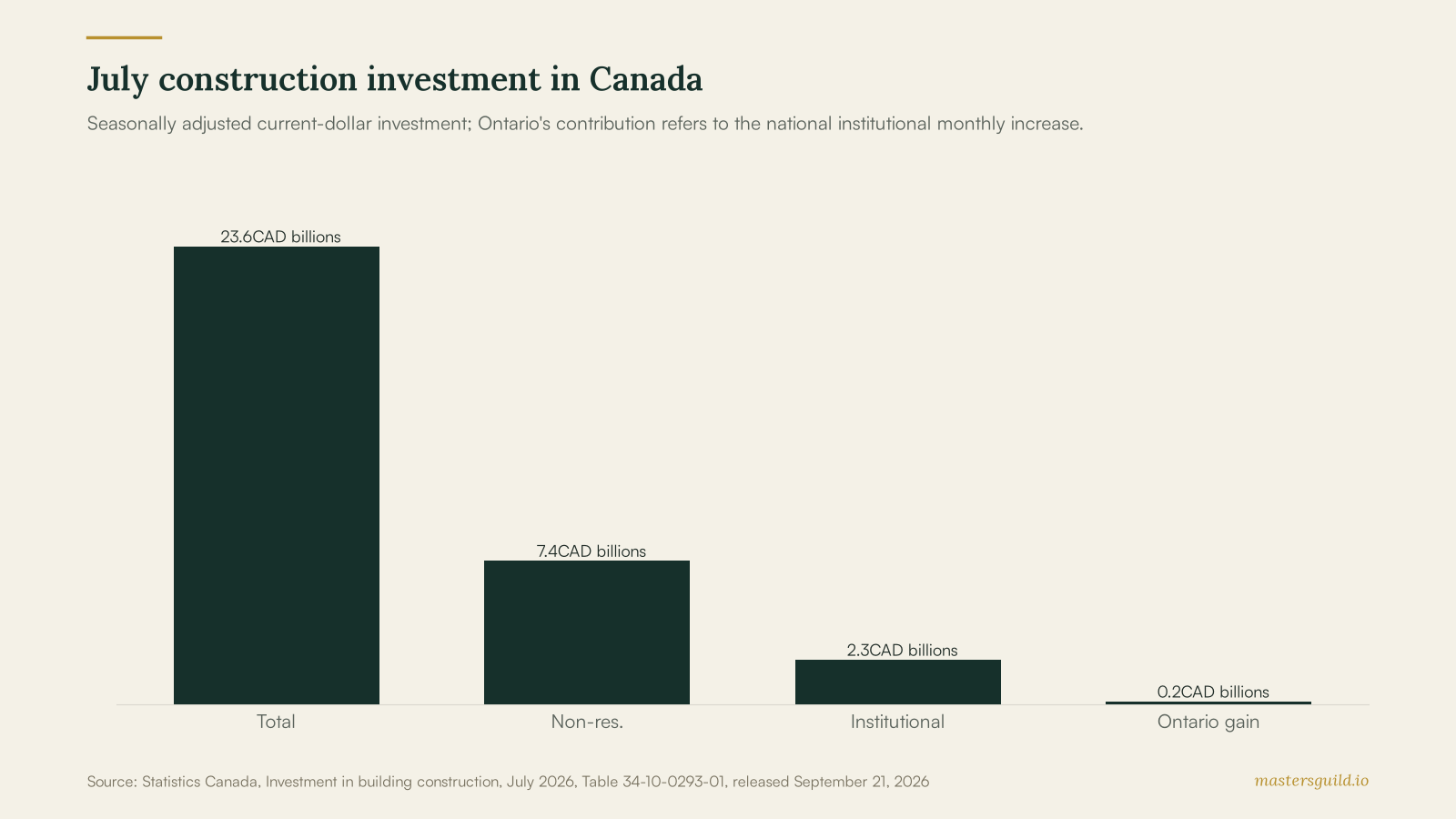
Statistics Canada reported that Canadian non-residential building investment reached $7.4 billion in July, up 3.2% from June. Institutional investment reached $2.3 billion after a $159.3 million increase. Ontario accounted for $151.0 million of that increase, and the agency identified new hospital construction as the driver. The agency’s monthly investment table provides the underlying series.
The release measures investment in building construction, while permit data measures authorizations. Statistics Canada also reported a July decline in permit values, which our building-permits report puts in context for homeowners who track the next wave of work.
| July 2026 Canadian construction measure | Value or change | What it signals |
|---|---|---|
| Total building investment | $23.6 billion | Construction activity already underway |
| Non-residential investment | $7.4 billion | Demand for commercial and public-project crews |
| Institutional investment | $2.3 billion | Hospitals, schools, and public facilities in progress |
| Institutional monthly change | +7.4% | Stronger July activity in that segment |
| Ontario institutional contribution | +$151.0 million | Ontario led the national gain |
Homeowners need a scope before they need a start date
Large projects do not make a kitchen repair impossible to book. They can make vague requests harder to schedule. A contractor can assess a compact job faster when a homeowner shares photos, measurements, access constraints, preferred dates, and the result they want.
Ask each bidder to state the work included, materials supplied, permit responsibility, payment schedule, and exclusions. That record makes an offer easier to compare when crews have limited openings. It also reduces the chance that a homeowner accepts a low first number that omits disposal, patching, electrical changes, or finish work.
Trade labor remains part of the scheduling picture. August’s U.S. employment report recorded a 22,000 construction-employment increase, and our contractor labor-cost coverage explains why homeowners should compare scope as well as price.
Trades pros benefit from specific residential requests
Residential customers help a pro quote responsibly when they describe the job in plain terms. A good request names the room or exterior area, shares photos, flags water or electrical issues, and explains the decision timeline. The pro can then decide whether a site visit, a diagnostic call, or a fixed-price scope fits the work.
Pros can return the favor with a written scope, a start-window estimate, and a clear list of assumptions. Homeowners can compare offers on work and timing instead of treating the lowest number as the only signal. That process protects both sides when large local projects occupy part of the skilled workforce.
A planned request creates better options
Ontario’s hospital construction helped lead a 7.4% July increase in Canadian institutional investment. Homeowners do not need to predict every market shift. They can prepare a documented project, request offers before the work becomes urgent, and hire a pro who explains the scope and schedule in writing.
Post your job on Masters’ Guild and get offers from identity-verified pros. Free on iOS and Android.