
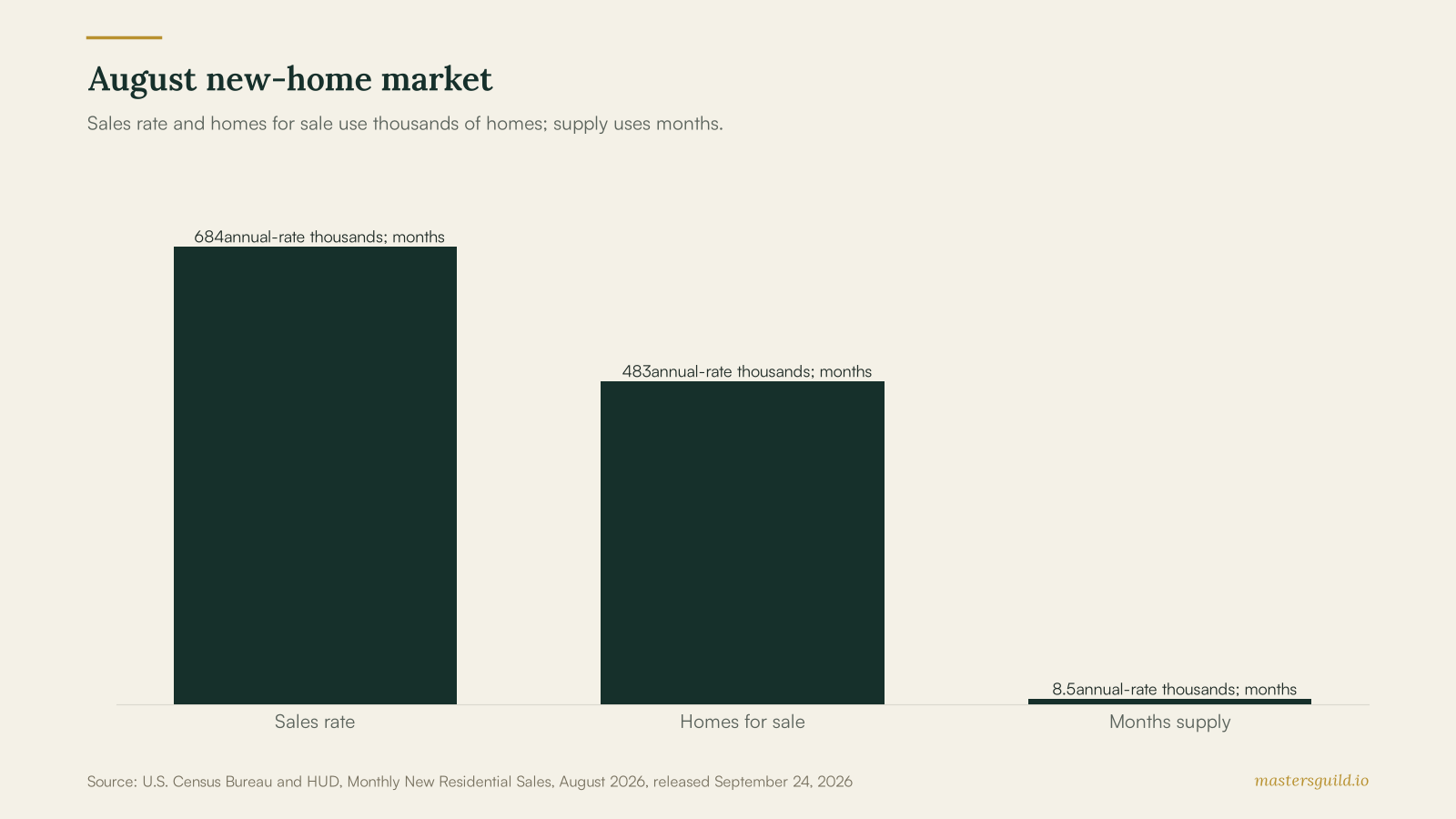
684,000 new single-family homes sold at an annual rate in August 2026, up 6.4% from July. The U.S. Census Bureau and HUD also reported that builders held 483,000 homes for sale, equal to 8.5 months of supply. Homeowners who buy a new place can use that breathing room to plan move-in work before the closing rush.
Key takeaways
- U.S. new-home sales reached a 684,000 seasonally adjusted annual rate in August.
- The monthly estimate rose 6.4% from July, while the year-over-year estimate was 2.0% lower.
- Builders reported 483,000 new homes for sale, equal to 8.5 months of supply.
- New-home buyers often need local help with finishes, fixtures, landscaping, and warranty punch lists after closing.
August sales rose while supply stayed high
Census and HUD estimated a 643,000 annual rate in July and a 684,000 rate in August. They also reported an 8.5-month supply of new houses for sale, down from 9.0 months in July. Their national estimates carry sampling uncertainty and cannot predict demand in a particular city.
| August 2026 U.S. new-home measure | Value | Change from July |
|---|---|---|
| Sales annual rate | 684,000 homes | +6.4% |
| Homes for sale | 483,000 homes | Virtually unchanged |
| Months of supply | 8.5 months | -5.6% |
| Median sale price | $393,700 USD | +0.4% |
A new closing creates a practical service list
Buyers do not need to renovate a new home on day one. They can start with work that makes the home safe, usable, and easier to maintain: changing locks, mounting fixtures, installing appliances, assembling furniture, improving drainage, or adding window coverings. A written punch list helps a homeowner group tasks and compare scopes from local pros.
Builders and buyers also benefit from a clean handoff. Photograph visible issues before move-in, keep product manuals, and ask the builder how warranty requests work. Reserve independent service work for items outside the builder’s warranty process or for improvements the buyer chooses after possession.
For a project that needs a contractor, use the same care you would for a larger repair: define the outcome, request an itemized scope, confirm insurance and licensing requirements in your area, and set a payment schedule tied to completed work. Our guide to choosing a contractor app covers vetting and payment questions that help homeowners compare options.
Canada shows a separate construction picture
Statistics Canada reported that residential building investment edged up 0.3% to $16.2 billion CAD in July. The agency recorded a 3.5% rise in single-family investment to $7.8 billion CAD and a 2.6% decline in multi-unit investment to $8.4 billion CAD.
Those national totals cover construction investment rather than home-service bookings. Local firms can keep capacity flexible across handover work, repairs, and owner-selected upgrades. A buyer in Calgary or Toronto may need a fixture installation or furniture assembly after possession even when national construction patterns differ from a U.S. sales release.
Homeowners can see the same pattern at the job level. A move often creates small projects that compete for attention. Prioritize safety work and water issues first, then schedule the upgrades that match your budget. Our appliance installation cost guide can help buyers scope one common move-in task.
Local pros can win turnover work with clear scopes
New-home transactions create work after construction crews leave: touch-ups, storage installation, lighting, smart-home setup, cleaning, and exterior fixes. A local pro can earn trust by separating warranty items from owner-paid improvements and by stating materials, timing, and exclusions in writing.
Homeowners should ask for an on-site assessment when the task affects electrical systems, plumbing, structure, gas, or a manufacturer warranty. For smaller tasks, photos, dimensions, and a list of supplied materials can give a pro enough detail to offer a useful estimate.
Homeowners: Post your move-in project and compare offers.
Pros: Respond with a defined scope, a realistic arrival window, and a clear note on builder-warranty limits. That clarity helps a buyer make a decision before move-in day.
The August release points to measured opportunity
Census and HUD recorded more August sales, while builders held 8.5 months of supply. Homeowners can turn a closing checklist into manageable projects, and local pros can compete for the work with precise scopes and dependable communication.