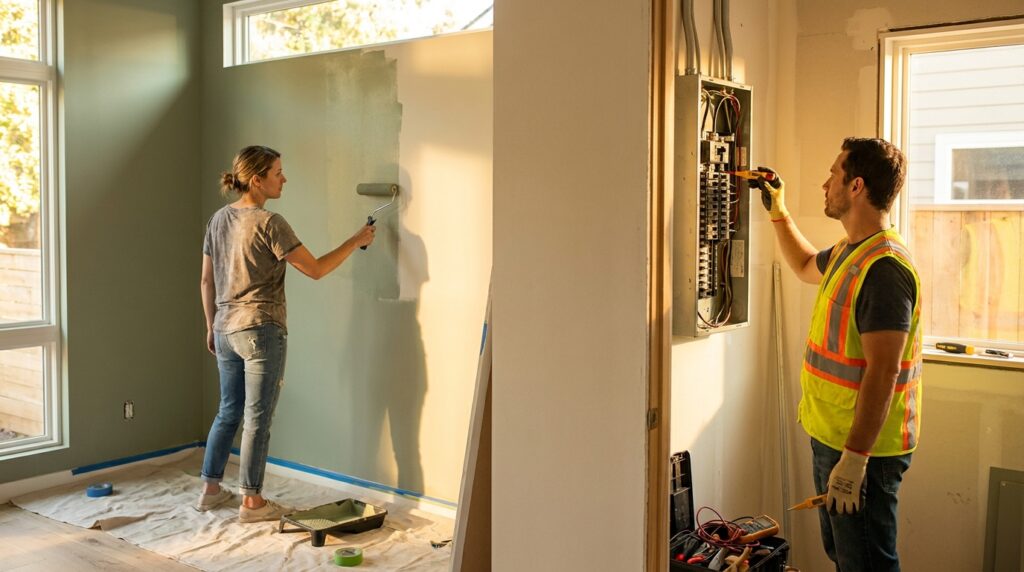
The 2026 DIY boom is official: 94% of North American homeowners plan at least one do-it-yourself project this year, one of the highest rates ever recorded. But the numbers behind the DIY vs hiring a pro decision tell a more complicated story — 61% of DIYers say they’re doing the work themselves because they can’t afford to hire a professional, not because they want a weekend hobby. When saving money is the whole point, knowing where DIY savings end matters more than ever.
A boom built on tight budgets
Survey data from early 2026 shows the median planned renovation budget has dropped to $15,000, down from $20,000 a year ago — a squeeze we unpacked in why renovation budgets are shrinking in 2026. Add tariff-inflated material prices and elevated labor costs on both sides of the border, and the math pushes homeowners toward the toolbox: 62% say saving money is the best part of DIY.
Most of that energy is going somewhere sensible. Around 87% of DIYers are staying in cosmetic territory — paint, fixtures, décor, caulking, hardware. Those are exactly the projects where DIY wins: low risk, low tool investment, and labor is most of what a pro would charge.
The worrying figure is the other one: 39% of surveyed homeowners say they’re eyeing major structural or system work — full remodels, expansions, or significant electrical, plumbing, and HVAC overhauls. That’s where the savings story often flips.
Where DIY actually saves money
A useful rule: DIY pays off when the job is reversible, low-stakes, and labor-heavy.
- Interior painting — a pro job runs $300–$1,000+ USD/CAD per room, and most of that is labor. Careful prep gets a DIYer 90% of the result.
- Fixture and hardware swaps — faucets, light fixtures (on existing wiring), cabinet hardware, smart thermostats.
- Sealing and weatherproofing — caulking, weatherstripping, minor gutter clearing on a single-storey home.
- Landscaping and mulching — sweat-heavy, skill-light.
Mess one of these up and you’re out a Saturday and some materials — annoying, not catastrophic.
Where the “savings” become a repair bill
The projects to leave alone are the ones that are irreversible, code-regulated, or hidden behind walls:
- Electrical beyond a fixture swap. Panel work, new circuits, and aluminum-wiring repairs are permit territory in both the US and Canada, and mistakes are fire risks. Botched wiring routinely costs 3–5× the original electrician’s quote to redo — find a licensed electrical pro near you before touching a panel.
- Plumbing inside walls. A slow DIY joint leak can quietly destroy drywall, framing, and flooring for months. As we noted in our 2026 plumber cost guide, a $150–$500 service call is cheap insurance against a five-figure water-damage claim.
- Structural changes, gas lines, and roofing. Insurance is the silent factor: many US and Canadian policies limit or deny claims arising from unpermitted DIY work on regulated systems.
There’s also a resale angle. Home inspectors flag amateur workmanship constantly, and in a market where buyers already favor move-in-ready homes, visible DIY shortcuts become negotiating leverage against you — one more reason the repair-or-replace decision deserves a pro’s opinion first.
The smart middle path: hybrid projects
The 2026 move isn’t DIY or pro — it’s splitting the job. Do the demolition, prep, and painting yourself; hire out the plumbing rough-in, the electrical, the tile. Many contractors on tight schedules are happy to quote a scoped-down “pro parts only” version of a project, and some now offer paid consult visits where they sanity-check your DIY plan before you start. An hour of a professional’s time at the planning stage is the cheapest labor you’ll ever buy — a licensed plumbing pro would rather spend one hour reviewing your layout than five days fixing it.
For the trades themselves, the DIY wave is a preview of 2027’s work orders: a large share of tomorrow’s service calls will be undoing today’s tutorial-guided experiments. Pros who position themselves as DIY-friendly — offering inspections, consults, and partial scopes — are converting budget-squeezed homeowners into future full-price customers.
The DIY boom is a rational response to real cost pressure. Just draw the line where the data says to draw it: keep the paintbrush, hand off the wire strippers.
Planning a project that’s bigger than a paintbrush? Compare vetted local pros and get quotes in minutes — Get quotes on MastersGuild.