

Use this dishwasher installation checklist to confirm the cabinet opening, water shutoff, drain access, electrical setup, and model manual before delivery day. A photo of each item gives an installer enough detail to flag a missing connection before the appliance reaches your kitchen.
Key takeaways
- Measure the opening and compare it with the exact model’s installation sheet.
- Locate the water shutoff, drain connection, and electrical supply before delivery.
- Ask the retailer which parts and hookup work its installation service includes.
- Hire a qualified pro when the job needs cabinet, plumbing, or electrical changes.
The model manual sets the fit and connection rules
Start with the installation instructions for the dishwasher you ordered. The manual gives the required opening dimensions, connection locations, and electrical details for that model. A standard-size ENERGY STAR dishwasher must meet limits of 3.2 gallons per cycle and 240 kWh per year, while compact models use different limits. ENERGY STAR’s current criteria use a test assumption of 215 cycles per year, so treat the label as a model comparison tool instead of a forecast for your household bill.
Measure the opening at the floor, midpoint, and underside of the counter. Record the width, height, depth, and any pipes or trim that intrude into the space. Compare those measurements with the exact installation sheet, including space for the door and hose routing. A retailer may decline a hookup when the opening, shutoff, drain, or electrical supply does not meet its requirements.
| Check before delivery | What to record | Bring in a qualified pro when |
|---|---|---|
| Cabinet opening | Width, height, depth, floor level, and obstructions | Cabinet changes or countertop adjustments are needed |
| Water supply | Shutoff location, condition, and access | The valve leaks, will not close, or needs moving |
| Drain path | Existing drain connection and hose route | The drain connection needs alteration |
| Electrical supply | Outlet or wiring location and model requirements | The supply does not match the model manual or local requirements |
GE’s published dishwasher delivery requirements provide a useful example of the details to confirm: a working, corrosion-free shutoff valve, an accessible drain, model-specific cutout dimensions, and an outlet within four feet on the same side of the wall and floor. Another retailer or manufacturer can set different conditions, so use this list to prepare and then follow the instructions for your appliance and installation service.
The water and energy label helps compare models
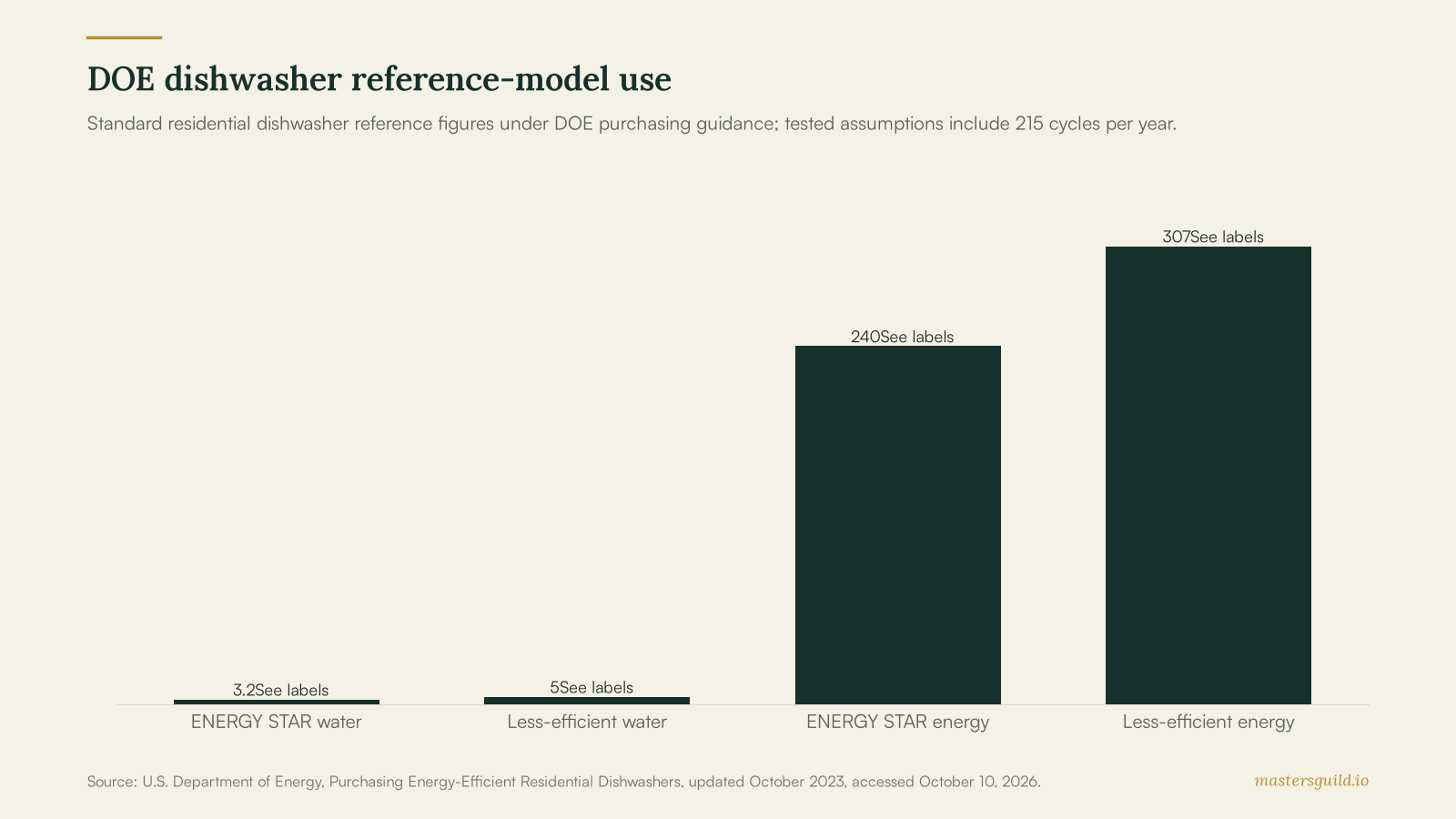
Efficiency does not tell you whether a dishwasher will fit your kitchen. It can help you compare similar models once the site works. The Department of Energy’s federal purchasing guidance uses 3.2 gallons per cycle and 240 kWh per year for an ENERGY STAR reference model, compared with 5.0 gallons per cycle and 307 kWh per year for its less-efficient reference model. The figures use a standardized test method and assumptions, including 215 cycles per year. Your selected cycle, utility rates, and household use will change your results.
ENERGY STAR says a standard-size certified dishwasher costs about $50 per year to run and can save about 5,800 gallons of water over its lifetime. Those are broad estimates rather than a local quote or guarantee. Check the yellow EnergyGuide label for the selected model’s estimated annual energy use and compare models of the same capacity. ENERGY STAR’s dishwasher buying guidance also recommends checking wash-cycle options and soil-sensing features.
A clear scope prevents a failed installation visit
Tell the installer whether you are replacing an existing built-in unit or creating a new location. Share photos of the opening, water shutoff, drain, outlet, and model number. Ask whether the quoted service includes a connection kit, haul-away, testing, and removal of packaging. Ask who will handle any cabinet, plumbing, or electrical correction that the site needs.
For a replacement that needs a new valve, drain connection, or circuit work, separate that trade work from the appliance hookup. Our appliance installation cost guide can help you define the larger project. If the scope reaches the circuit or outlet, review the electrician cost guide before requesting that work. Homeowners planning a broader layout change can also use our kitchen remodel cost guide to organize the sequence.
Do the measuring and photo gathering yourself. Leave cabinet alterations, plumbing repairs, and electrical changes to qualified pros who can assess the site and local requirements. Post your dishwasher installation job on Masters’ Guild and compare offers from identity-verified local pros.