

U.S. construction spending rose 0.9% in August 2026 to a $2.2031 trillion annual rate, according to the U.S. Census Bureau. Homeowners who want fall work should use that signal to prepare a detailed scope and compare bids line by line before choosing a contractor.
Key takeaways
- U.S. construction spending reached a $2.2031 trillion annual rate in August, up 0.9% from July.
- Private residential construction reached an $882.3 billion annual rate, up 1.1% from July.
- Construction employment changed little in September, rising by 11,000 jobs.
- A shared written scope gives homeowners and contractors a fair basis for comparing bids.
August spending rose across private construction
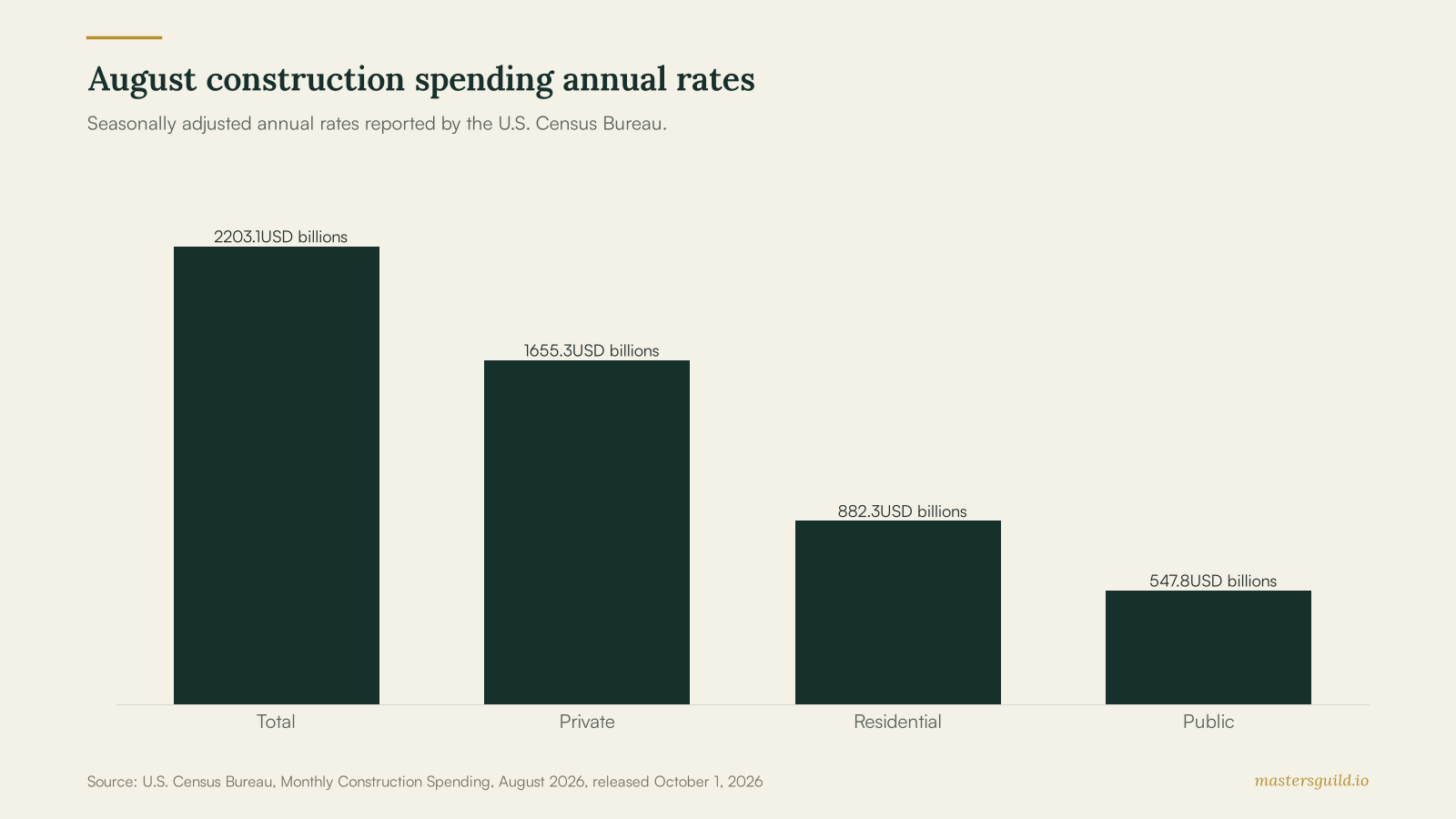
The Census Bureau estimates total construction spending at a seasonally adjusted annual rate, so the $2.2031 trillion figure is not a monthly household bill. It measures the pace of public and private construction work across the United States. Private construction rose 1.1% from July to a $1.6553 trillion annual rate, and residential construction rose 1.1% to an $882.3 billion annual rate.
| August 2026 measure | Annual rate | Change from July |
|---|---|---|
| Total construction spending | $2.2031 trillion | +0.9% |
| Private construction | $1.6553 trillion | +1.1% |
| Private residential construction | $882.3 billion | +1.1% |
| Public construction | $547.8 billion | +0.2% |
The September Bureau of Labor Statistics employment report adds useful context for home-service buyers. Construction employment changed little, with a gain of 11,000 jobs. That release does not set the price of a kitchen repair, roof patch, or electrical job. It does show that a single national number cannot tell you whether a local crew has room in its schedule.
A written scope makes fall bids comparable
Ask each contractor to price the same written scope. List the work area, the materials or allowance you want, access limits, permit responsibility, debris removal, target schedule, and payment milestones. Add photos and measurements when you have them.
Then compare the bids in the same order: scope first, exclusions second, schedule third, warranty fourth, and price last. A lower bid can omit a disposal fee, finish material, permit work, or site protection that another contractor included. Call out those differences before you accept either proposal.
For a broader hiring checklist, see our guide on choosing a contractor app. Homeowners who expect exterior work can also use our fall maintenance booking guide, while owners planning a larger project can review kitchen remodel costs.
Homeowners can give pros a cleaner starting point
Homeowners can shorten the first estimate visit by deciding which parts of the job are fixed and which remain flexible. Tell a pro if you will supply fixtures, if a building manager controls access, or if you need the work complete before a specific date. Those details affect labor planning and material ordering.
Trades pros can respond with an itemized scope, a realistic start window, and the change-order process. That approach helps a homeowner compare offers without asking a contractor to guess what another bid includes.
Use the new spending data as a prompt to organize your project, not as a reason to rush. Post your home-service job on Masters’ Guild and compare offers from identity-verified local pros.