ChatGPT ads for contractors stopped being an experiment on August 31. OpenAI announced that its ad business reached a $1 billion annualized run rate in under 200 days, that “tens of thousands” of advertisers are buying, and that small businesses already make up a “material share” of the total. For a plumber in Houston or a roofer in Calgary, the question is simpler: what does it cost, and does it beat the $50-plus per lead Google charges? Short answer: clicks are cheap and competition is thin, and the only way to learn what a ChatGPT lead is worth in your trade is a small, tracked test this fall.
Key takeaways
- OpenAI’s ChatGPT ad business hit a $1B annualized run rate on Aug 31, less than 200 days after launch, with SMBs a “material share”
- Self-serve Ads Manager has no minimum spend; OpenAI’s bid guidance is $3–$5 per click, $60 per 1,000 impressions
- Google Local Services Ads average $39–$59 per lead for core trades; Google Ads runs about $104 per HVAC/plumbing lead
- 45% of consumers now ask AI for local business recommendations (6% a year ago); 22% of homeowners go to ChatGPT before Google
- Ads only show to Free and Go users, sit below the answer with a “Sponsored” label, and can’t change what ChatGPT says
What OpenAI Announced on August 31
Three things changed at once. The ad business crossed $1 billion in annualized revenue roughly 200 days after the first US test. The self-serve Ads Manager, until now limited to a handful of markets including the US and Canada, opened to advertisers in Europe, India, the Middle East and North Africa, taking ChatGPT ads past 40 countries. And OpenAI credited the May launch of Ads Manager, which removed the minimum spend, for pulling in small and midsize businesses.
The mechanics we described in July, when we looked at the ads from the homeowner’s side, haven’t changed. Ads appear only for users on the Free and Go plans. They sit below the end of the answer, carry a “Sponsored” label, and run on separate systems from the chat model, so an advertiser can’t shape, rank or alter what ChatGPT says. What changed is the scale, and how many local businesses are now testing the channel.
What ChatGPT Ads for Contractors Cost
OpenAI’s help center guidance is to start click campaigns at a maximum bid of $3–$5 per click, and reach campaigns at a default $60 per 1,000 impressions. Ads clear through a relevance-weighted second-price auction, so you pay just above the next bidder, and Ads Manager flags whether a bid is likely to win delivery. There is no minimum budget, and the conversion pixel and Conversions API have been live since May.
The useful comparison is what the same trades already pay Google:
| Channel | What you pay for | Typical 2026 cost (USD) |
|---|---|---|
| ChatGPT ads (OpenAI guidance) | Click | $3–$5 |
| Google Local Services Ads, electrical / HVAC / plumbing | Lead | $39 / $51 / $57 |
| Google Local Services Ads, roofing | Lead | $71–$162 |
| Google Ads, HVAC & plumbing (blended) | Lead | ~$104 |
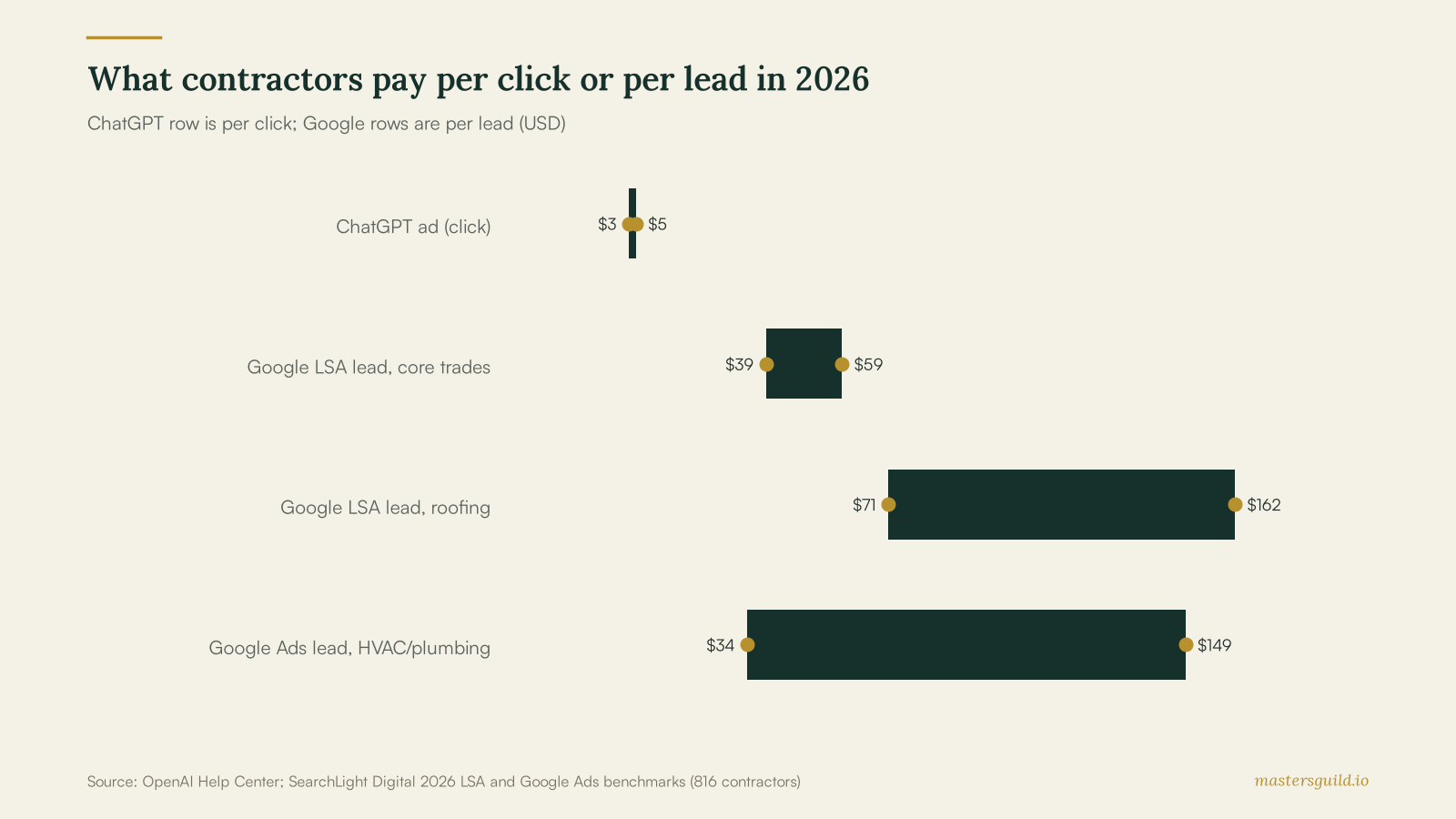
Google figures come from SearchLight’s Local Services benchmark by trade and its January 2026 Google Ads benchmark of $14.9 million in spend across 816 HVAC and plumbing contractors, where branded search averaged $34 a lead, non-branded $149 and Performance Max $72.
The obvious caveat: a click is not a lead. If one in ten ChatGPT clicks becomes a call, a $4 click is a $40 lead, right in the LSA range. At one in twenty you’re at $80 and Google wins. Nobody has trade-level conversion data yet, which is exactly why the test is worth running while clicks are cheap.
Why the Auction Is Still Soft
Demand moved faster than supply. BrightLocal’s 2026 Local Consumer Review Survey found 45% of consumers now use AI tools for local business recommendations, up from 6% a year earlier, while Google’s share of local discovery slipped from 83% to 71%. Scorpion’s homeowner study puts it in trade terms: 22% of homeowners go to ChatGPT first, not Google, when they need a contractor, and 80% of home-service business leaders don’t know how to show up in AI results.
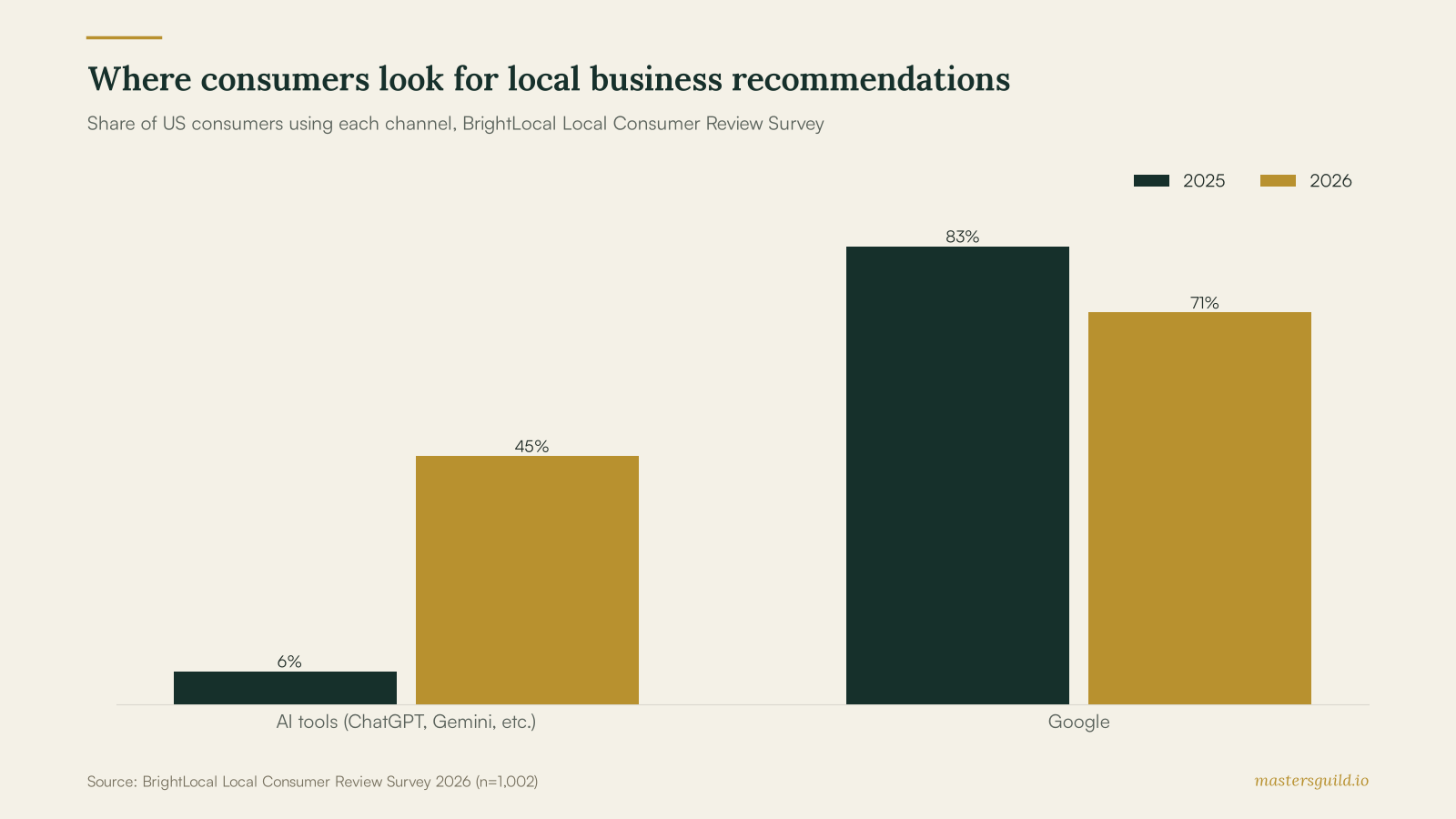
That gap, nearly half of customers asking AI while four in five pros don’t know how to answer, is why early accounts report clicks below OpenAI’s guidance. One agency publishing 15 days of live spend saw about $1.72 per click. That won’t last as more advertisers arrive. Google Ads followed the same arc twenty years ago, and the pros who learn the channel in 2026 will own the cheapest data.
A Sensible First Test for a Trades Pro
- Pick one service, not your whole menu. A campaign for “water heater replacement” or “furnace tune-up” matches the conversations homeowners actually have with ChatGPT far better than a generic “plumber” ad.
- Target your real service area. Ads Manager limits delivery by geography. A contractor serving Houston plumbing jobs has no reason to pay for clicks from Dallas.
- Install the pixel before you spend a dollar. Count booked calls and form fills, not clicks. The number you want at the end is cost per booked job, set next to your LSA and Google Ads cost per lead.
- Cap the test. A few hundred dollars over three or four weeks is enough to learn whether clicks turn into calls in your trade. Fall is a good moment, with HVAC and plumbing demand building into the heating season.
- Land somewhere that converts. Send the click to a page with your phone number, service area, licence and reviews above the fold. A ChatGPT user has already described the problem. They want to book, not browse.
What It Means for Homeowners
Ask ChatGPT what to do about a leaking water heater and the answer is still the model’s own. The contractor beneath it paid to be there, and the “Sponsored” label is your cue. The vetting rules we laid out when Angi joined Gemini still apply: check the licence and insurance, read recent reviews, and get two or three real quotes before you sign. An ad can start the conversation, but it can’t price your job. When you’re ready to compare, find a verified plumber near you without wondering who paid for the spot.
The Bottom Line
ChatGPT ads for contractors went from a US pilot to a $1 billion global channel in under 200 days, and entry still costs a few dollars a click with no minimum spend. For trades pros, that’s an underpriced experiment worth running this fall with a pixel installed and a hard budget cap. For homeowners, the AI chat window now has a business model, and the Google rule applies: the advice is free, the placement is paid, and the credential check is still on you.
Post the job with your budget, get offers from identity-verified pros, and pay only when the work is done.