

It’s a buyer’s market across most of the US, and that changes which home repairs are worth paying for. Redfin’s September 3 housing update says new listings reached their highest level since August 2022, pending sales fell to their lowest since February, and months of supply hit 4.0, the edge of balanced. With that much choice, the house with the sticking door and the foggy window loses to the move-in ready one, or sells with a concession that pays for those repairs at the buyer’s price. Selling this fall? The cheap fixes come first. Buying? The inspection is your leverage. Either way, the pros who do small jobs fast are about to be busy.
Key takeaways
- Redfin, Sept 3: new US listings at a 4-year high, pending sales at a February low, months of supply 4.0 (4 to 5 is balanced)
- Sellers gave concessions in 46.2% of May sales, a record for the month; Nashville 75.5%, Charlotte 71.4%, Atlanta 68.7%
- Concessions include money toward repairs, so skipped fixes get paid for at the negotiating table, on the buyer’s terms
- The pre-listing list is cheap: deep clean $200-$500, siding wash $250-$700, sticking door $100-$250, foggy window $75-$250
- Canada is balanced, not a buyer’s market: CREA reports 4.7 months of inventory, though Ontario was a buyer’s market from January to April
What Redfin’s September Report Says
The numbers cover the four weeks ending August 30. New listings rose 8% year over year to 383,795, seasonally adjusted, while pending sales fell 2.5% and active listings passed 1.5 million. The median sale price still rose 2.2% to $398,632, but the median asking price slipped 0.1%, and 20.9% of listings carried a price drop. Redfin’s agents say move-in ready homes in good neighborhoods still sell fast; 25.9% went for more than asking. The rest sit, with a median of 45 days on market.
The concession data is where sellers feel it. Redfin’s June analysis found sellers gave buyers a concession in 46.2% of May sales, up from 43.1% a year earlier and the highest May share on record. A concession is money toward repairs, closing costs or a rate buydown, on top of any price cut. One sale in seven (15.7%) had both. Redfin counts 47% more sellers than buyers nationally.
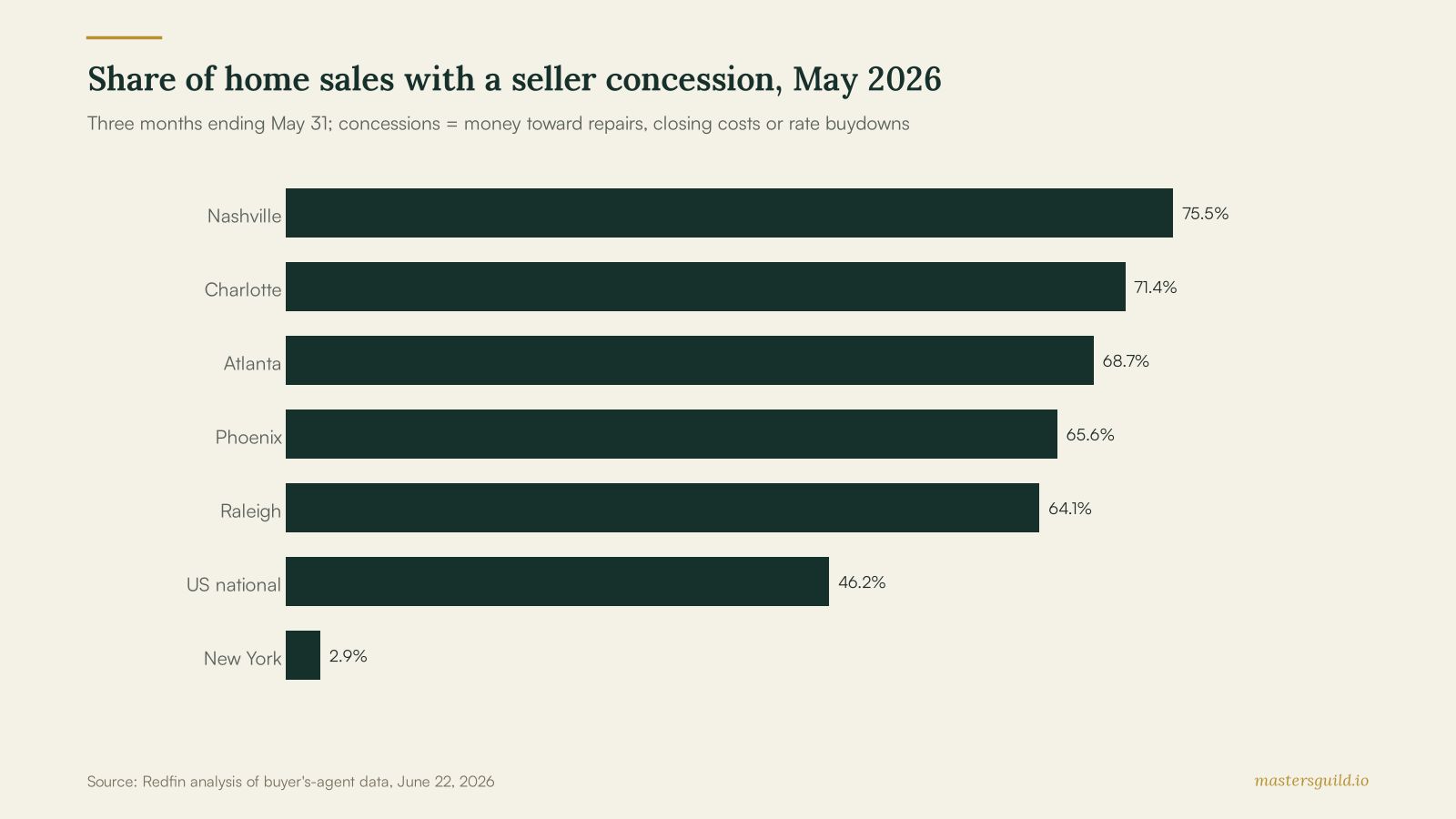
The Sun Belt leads because it built the most homes during the pandemic boom and now has the most listings piled up. Orlando’s rate jumped from 38.3% to 58.6% in a year, Phoenix from 50.7% to 65.6%. New York (2.9%), San Jose (5.9%) and San Francisco (14.9%) are the exceptions, still balanced or seller’s markets.
Why a Buyer’s Market Changes the Repair Math
In a seller’s market, the buyer waives the inspection and takes the sticking door. In a buyer’s market, the buyer has three other houses to see, so every visible flaw becomes a reason to walk or a line in the repair request. Amanda Peterson, a Redfin agent in Dallas, put it plainly in the concessions report: buyers “can be selective and negotiate for everything from repairs to closing costs,” and sellers with “dated homes that haven’t been renovated in decades” give the most ground.
That is the case for fixing before listing. A repair done on the seller’s schedule costs the trade rate. The same repair negotiated after an inspection costs whatever the buyer’s agent estimates, plus the days the house sits while both sides argue. Our post on the cost of delaying repairs made the same point about maintenance; a listing just compresses the timeline.
The Pre-Listing Fixes That Pay in a Buyer’s Market
None of these are renovations. They are what a buyer notices in the first ten minutes and what an inspector writes up in the first hour, priced from our 2026 cost guides.
| Pre-listing job | United States (USD) | Canada (CAD) | Why it matters to a buyer |
|---|---|---|---|
| Deep clean (2–3 bedroom) | $200–$500 | $250–$550 | First impression; photos and showings |
| Pressure wash siding (two storey) | $350–$700 | $350–$700 | Curb appeal in the listing photo |
| Sticking door planed / hinges reset | $100–$250 | $100–$250 | Inspectors flag every door that binds |
| Foggy window (failed seal) | $75–$250 | $200–$400 | Failed seals appear on every inspection report |
| Leaking pipe or drip repair | $150–$500 | $150–$500 | Moisture is the fastest way to lose a buyer |
| Missing or damaged shingles | $150–$450 | $150–$450 | Roof line items trigger the biggest credits |
| Fall yard cleanup | $200–$600 | $200–$600 | The lawn is the first photo |
| Junk removal (full truckload) | $600–$850 | $600–$850 | Empty garage, empty basement, bigger rooms |
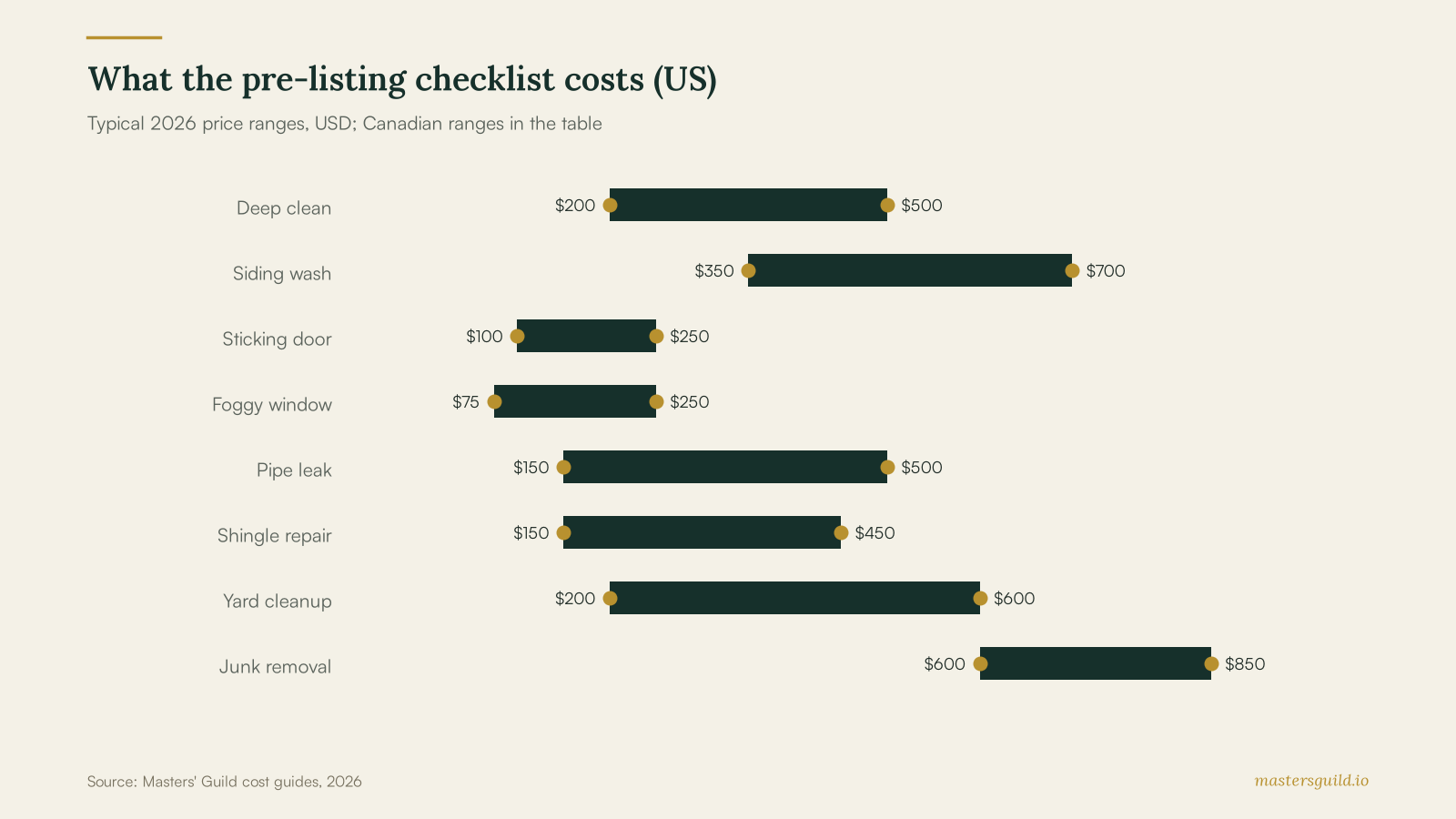
The whole list runs roughly $1,800 to $4,100 in the US if a seller does every line; most houses need three or four. Our house cleaning cost guide covers the deep clean, and the door repair cost guide explains why a $100 planing job beats a door on the inspection report. A seller in Nashville, where three sales in four now carry a concession, has the clearest case in the country for spending up front. Book the pressure washing and the painter near you two weeks before the photographer, not two days.
Buyers: how to use the inspection
The same list works in reverse. Ask for the repairs that affect safety and water first: roof, plumbing, electrical. For cosmetic items, a credit usually beats a seller-completed repair, because the seller picks the cheapest contractor and you live with the result. Before you sign the inspection response, get your own quotes for the big items so the credit matches what the work costs. That is a ten-minute job on the app, and it stops you taking a $500 credit for a $1,500 roof repair.
Canada: Balanced, Not a Buyer’s Market Yet
Canada is different. CREA’s July release reports 4.7 months of inventory nationally, the lowest so far in 2026 and just under the long-term average of 5. CREA calls anything above 6.4 months a buyer’s market and below 3.6 a seller’s market, so the country as a whole is balanced. Ontario is the exception: it spent January through April in buyer’s-market territory before converging back toward average in July. Sales have risen four months in a row, and the national average price is $674,819, up 0.2% year over year. August numbers land September 15.
A seller in Toronto faces less pressure than one in Phoenix, but the logic holds: a $250 to $550 CAD deep clean and a $200 to $400 CAD window defog still cost less than the adjustment a buyer will ask for. Our renovate-or-move analysis covers the other side of that decision for Canadians who would rather not list at all.
What It Means for Pros
Pre-listing work is small, fast and urgent, the best kind of small job. Agents want a fixed price and a date this week, and the agent who gets both refers the next listing. A packaged pre-listing quote (clean, wash, doors, windows, yard) is easier to sell than four separate ones. On the buyer side, credits mean post-closing work: the family who took $1,200 instead of a seller-done roof patch still needs a roofer in October. In Sun Belt metros where concession rates run above 60%, that pipeline is most of the fall.
Our Take
A buyer’s market does not make every house worth less. It makes every flaw worth more, to the buyer. Sellers who spend a few hundred dollars on visible fixes before the photographer arrives keep that money out of the concession column. Buyers who price the repairs themselves before answering an inspection get credits that match reality. On both sides the pros are the same, and they are cheaper and more available now than once the fall listing wave becomes the fall closing wave.