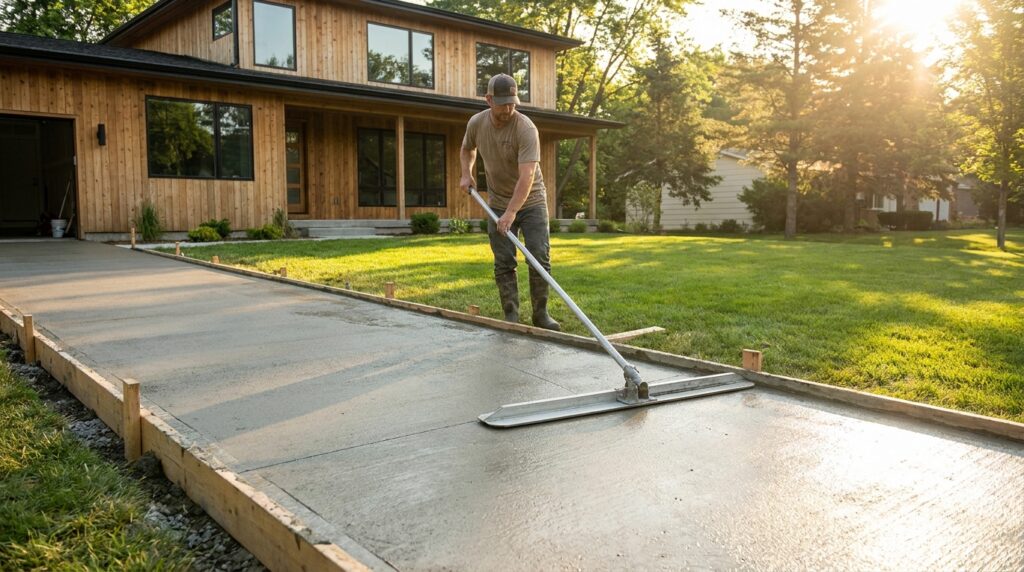
If you’re pricing a new driveway this summer, here’s the short answer: concrete driveway cost in 2026 runs about $5–$18 per square foot installed in the US and $10–$17 CAD per square foot in Canada for a standard pour, with decorative finishes climbing to $25 or more. For a typical two-car driveway (400–600 sq ft), that means a total bill of roughly $3,200–$8,600 USD, or $6,000–$10,200 CAD for a 600 sq ft double. July and August are peak pouring season — warm, dry weather is exactly what curing concrete wants — so quotes book up fast.
Here’s what moves the number, and how to make sure you’re paying for concrete, not confusion.
Concrete Driveway Cost: 2026 Price Ranges
| Project | US (USD) | Canada (CAD) |
|---|---|---|
| Plain broom finish, per sq ft | $5–$10 | $10–$17 |
| Decorative (stamped, exposed aggregate), per sq ft | $10–$18 | $15–$25+ |
| Single-car driveway (~400 sq ft) | $2,500–$5,500 | $4,000–$6,800 |
| Two-car driveway (400–600 sq ft) | $3,200–$8,600 | $6,000–$10,200 |
| Backyard patio slab (~200 sq ft) | $1,200–$2,400 | $1,000–$2,200 |
Labor typically accounts for around 40% of the total ($3–$7 per square foot), with materials making up the rest. Prices are up 3–5% over 2025 — cement and rebar costs haven’t escaped the tariff pressure hitting renovation budgets this year.
What Drives the Price Up or Down
Finish and decorative work
A plain gray broom finish is the budget floor. Exposed aggregate adds roughly $3–$5 per square foot; stamped patterns that mimic stone or pavers can double the per-foot price. This is where quotes diverge the most.
Site prep and tear-out
Removing an old driveway adds $1–$3 per square foot before any new concrete arrives. Sloped lots, poor drainage, or soft soil needing extra gravel base all add cost — and skipping proper base prep is the #1 cause of early cracking.
Thickness and reinforcement
Four inches is standard for cars; five to six inches (plus rebar or wire mesh) is worth the upcharge if you park a truck, RV, or trailer. A cheap quote is often a thin quote — always ask.
Region and access
Cold-climate markets like Toronto price higher because crews use air-entrained mixes and frost-depth base prep to survive freeze-thaw cycles. Tight access that forces wheelbarrow work instead of direct chute pouring adds labor hours.
DIY vs. Hiring a Pro
A small patio slab or walkway is a realistic weekend DIY — bagged concrete, forms, and patience. A driveway is not. It’s 10+ cubic yards of material arriving on a truck that waits for no one, and mistakes (bad slope, no control joints, weak base) literally get set in stone. Concrete work is one of the clearest “hire it out” calls in home improvement: the material is cheap, but the skill window is unforgiving.
Where DIY does pay: maintenance. Sealing every 2–3 years ($20–$50 in sealer) and pressure washing the surface each spring can add a decade to a driveway’s 25–30 year lifespan.
How to Vet a Concrete Contractor
- Get three itemized quotes. Identical slabs can vary 40% between bids. Make sure each quote states thickness, base depth, reinforcement, and finish — not just a lump sum.
- Ask about control joints and curing. A pro will cut or tool joints at roughly 8–12 foot intervals and keep the slab damp for several days. Anyone who says “you can park on it tomorrow” is a red flag (7 days minimum for vehicles).
- Check licensing, insurance, and photos of 2+ year-old work. New concrete always looks good; concrete that’s survived two winters tells the truth.
- Confirm warranty terms in writing. One to two years against structural cracking is standard.
Ready to get numbers for your own driveway? You can find vetted concrete contractors near you and compare quotes before the summer pouring window closes — or browse the full concrete work service overview first.
Frequently Asked Questions
How much does a concrete driveway cost per square foot in 2026?
Expect $5–$10 USD per square foot for a plain finish in the US and $10–$17 CAD in Canada, installed. Decorative finishes like stamping or exposed aggregate run $10–$25+ per square foot.
Is concrete cheaper than asphalt?
No — asphalt is usually 30–50% cheaper upfront. But concrete lasts 25–30 years versus 15–20 for asphalt and needs less maintenance, so lifetime cost often favors concrete.
How long before I can drive on a new concrete driveway?
Wait at least 7 days before parking vehicles on it, and about 28 days for full strength. Foot traffic is fine after 24–48 hours.
What time of year is best to pour a concrete driveway?
Late spring through early fall. Concrete cures best between 10–27°C (50–80°F), which is why summer is peak season — and why crews book out weeks in advance.
Planning a driveway, patio, or any concrete project this season? Get quotes on MastersGuild and compare vetted local pros in minutes.