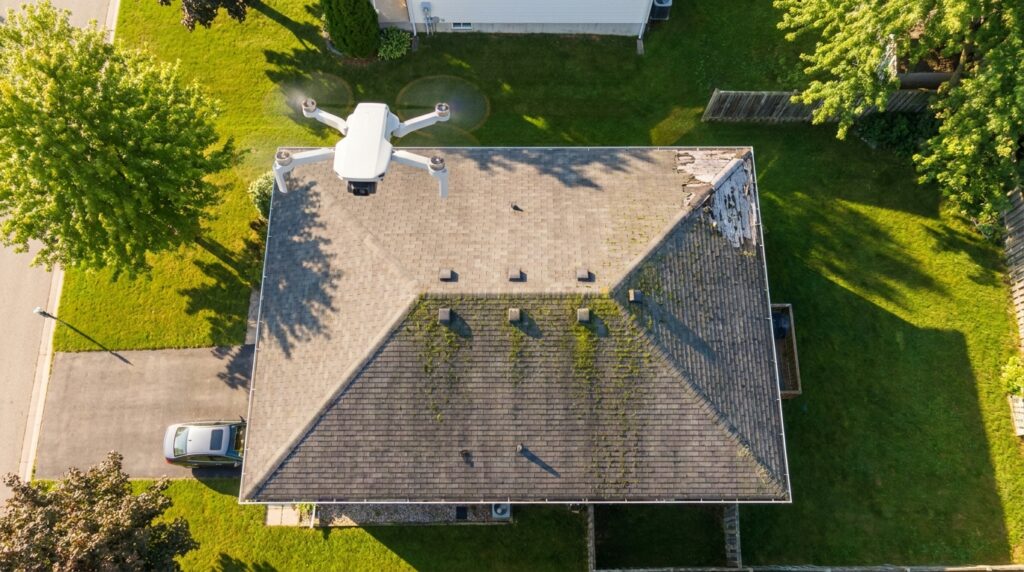
Here’s an uncomfortable question for 2026: when did your home insurance company last inspect your house? If your answer is “never,” think again — the inspection probably happened from the air. Home insurance and aerial imagery are now deeply intertwined: insurers routinely feed photos from planes, drones, and satellites into AI systems that decide whether to write, renew, or reprice your policy. And in a growing number of cases, an algorithm flags a roof as risky and the policy is dropped without a human inspector ever setting foot on the lot.
For homeowners already watching premiums climb year after year, this adds a new twist: the condition of your roof — as seen from 400 feet up — can now cost you your coverage entirely.
How the Eye in the Sky Works
Insurers have quietly built one of the largest property-surveillance operations in North America. Imaging companies fly fixed-wing aircraft over virtually every neighborhood on the continent multiple times a year, and insurers buy access, layering AI on top to scan millions of rooftops for trouble: curling or missing shingles, moss and algae streaks, tarps, sagging lines, overhanging tree limbs, even yard clutter like trampolines and unfenced pools.
The economics are obvious — a remote scan costs pennies against a $150+ in-person inspection. And to be fair, the technology often works in homeowners’ favor: after a hailstorm, aerial imagery can speed up claims dramatically. The problem is what happens between claims. Consumer advocates at United Policyholders have collected case after case of homeowners nonrenewed over grainy photos — a “damaged” roof that turned out to be shadows, a “tarp” that was a pool cover, a roof flagged as aging that had years of life left.
Regulators Are Pushing Back — Slowly
The rules are finally catching up to the cameras. Colorado issued formal guidance on insurers’ AI use in March 2026. Massachusetts regulators have warned that cosmetic roof conditions visible in an aerial photo shouldn’t, by themselves, justify canceling or non-renewing a policy — insurers should do real underwriting review, including a physical inspection when the picture isn’t clear. And twelve states are piloting a new NAIC tool that lets regulators audit insurers’ AI systems directly, with formal adoption expected at the NAIC’s November 2026 meeting.
That’s meaningful progress. But guidance in a dozen states is not protection in all fifty, and Canadian homeowners have even fewer formal guardrails. For now, the practical burden sits where it usually does: on you.
What Homeowners Should Do Before the Letter Arrives
The good news: you can see roughly what the algorithm sees, for free. Pull up the satellite view of your address and look at your home the way an underwriter would.
- Check the roof honestly. Moss, dark streaks, patched sections, or a visible tarp are the top triggers. If it’s cosmetic, clean it; if it’s real wear, budget for repairs now — a $1,000 fix beats a nonrenewal followed by a forced replacement. A local roof repair pro can document the roof’s actual condition, which is exactly the evidence an appeal needs.
- Clear the roofline. Overhanging branches read as risk in every model. Trimming or removing a problem tree is one of the cheapest ways to change how your property scores from above.
- Tidy what’s visible from the sky. Debris piles, dead vehicles, an aging trampoline — liability flags, all of them.
- Never ignore an insurer’s letter. Most carriers will give you a window to fix flagged issues. Respond fast, make the repair, and send dated photos and invoices.
- Appeal with evidence. If you believe the image is wrong or outdated, request a physical inspection and put your documentation in front of a human. In states like Massachusetts, the regulator has explicitly said you’re entitled to more than an algorithm’s verdict.
The Bottom Line
Aerial imagery in home insurance isn’t going away — it’s getting sharper, cheaper, and more automated every year. The homeowners who get burned are the ones who find out their roof “failed” a photo shoot they never knew happened. Look at your home from above before your insurer does, fix what’s genuinely worn, and keep the paper trail. And when a flagged roof or overgrown tree needs a pro’s hands this week, not next month, we can help you find one fast.