

Canada housing supply would need to reach 417,000 to 469,000 homes per year through 2036 to restore pre-pandemic affordability, according to CMHC’s Fall 2026 Housing Supply Report. The agency projects 231,000 annual starts under current trends, leaving an estimated annual gap of 187,000 to 238,000 homes. The estimate covers a decade of national housing supply. A homeowner still needs a project-specific quote and a local contractor’s schedule.
Key takeaways
- CMHC estimates Canada needs 417,000 to 469,000 homes each year through 2036 to restore pre-pandemic affordability.
- Current-trend construction totals 231,000 homes a year in CMHC’s business-as-usual scenario.
- The resulting annual supply gap ranges from 187,000 to 238,000 homes.
- Edmonton has no measurable supply gap in CMHC’s assessment, while Ottawa and Montreal face wider gaps.
CMHC’s estimate measures a decade of housing supply
CMHC compares expected annual housing starts with the annual pace needed to return affordability to 2019 levels by 2036. Its low and high scenarios require 417,000 and 469,000 homes per year. The agency’s business-as-usual case projects 231,000 annual homes, so the gap falls between 187,000 and 238,000 homes each year.
| CMHC national scenario through 2036 | Homes per year | Meaning |
|---|---|---|
| Business as usual | 231,000 | Expected annual starts under current trends |
| Lower need scenario | 417,000 | Annual starts needed under CMHC’s lower scenario |
| Higher need scenario | 469,000 | Annual starts needed under CMHC’s higher scenario |
| Annual supply gap | 187,000–238,000 | Difference between required and expected starts |
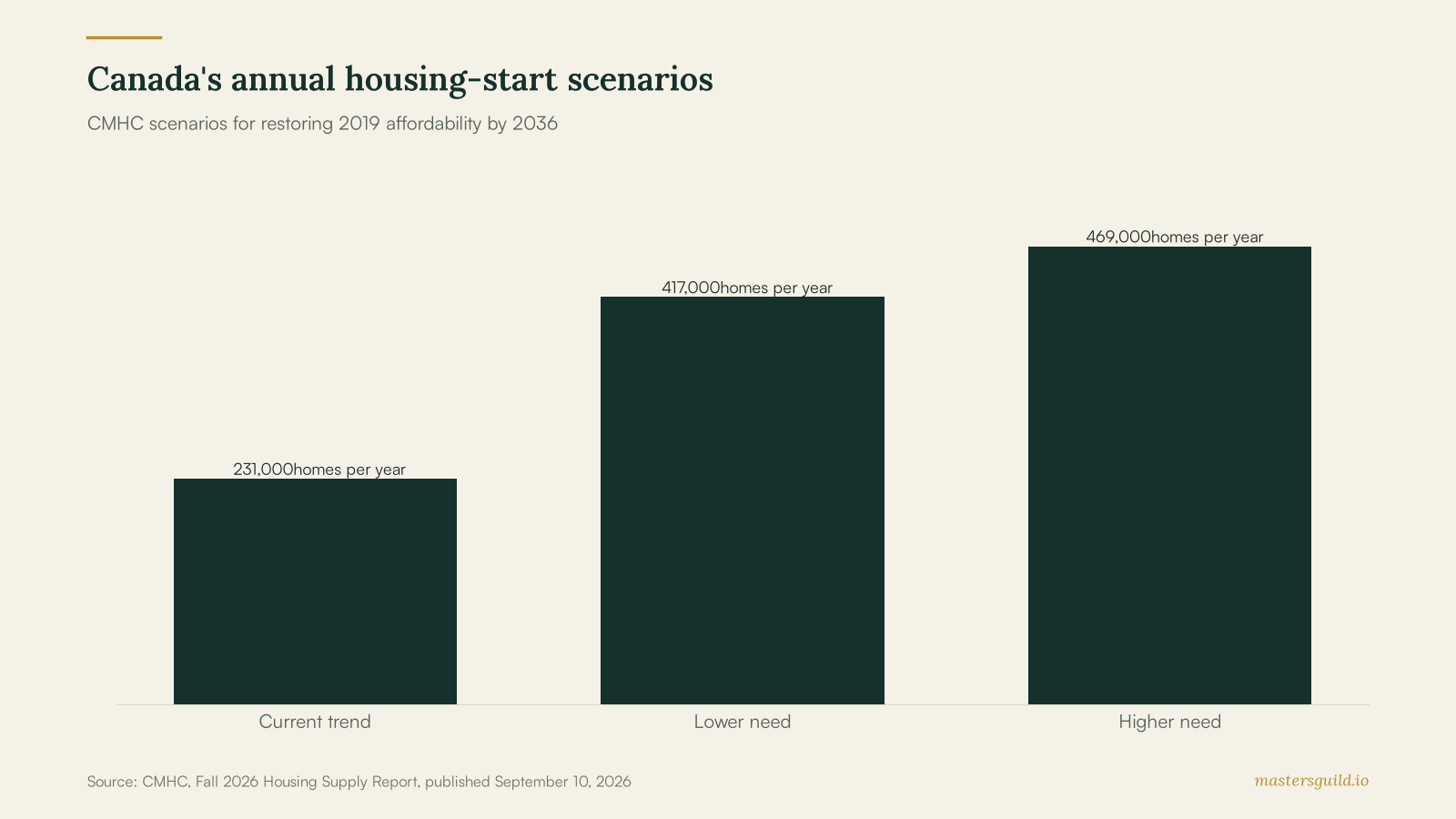
CMHC describes the range as a scenario-based estimate. Housing prices, household formation, incomes and construction all affect the result. Homeowners should not use the national total to predict a local bid. The report is useful because it points to a broad constraint: Canada needs sustained construction, with the right mix of homes, to improve affordability.
Ownership housing is the pressure point
CMHC says rental construction has supported better-balanced rental markets in many cities, while new condominium and ground-oriented construction has weakened. That split matters for households trying to buy a home. More rental units can ease one part of the market without adding enough ownership options.
The agency reports that Edmonton has no measurable supply gap because construction has generally kept pace with population growth. Calgary narrowed its gap through strong construction activity. Ottawa and Montreal widened as their future housing supply falls short of the pace needed to restore affordability. Local conditions still determine whether a homeowner can find a crew for a repair, remodel or addition.
For a current view of projects entering the pipeline, see the latest Canadian residential permit data. For a household project, a written scope matters more than a national forecast. Describe the site, materials, measurements, finish level and permit needs before requesting offers.
Homeowners can plan a project without chasing the market
A supply gap is not a reason to rush into a contract. It is a reason to prepare before a project becomes urgent. Get at least two comparable offers, ask each pro to list labour, materials, permits and exclusions, and set a written process for changes. The 2026 renovation-price data for Canada can help you frame questions before you collect quotes.
Keep emergency repairs separate from discretionary upgrades. A leaking roof, failed furnace or electrical hazard needs a qualified response. A kitchen layout change can wait until you have a complete scope and a realistic budget. That distinction helps homeowners make a calm decision when local capacity feels tight.
Local pros can turn a forecast into a clear job
Homeowners do not need a national housing model from a contractor. They need a clear plan for their house. Contractors can earn trust by visiting the site, naming assumptions, explaining permit responsibility and giving a dated start window. Those details help a homeowner compare offers without relying on a vague low total.
CMHC’s report also reinforces the value of local knowledge. Edmonton, Calgary, Ottawa, Montreal, Toronto and Vancouver face different supply conditions. A pro who explains local lead times, inspections and material availability gives a client a more useful answer than a national headline.
The bottom line
Canada housing supply needs a far faster annual pace to restore pre-pandemic affordability by 2036, CMHC estimates. The report does not set the price of a home repair or guarantee a contractor’s availability. Homeowners can respond with a defined scope and comparable offers, while local pros can respond with transparent prices and reliable schedules.
Post your job on Masters’ Guild and get offers from identity-verified pros. Free on iOS and Android.