
Local service guide
Warehouse Organization in Windsor, ON
Arrange Warehouse Organization in Windsor, ON by defining the stock to sort, the locations to label and the waste to remove before requesting quotes. Hire a crew for that written scope, and refer racking alterations to a specialist. Ontario guidance identifies pre-start health and safety review requirements for new or modified mechanically loaded racks in factories, unless the employer establishes an exemption. Ask each bidder to explain who will handle stock, authorize disposal and hand the work area back to your staff. [4]
Define the reset before asking for quotes
Choose a specific result: staff can find each stock item, identify its assigned location and distinguish saleable inventory from returns or disposal stock. Send bidders a floor sketch, photographs, an inventory export and your proposed work boundary. Mark receiving, picking, packing and outgoing orders so the crew can plan around the work you need to continue.
Describe handling requirements in the brief. Include pallet or bin counts that you have checked, known item weights, storage heights and the equipment you expect workers to use. Ask the provider to identify its crew size, supervisor, equipment responsibilities and insurance coverage for work on your business premises.
Agree on a completion test before accepting a quote. Ask your supervisor to select stock locations and check the physical contents against the updated inventory record. Require a list of unresolved discrepancies, photographs of completed zones and a staff handover. Keep stock write-offs under the control of your designated employee.
Separate stock organization from racking changes
Ontario's Item 3 guidance covers racks designed for mechanical lifting devices to place loads onto them. In factories, installing new racks or modifying existing racks triggers a pre-start health and safety review unless the employer establishes an exemption. Changes to lift trucks or loads outside the original design parameters may also trigger a review. Ask a racking specialist to assess proposed changes before including them in an organization crew's scope. [4]
An Item 3 reviewer must be an engineer. Ontario describes exemption documentation that includes a statement of compliance with the named rack standard, capacity information, structural drawings and assembly and safe-use instructions. Ask your supplier for documentation covering the complete rack system. Documentation for separate beams and frames may not establish an exemption for the assembled system. [4]
Ontario excludes low-weight shelving loaded by hand from the ground from Item 3 review requirements. It also places Building Code-regulated storage systems with raised platforms or personnel walkways outside Item 3's scope, and requires an engineer to design those systems. A building permit does not replace a required review or exemption. Describe the proposed installation to Windsor's Building Division before authorizing construction. [1] [4]
Compare the complete service price
Ask bidders to separate labour from labels, bins, equipment rental, transport and disposal. Specify whether the labour figure covers each worker or the whole crew, how the provider bills travel and waiting time, and who approves extra work. For a fixed quote, identify the stock and zones included and the conditions that would require a revised price.
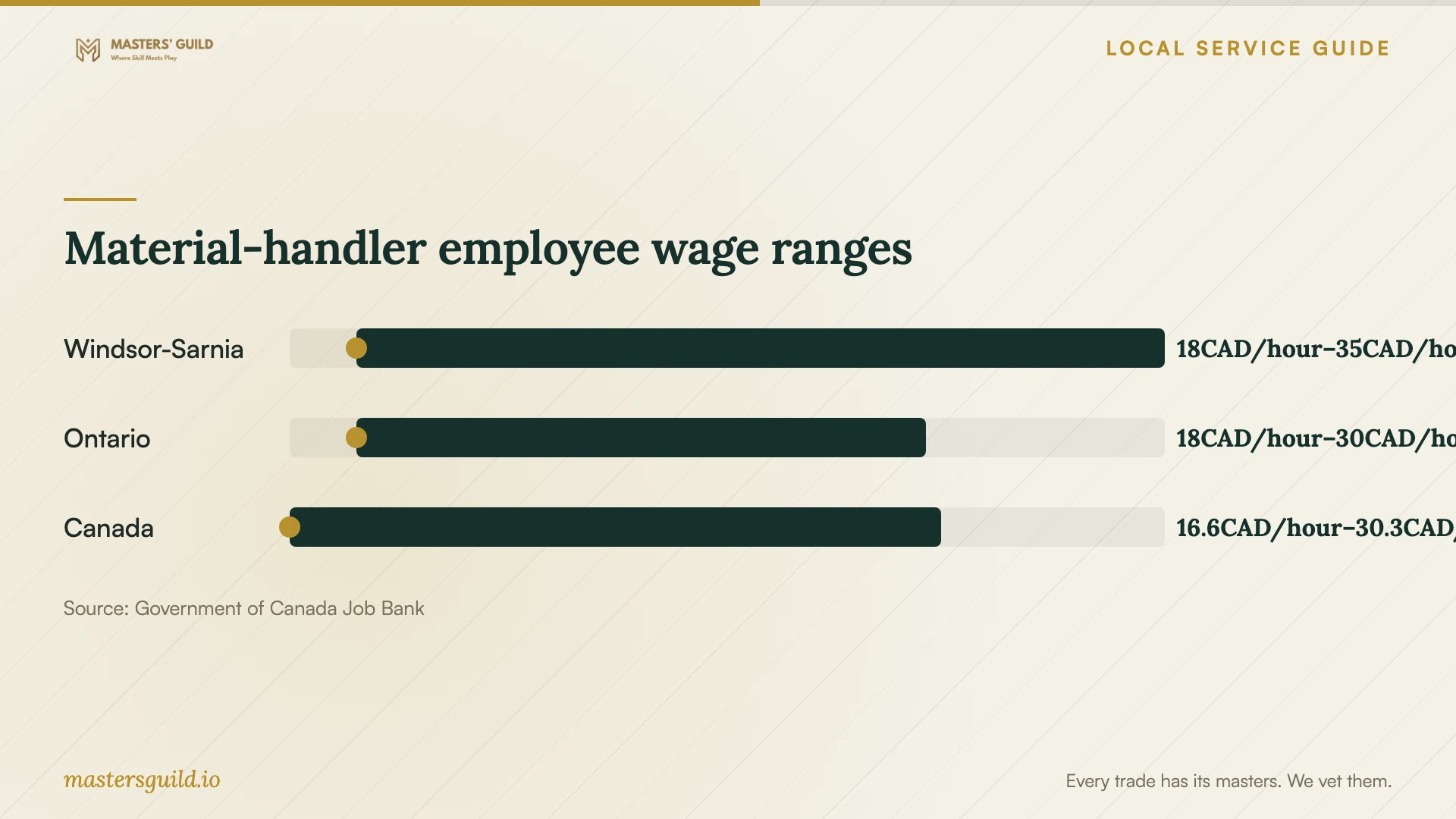
Job Bank reports material-handler employee wages for the Windsor-Sarnia Region at CAD 17.95 low, CAD 22.00 median and CAD 35.00 high per hour for 2023–2024. It updated these wage estimates on November 19, 2025. The chart compares published wage ranges across geographies; it does not establish the price of a warehouse organization contract. [5]
Request a site visit if the provider cannot assess handling or access from your brief. Ask it to state exclusions such as rack installation, inventory reconciliation, chemical disposal or moving stock above the agreed storage height. Compare offers against the same deliverables and choose a work window your receiving and dispatch staff can support.
Plan disposal and the staff handover
Create separate holding areas for stock to retain, items awaiting your approval and materials for removal. Ask the hauler to identify the destination and provide disposal receipts. EWSWA accepts wood pallets at Windsor's depot but charges the current garbage rate. Its page lists unidentified chemical waste as unacceptable and industrial or commercial chemical waste as appointment-only. Contact EWSWA before including chemicals in a removal job. [2]
Match the destination to the hauler's vehicle. EWSWA restricts non-hazardous solid-waste disposal at the Regional Landfill to vehicles with a gross vehicle weight of at least 3,000 kg. Smaller businesses can use the Public Drop Off Depot or Transfer Station #2 as commercial customers. Ask the provider to confirm the applicable facility policies before loading. [3]
Finish with a walk-through involving the staff who receive and pick stock. Check that they understand the location labels, returns area and process for adding new products. Assign an employee to maintain the location list, resolve discrepancies and approve future changes. Keep the provider's agreed follow-up work in writing.
Material-handler employee wage ranges
Local details that affect your job
Send proposed construction to Windsor's Building Division
For uncertainty about permits, Windsor asks you to describe the planned work to the Planning & Building Department at 519-255-6267 or [email protected]. The City accepts permit applications through its online e-permitting system. Send details of proposed rack installations, platforms or building alterations before agreeing to an installation date; request a determination for your specific project. [1]
Use the Windsor depot with a material-specific plan
The Public Drop Off Depot at 3560 North Service Rd. East accepts business customers. Wood pallets incur the current garbage rate, and the authority directs customers to check its current fee schedule. Ask your provider to separate pallets from other materials and confirm the charges and acceptance rules before hauling. [2]
Check the disposal calendar before scheduling
EWSWA publishes Monday-to-Saturday hours of 8:00 AM to 5:00 PM for March 30 through November 28, 2026, and lists an October 12, 2026 Thanksgiving closure. If you plan removal around that holiday, confirm a different disposal date with the hauler. Recheck the published schedule for later bookings. [2]
Choose the scope and specialist support
| Planned work | Who to involve | Before authorizing |
|---|---|---|
| Sort stock and update location labels | Organization crew and your inventory supervisor | Agree on stock approvals, label format and completion checks. |
| Organize low-weight shelves loaded by hand from the ground | Crew familiar with your storage equipment | Ontario places these shelves outside Item 3 PSR requirements; keep the agreed work within that scope. |
| Install or modify mechanically loaded racks in a factory | Racking supplier and engineer where a PSR is required | Establish the required PSR or documented exemption before proceeding. |
| Build a Building Code-regulated storage system with raised platforms or personnel walkways | Engineer and Windsor Building Division | Ontario requires an engineer's design for these systems; request a project-specific permit determination. |
| Remove pallets or commercial chemical waste | Hauler and EWSWA | Budget for pallet disposal charges and contact EWSWA about appointment-only commercial chemical waste. |
Your hiring checklist
- Mark the work zones and the receiving or dispatch operations you need to continue.
- Provide photographs, checked stock quantities and known handling requirements.
- Name the employee who can approve stock write-offs and disposal.
- Identify rack alterations and ask for specialist assessment before authorizing them.
- Request crew, equipment, insurance and supervision details.
- Separate labour, materials, hauling and disposal in the quote.
- Confirm the disposal destination, accepted materials and booking date.
- Agree on inventory checks, unresolved-item reporting and a staff handover.
Frequently Asked Questions
What should I send a provider for a quote?
Send a floor sketch, photographs, checked stock quantities and the work zones. Describe handling equipment, inventory records, disposal materials and your operating hours. Ask for a written scope that identifies exclusions, approval of extra work and the completion test.
Can an organization crew change pallet-rack beams?
Refer a proposed configuration change to a racking specialist for assessment. Ontario identifies modifications to mechanically loaded racks in factories as a PSR trigger unless an exemption applies. It says installers should have adequate training and follow the manufacturer's or an Ontario engineer's instructions. [4]
Can the crew take old wood pallets to the Windsor depot?
EWSWA accepts wood pallets at the Public Drop Off Depot and charges the current garbage rate. Ask the hauler to confirm facility policies and current fees, then include transport and disposal responsibilities in the quote. [2]
Does the wage chart tell me what a contractor should charge?
Job Bank publishes employee wage estimates for material handlers, including the Windsor-Sarnia Region, using 2023–2024 Labour Force Survey data. Use those figures for staffing context. Obtain a contractor quote covering your scope, crew, equipment, materials and disposal. [5]
Sources and scope
This guide combines the sources below with practical planning guidance. Figures apply to the stated geography and period; request a written quote for your property.