
Local service guide
HVAC Services in Syracuse, NY: Hiring and Planning
To arrange HVAC Services in Syracuse, request a written diagnosis for a repair or a home assessment for replacement, then compare itemized quotes. Check the technician’s applicable EPA Section 608 certification for covered refrigerant work. Before accepting a National Grid heat-pump incentive estimate, confirm your electric account, the installer’s program participation, and whether you will keep your existing heating system. [1] [3]
Describe the job before booking
Tell the company whether you need a diagnosis, a repair proposal, or replacement planning. Send the equipment model, photographs, thermostat setting, and a description of the problem. Note which rooms feel uncomfortable and when the symptoms occur. Confirm the diagnostic charge, what the visit includes, and how you will approve any repair price.
For replacement, arrange a home assessment before choosing equipment. Request a documented heating and cooling load calculation, proposed capacity, and installation layout. Include rooms you plan to renovate and equipment you want to retain. Have each bidder address the same scope so you can compare the proposals without guessing what each price includes.
Discuss winter heating and backup equipment
The Japan Meteorological Agency’s Syracuse/Hancock table lists monthly mean temperature normals of minus 4.2 degrees Celsius for January and minus 3.5 for February. The supplied table does not identify the averaging years. Use these figures as local background for a winter-performance discussion; request the contractor’s chosen winter design temperature and the proposed equipment’s heating capacity at that temperature. [2]
Have the installer explain how the system will heat your home during colder conditions. Request details about supplemental heating, thermostat controls, and the operation of any retained furnace or boiler. Review the outdoor-unit location, required clearances, and maintenance access before approving the layout.
National Grid says customers switching from natural gas, oil, or propane to heat pumps will increase electricity use during colder months while reducing or eliminating fossil-fuel costs. Give the contractor your bills and request an operating-cost comparison with stated fuel prices and supplemental-heating assumptions. Treat a proposed bill reduction as something to examine before committing. [1]
Build a budget around the complete quote
Request project-specific quotes for your Syracuse home. Separate the diagnostic fee from the repair price and ask whether the company credits that fee toward approved work. For replacement, request equipment model numbers and separate prices for labor, removal, electrical work, duct changes, controls, and any proposed permit or inspection charges.
Compare the gross installation price before incentives. National Grid says contractors deliver incentives through an upfront discount or reimbursement after installation. Have the bidder identify the method, application responsibility, expected incentive, and amount you must pay before reimbursement. Get a written explanation of your payment obligation if the program awards a different amount. [1]
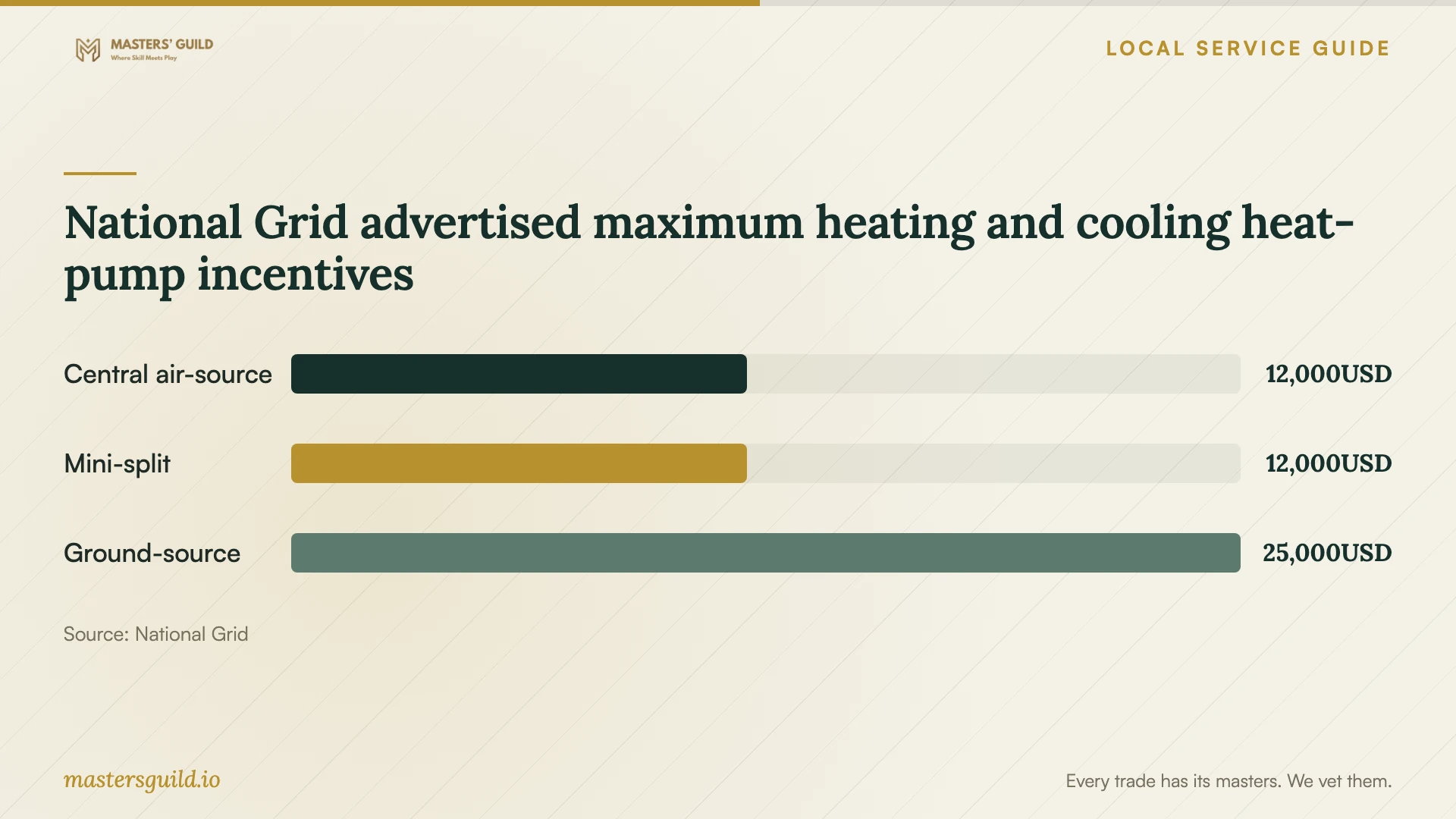
National Grid advertises heat-pump incentive maximums that vary by equipment type; actual incentives depend on the premise, project scope, and heat-pump type. The chart compares advertised ceilings rather than installation prices. Ask the participating contractor to document the amount applicable to your address and proposed work before you use it in your budget. [1]
Verify the technician and agree on handover
EPA requires Section 608 certification for technicians performing covered work on equipment that could release regulated refrigerants. Technicians take tests specific to the equipment type, and their certification credentials do not expire. Have the company identify who will perform refrigerant work and confirm that person’s applicable certification. [3]
Request proof of insurance and identify who will confirm and handle any local approvals for the proposed scope. Include warranty terms, payment milestones, and exclusions in the agreement. Require your approval of a written price for additional work. Before final payment, arrange a walkthrough of thermostat settings, filter access, maintenance instructions, and how to report an unresolved comfort problem.
National Grid advertised maximum heating and cooling heat-pump incentives
Local details that affect your job
Confirm the electric account and participating installer
Check the electric-service provider on your Syracuse home’s bill. National Grid limits its NYS Clean Heat heat-pump incentives to its electric-service customers. It also requires a participating contractor to process heating-equipment incentive applications. Confirm both conditions before accepting a quote that subtracts an incentive from your expected payment. [1]
Settle the retained-heating plan before estimating incentives
National Grid requires central air-source, mini-split, and air-to-water projects to remove the previous heating source from service to qualify for higher incentives. If you want to keep a furnace or boiler available as backup, tell the contractor before they calculate your incentive. Request a proposal that connects the heating plan, decommissioning work, and applicable incentive. [1]
Check your address for the enhanced incentive tier
National Grid offers higher heat-pump incentives under its DAC Tier for selected advancement communities and directs customers to NYSERDA’s interactive address map. Check your property’s address rather than treating a Syracuse mailing address as proof of eligibility. Have the participating contractor identify the applicable tier and amount in writing. [1]
Choose the next step for your project
| Your situation | Next step | Confirm before signing |
|---|---|---|
| Your existing system has a fault | Arrange a diagnostic visit | Visit charge, written diagnosis, and approval of the repair price |
| You are planning replacement | Request a home assessment and itemized proposal | Sizing assumptions, winter heating plan, and complete installation scope |
| You want National Grid heat-pump incentives | Verify electric-service eligibility and participating-contractor status | Applicable amount, application responsibility, and discount or reimbursement timing |
| You want to retain the previous heating source | Discuss that plan before accepting an incentive estimate | Eligibility for higher incentives on central air-source, mini-split, or air-to-water work |
| The job includes covered refrigerant work | Confirm the technician’s applicable EPA Section 608 certification | Technician identity and certification appropriate to the equipment |
Your hiring checklist
- Send equipment details, photographs, symptoms, and preferred appointment times.
- Confirm the diagnostic fee and how you will approve repair work.
- Request a home assessment and documented sizing assumptions for replacement.
- Check insurance and the refrigerant technician’s applicable certification.
- Identify who will confirm and handle local approvals.
- Confirm the electric account, participating installer, address tier, and retained-heating plan for an incentive project.
- Compare gross prices, incentive payment timing, exclusions, and warranty terms.
- Collect operating instructions and arrange a handover walkthrough.
Frequently Asked Questions
Can I keep my furnace when adding a heat pump?
Ask the installer to assess your preferred arrangement and document the controls and operating plan. National Grid requires removal of the previous heating source from service for higher incentives on central air-source, mini-split, and air-to-water projects. Confirm how retaining your furnace affects the proposed incentive. [1]
Does any HVAC contractor qualify for National Grid incentives?
National Grid requires a NYS Clean Heat participating contractor for its heating-equipment incentives and limits eligibility to National Grid electric-service customers. Check your bill and the contractor’s participation before signing a proposal that includes an incentive. [1]
Will I receive the maximum incentive in the chart?
National Grid advertises these amounts as maximums. Incentives vary by premise, project scope, and heat-pump type, with additional eligibility conditions for higher amounts. Request the participating contractor’s written calculation for your address and equipment. [1]
What credential should I check for refrigerant work?
Check the technician’s applicable EPA Section 608 certification for covered refrigerant work. EPA ties certification tests to equipment types, and the credentials do not expire. Ask the company who will perform that part of your job. [3]
Sources and scope
This guide combines the sources below with practical planning guidance. Figures apply to the stated geography and period; request a written quote for your property.