
Local service guide
Long-Distance Moving in Saint Paul, MN
Arrange Long-Distance Moving in Saint Paul by checking the carrier’s credentials, comparing written quotes for the same inventory, and agreeing on a loading location before booking. Minnesota-only and cross-state trips use different USDOT registration types. For the local pickup, check truck parking restrictions and determine whether a moving container will occupy city right of way. Ask each bidder to price your actual access plan and explain the delivery window. [1] [2] [3]
Check the carrier for your route
Start with the destination state. MnDOT distinguishes intrastate transportation within state boundaries from interstate transportation across a state boundary. Its household-goods permit process includes USDOT registration and liability and cargo insurance filings, and it states that a carrier cannot operate until it receives its permit. [3]
Ask the bidder to identify the business that will transport your belongings. Request its legal name, USDOT number and applicable operating credentials. For a Minnesota-only move, ask MnDOT to confirm the household-goods permit. For a cross-state move, ask the carrier how you can verify its interstate authority before you sign. [3]
Ask who handles loading, transport, storage and delivery, and whom you contact if the shipment arrives late or damaged. Request the written loss-and-damage terms, coverage options and claim procedure. Keep your signed documents and an inventory with photographs of valuable or fragile items.
Compare quotes against one written move plan
Send each bidder the same room-by-room inventory, including items in the garage, basement and storage areas. Identify what you will pack and what you want the crew to pack. Provide photographs of stairs, entrances and the proposed loading space, and ask the bidder to inspect anything it cannot assess from those details.
Request separate written prices or terms for packing, stairs, elevator use, carrying items from the door to the truck, a smaller transfer vehicle, storage and destination unloading. Ask which services the total includes and what changes would trigger a revised quote. Have the bidder explain whether it bases the price on shipment weight, volume, time or a fixed scope.
Agree on a pickup window and delivery window, then ask what happens if you cannot receive the shipment on the proposed date. Keep medication, identification, keys and essential paperwork with you. Use the city fees below to budget container placement; obtain the transport price from a quote for your shipment. [1]
Choose a workable loading arrangement
Ask the mover for the truck’s size and weight and its proposed stopping location. Saint Paul prohibits street parking for vehicles over 26,000 pounds unless they are loading, unloading or providing a service. The city also prohibits commercial vehicles and vehicles over 10,000 pounds from parking on streets adjacent to residential zoning districts. Confirm how the rules apply to your address rather than treating the loading exception as permission for overnight staging. [2]
For an apartment or condominium, ask the building manager to approve the loading entrance and elevator reservation before you accept a pickup time. Walk the route from the loading space to your door. Give the mover measurements or photographs of tight turns and entrances, and ask for a written alternative if the planned truck cannot reach the loading point.
Saint Paul lists 651-266-6151 for street obstruction permits or meter hooding. Use that contact to check the proposed curb arrangement, especially at a metered address. Describe the vehicle or container, exact location and dates, and ask who should submit any application. [4]
Budget and apply for container placement
Saint Paul requires a storage-container permit when you place the container in city right of way. The city does not require that permit when the container sits entirely on private property. Before choosing driveway placement, ask the container company to confirm delivery clearance and ask your property manager or association for any required approval. [1]
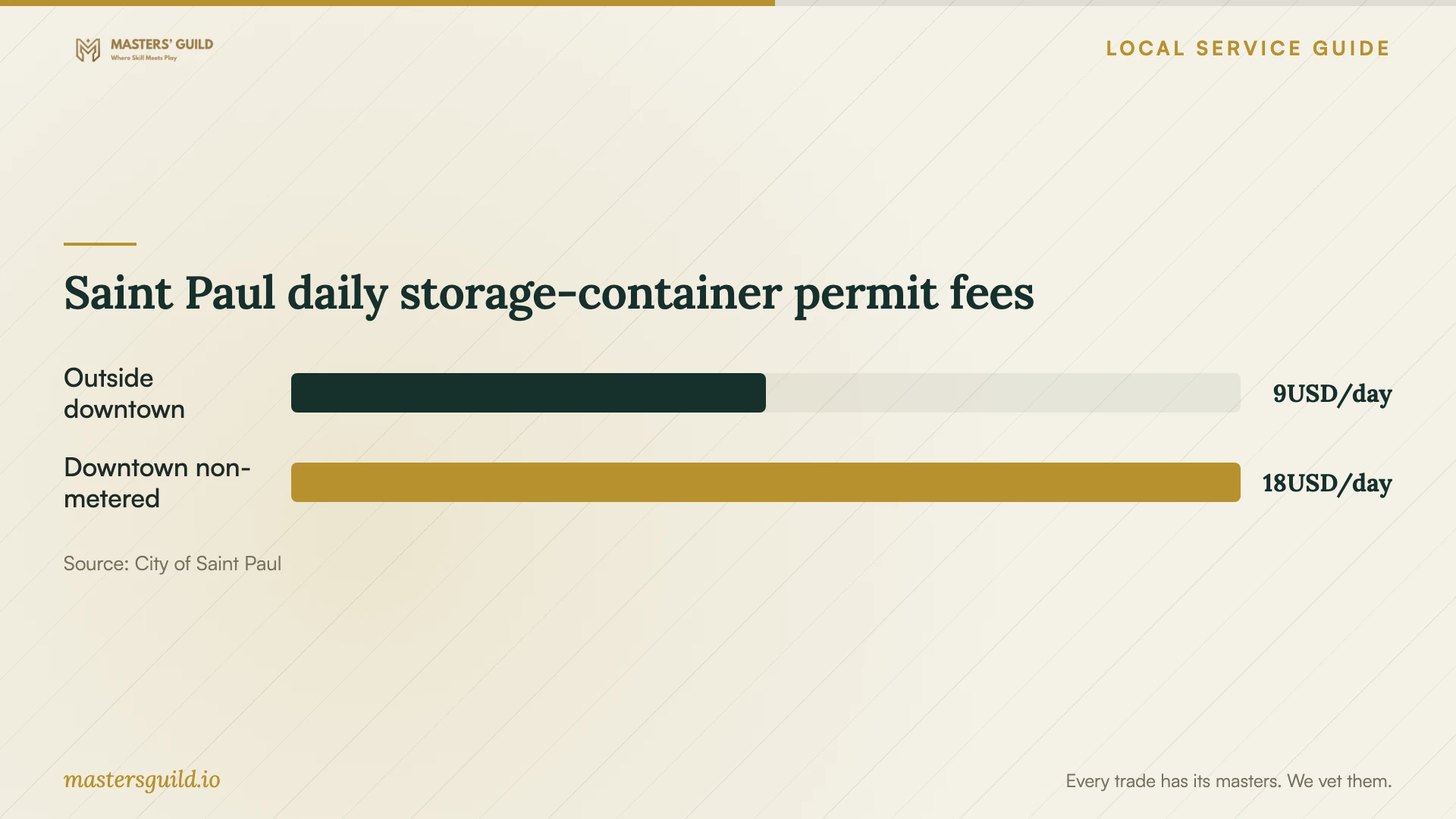
For one container up to 20 feet long, the city lists $9 per day outside downtown and $18 per day downtown in non-metered areas. At parking meters, the city directs applicants to submit a Meter Hooding Application through PAULIE. Do not apply the non-metered fee to a metered location without confirmation. [1]
Apply through PAULIE, the city’s permitting platform. Register for an account if needed, follow the application instructions and submit the request. Agree with the container company on who obtains the permit and who pays for additional placement days before scheduling delivery. [1]
Prepare a winter access backup
During a declared Snow Emergency, Saint Paul starts night-route parking restrictions at 9 p.m. All downtown streets have the nighttime restriction, including streets without signs. Day-route restrictions start at 8 a.m. the following day on streets or sides without night-route signs and continue until crews plow to the curb. [5]
Check the city’s current declaration and parking map before the truck arrives. Ask the mover to agree on an alternate loading location or arrival plan if the intended curb space becomes unavailable. Assign someone to clear steps and the carrying path, and confirm who will arrange alley clearance because the city does not plow alleys. [5]
Saint Paul daily storage-container permit fees
Local details that affect your job
Container location changes the permit and fee
Choose the placement location before reserving a container. Saint Paul requires a permit in city right of way but exempts placement entirely on private property from its storage-container permit. For one container up to 20 feet, the published daily fee is $9 outside downtown or $18 downtown in non-metered areas. Apply through PAULIE; ask about meter hooding for metered placement. [1]
A loading stop and overnight staging need separate plans
Ask the mover where it will keep the truck before and after loading. Saint Paul’s rule for vehicles over 26,000 pounds includes a loading, unloading or service exception, while its residential-zoning rule restricts commercial vehicles and vehicles over 10,000 pounds. Confirm the proposed arrangement with Traffic Engineering at 651-266-6200. [2]
Winter alley access needs an assigned person
If the crew plans to use an alley, arrange clearance with the property owner, manager or a snow-removal provider. Saint Paul does not plow alleys. Also confirm an alternate street loading point that complies with the active Snow Emergency restrictions. [5]
Choose the next step for your pickup arrangement
| Your arrangement | What to confirm | Next step |
|---|---|---|
| Container entirely on private property | The city exempts this placement from its storage-container permit. | Confirm delivery clearance and property-owner approval. |
| Container in right of way outside downtown | The city requires a permit and lists $9 per day for one container up to 20 feet. | Assign someone to submit the PAULIE application. |
| Container downtown, non-metered | The city lists $18 per day for one container up to 20 feet. | Confirm the location and planned placement days. |
| Container at a parking meter | The city directs applicants to a Meter Hooding Application in PAULIE. | Ask the permit desk about the proposed location and applicable charges. |
| Commercial truck beside residential zoning | The city restricts commercial and heavy-vehicle street parking. | Confirm the loading arrangement and a separate staging location. |
| Winter pickup through an alley | The city does not plow alleys. | Assign alley clearance and agree on an alternate loading plan. |
Your hiring checklist
- Prepare one inventory and packing scope for all bidders.
- Identify the transporting carrier and confirm credentials for the destination route.
- Request written pricing, payment terms and loss-and-damage procedures.
- Send photographs of stairs, entrances and the proposed loading space.
- Confirm building access, elevator reservations and the destination unloading plan.
- Assign responsibility for permit applications and container pickup.
- Agree on delivery timing and a weather-related access backup.
Frequently Asked Questions
Does every moving container need a city permit?
Saint Paul requires its storage-container permit for placement in city right of way. It does not require that permit when you place the container entirely on private property. Confirm the footprint with the delivery company before choosing the location. [1]
Can the moving truck stay on my street overnight?
Confirm the truck and address with the city before agreeing to overnight staging. Saint Paul restricts commercial and heavy-vehicle street parking. The over-26,000-pound rule includes an exception for loading, unloading or providing a service; arrange a separate staging plan with the mover. [2]
What should I check for a move that stays in Minnesota?
Ask for the carrier’s legal business name, household-goods permit and USDOT number, then confirm them with MnDOT. MnDOT’s process requires liability and cargo insurance filings and prohibits operation before the carrier receives its permit. [3]
How should I plan a pickup during a Snow Emergency?
Check the active declaration and parking map, then confirm the loading location with the mover. Night restrictions begin at 9 p.m.; day restrictions begin at 8 a.m. the following day. Arrange alley clearance yourself or through your property manager because the city does not plow alleys. [5]
Sources and scope
This guide combines the sources below with practical planning guidance. Figures apply to the stated geography and period; request a written quote for your property.