
Local service guide
HVAC Services in Sacramento: Hiring and Cost Guide
To arrange HVAC Services in Sacramento, start with a diagnosis for a malfunctioning system and compare written bids before approving replacement. For installation, verify an active CSLB C-20 license and ask who handles permits, duct sealing and required compliance testing. If you have a SMUD account, check heat pump rebate eligibility before choosing equipment or a contractor. [1] [2] [3]
Define the job before requesting offers
Describe the problem rather than prescribing a replacement: rooms that stay warm, a system that stops during operation, unusual noise or a thermostat that does not reach its setting. Send the contractor equipment-label photos, the service history you have and a description of when the problem occurs. Ask for the diagnostic charge and what it includes before booking.
For a repair visit, request a written diagnosis, the proposed repair and the total authorization amount. If the contractor recommends replacement, ask them to explain the diagnosed fault and provide a separate replacement proposal. Compare the repair scope with the replacement scope without committing during the first visit.
For maintenance, specify whether you want heating, cooling or both inspected. CSLB’s C-20 classification covers installation, maintenance, service and repair of warm-air heating and air-conditioning systems, along with associated ducts, controls and filters. [4]
Use SMUD costs as a planning reference
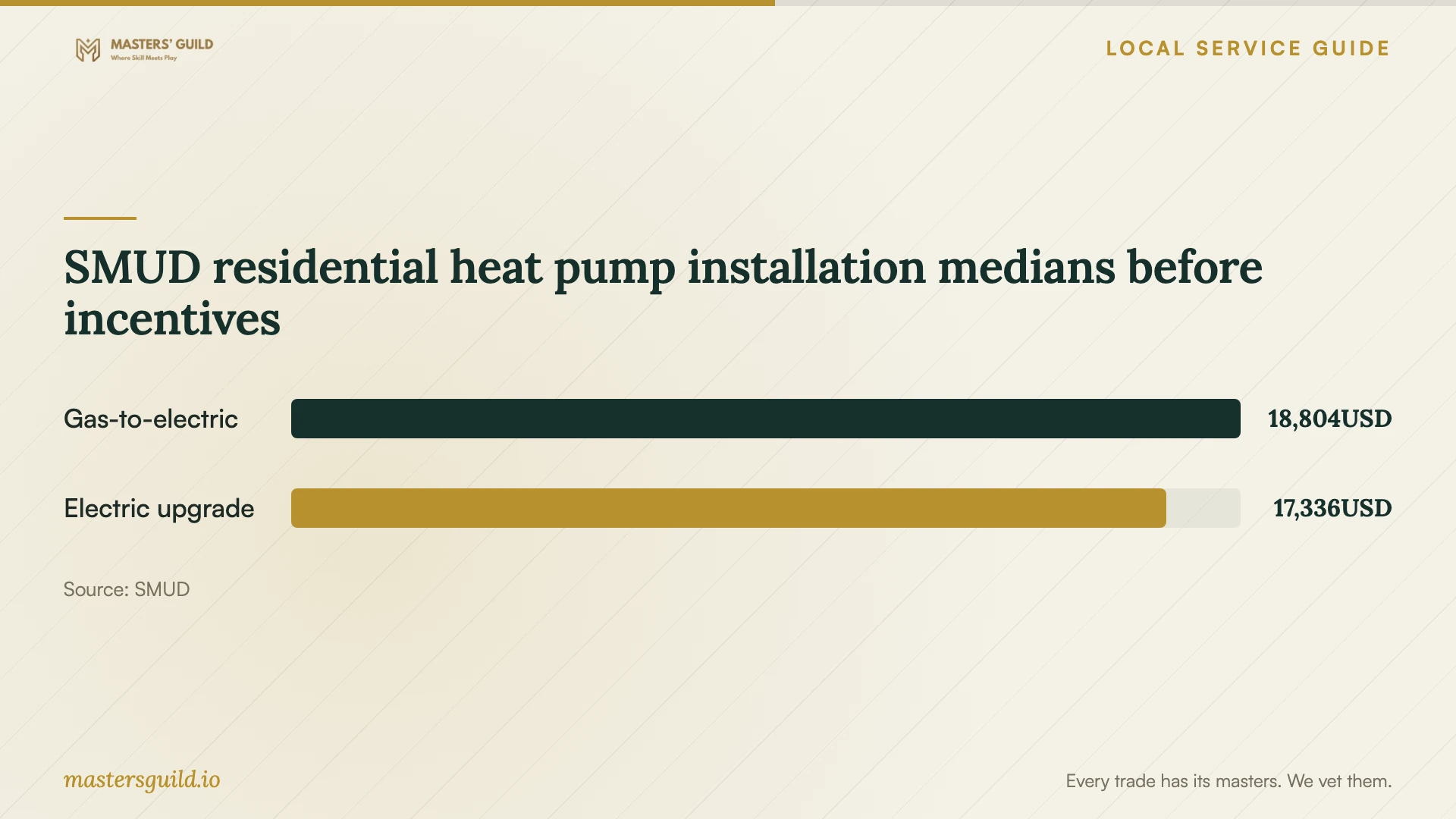
SMUD publishes actual residential heat pump project costs from its rebate program. Its reported medians are $18,804 for gas-to-electric installations and $17,336 for electric-to-electric upgrades. These figures describe participating customer projects, before rebates or tax credits, rather than a price promise for your home. [1]
The utility’s sample covers single-measure projects during the past 12 months and refreshes each quarter. SMUD excludes projects involving additional measures or multiple heat pumps. Use the chart to prepare a replacement budget; request separate quotes for diagnostics, maintenance and repairs because this dataset does not price those services. [1]
SMUD recommends at least three bids. It identifies duct changes, equipment efficiency, installation location and system features among cost considerations. Ask each bidder to describe the work included and list exclusions so you can compare more than the equipment price. Request a separate breakdown for any proposed electrical work. [1]
Compare complete replacement proposals
Ask for equipment model numbers, capacity, efficiency, thermostat, ductwork scope and any proposed electrical work. Request the sizing calculation for a new system. The California Energy Commission states that new HVAC systems require load calculations. [3]
California’s single-family guidance states that replacing either the outdoor or indoor unit of a split system triggers duct sealing and field verification requirements, with requirements and exceptions specific to alterations. Ask the contractor to identify which requirements apply to your project and whether the quote includes the necessary duct work. [3]
The Energy Commission says the Certificate of Compliance, called the CF1R, specifies required field verification and diagnostic testing. An Energy Code Compliance rater provides third-party compliance ratings. Ask who books that rater, pays the testing charge and resolves a failed test. Request the applicable compliance documents and inspection records at handover. [3]
Check qualifications and agree on completion
CSLB advises homeowners installing a new HVAC system to verify that the contractor holds an active C-20 license in good standing. Match the licensed business to the name on your proposal. Ask for insurance documentation and name the person responsible for coordinating any other trades. [2]
Before signing, agree on access to the equipment, protection of your home, removal of old equipment and the expected interruption to heating or cooling. Ask for a schedule that includes testing and inspection appointments. Record how the contractor will explain thermostat operation and respond to problems after installation.
For a gas-to-electric conversion, ask the bidder to separate heat pump installation from panel, circuit and other electrical work. SMUD lists separate Go Electric incentives, with additional gas-to-electric conditions for subpanel and circuit rebates. Have the contractor confirm the applicable program rules before you treat those incentives as part of your budget. [1]
SMUD residential heat pump installation medians before incentives
Local details that affect your job
Select the contractor around SMUD rebate eligibility
SMUD lists $3,000 for a qualifying variable-stage gas-to-electric heat pump conversion, $2,000 for a qualifying two-stage conversion with at least 15.2 SEER2, and $1,000 for a qualifying multi-stage electric-to-electric upgrade. You need an active SMUD account and an individually metered eligible home. A participating SMUD Contractor Network contractor must submit the application, and funding availability applies. Ask whether the proposal deducts the rebate upfront or you receive it after completion. [1]
Budget from utility customer projects
For Sacramento homeowners served by SMUD, the utility’s residential program data offers a relevant replacement reference: published gas-to-electric project costs range from $3,500 to $65,620, while electric upgrades range from $7,250 to $44,763. The sample covers SMUD program participants rather than all Sacramento installations. Ask bidders to explain your scope against these figures instead of treating the minimum as an available offer. [1]
Include California testing in the installation plan
California’s single-family HVAC guidance applies to additions and alterations as well as new construction. Installation of a space-conditioning appliance other than a plug-in room appliance requires a building permit. Ask the contractor to identify the building authority for your address, include permit handling in the proposal and explain the required testing. A factory-charged DIY split system does not remove the permit requirement. [3]
Choose the next step for your HVAC job
| Your situation | Next step | Ask before approving |
|---|---|---|
| A system fault without a diagnosis | Book a diagnostic visit | What is the visit charge, and when will you receive a repair estimate? |
| Considering a gas-to-electric heat pump | Compare complete bids from SMUD participating contractors if seeking its rebate | Which equipment qualifies, and how will the contractor handle the rebate? |
| Replacing an existing electric heat pump | Check SMUD multi-stage upgrade eligibility | Does the equipment qualify for the published $1,000 upgrade rebate? |
| Replacing one split-system component | Ask about duct sealing and field verification | Which alteration requirements and exceptions apply, and who handles testing? |
| Considering a DIY split system | Confirm permit and installation requirements before buying | Who handles load calculations, compliance and removal of the old system? |
Your hiring checklist
- Send equipment-label photos, symptoms and available service records.
- Confirm the diagnostic charge and the amount you must authorize before repairs.
- Match the contractor’s license and insurance documentation to the proposal’s business name.
- Request comparable written bids with equipment models, sizing, ductwork, electrical-work breakdowns and exclusions.
- Ask who handles permits, compliance testing and inspection appointments.
- Confirm SMUD participation and rebate treatment before signing a heat pump contract.
- Agree on access, service interruption, cleanup and completion documents.
Frequently Asked Questions
How much should I budget for a heat pump replacement?
SMUD reports a median of $18,804 for gas-to-electric installations and $17,336 for electric upgrades in its residential rebate-program sample, before incentives. Request a home-specific bid covering equipment, ducts, electrical work, permits and required testing. [1]
Can any licensed HVAC contractor obtain my SMUD rebate?
SMUD requires a qualifying participating contractor from its Contractor Network to install the equipment and submit the rebate application. Verify both license status and program participation before hiring. [1] [2]
Do I need testing if the contractor keeps my existing ducts?
California’s guidance says heat pump replacement triggers duct sealing requirements even when the existing ducts remain. Ask the contractor to explain the applicable testing, exceptions and independent verification for your project. [3]
Should I include a federal heat pump tax credit in a 2026 budget?
SMUD describes this federal heat pump tax credit as applying only to systems installed before December 31, 2025. Do not subtract that listed credit from a 2026 installation quote. Ask the contractor to document any separate incentive they propose. [1]
Sources and scope
This guide combines the sources below with practical planning guidance. Figures apply to the stated geography and period; request a written quote for your property.