
Local service guide
HVAC Services in Lincoln, NE: Hiring and Permits
Arrange HVAC Services in Lincoln, NE by asking for the contractor’s city mechanical registration, a written diagnosis or replacement scope, and named responsibility for permits and final inspection. Before accepting a heat-pump quote, check the City of Lincoln and LES incentive requirements. Lincoln distinguishes equipment replacement from exempt minor repairs, while the utility’s incentive process can affect which contractor you choose and what you must arrange before installation. [1] [2]
Start with a diagnosis and a clear service request
Tell the contractor whether you need a repair visit, maintenance, or a replacement proposal. Describe the symptoms, affected rooms, thermostat setting, and when the problem occurs. Share photographs of the equipment labels and any displayed fault code. Ask for the diagnostic charge, after-hours charge if applicable, and the amount of work you authorize before the technician must contact you.
For a replacement recommendation, request the diagnosis in writing and ask the contractor to explain the repair option. Ask what each proposal includes: equipment models, controls, duct changes, electrical work, condensate drainage, venting, disposal, permits, and inspection. Request separate prices for optional work so you can compare proposals without guessing what each contractor omitted.
Check the contractor’s Lincoln registration
Lincoln’s mechanical code defines master contractors, journeyman technicians, and apprentices. A company may register as a master mechanical contractor when a registered master serves as a bona fide officer or employee and remains in actual charge of its mechanical or fuel-gas work. Ask for that person’s name and the company’s registration number, then confirm the registration with the city before accepting an installation proposal. [1]
Ask for a current insurance certificate as part of your hiring checks. Before issuing a mechanical permit, Lincoln requires the master contractor to maintain the specified liability coverage and keep a current certificate on file with the code official. Ask who handles subcontracted work and who you contact if the installation needs correction. [1]
The city’s code viewer lists separate Lincoln Mechanical Code and Lincoln Fuel Gas Code chapters under Title 25, Heating. If your proposal changes gas piping or furnace venting, ask the contractor to identify the applicable requirements alongside the mechanical scope. [3]
Agree on permits and final inspection before work
Lincoln requires a permit before regulated mechanical installation, alteration, removal, conversion, or replacement. Its minor-repair exception includes coil cleaning, filter replacement, approved condensate-line repairs, and replacement of listed components such as motors, circuit boards, capacitors, and compressors. Ask the contractor to explain which category your specific job falls into rather than assuming that every service visit needs a permit. [1]
For permitted equipment, Lincoln requires inspection before permanent building work conceals relevant portions and a final inspection after completion. The registered master contractor must call for inspection, or provide instructions if the owner will request the final inspection. Put that arrangement in writing and retain the permit number and final approval with your equipment documents. [1]
For an emergency equipment replacement or repair that requires a permit, Lincoln allows the permit application on the next working business day. Ask the contractor how they will document and complete that follow-up. The emergency exception concerns application timing; it does not remove the permit requirement. [1]
Check heat-pump incentives before accepting a quote
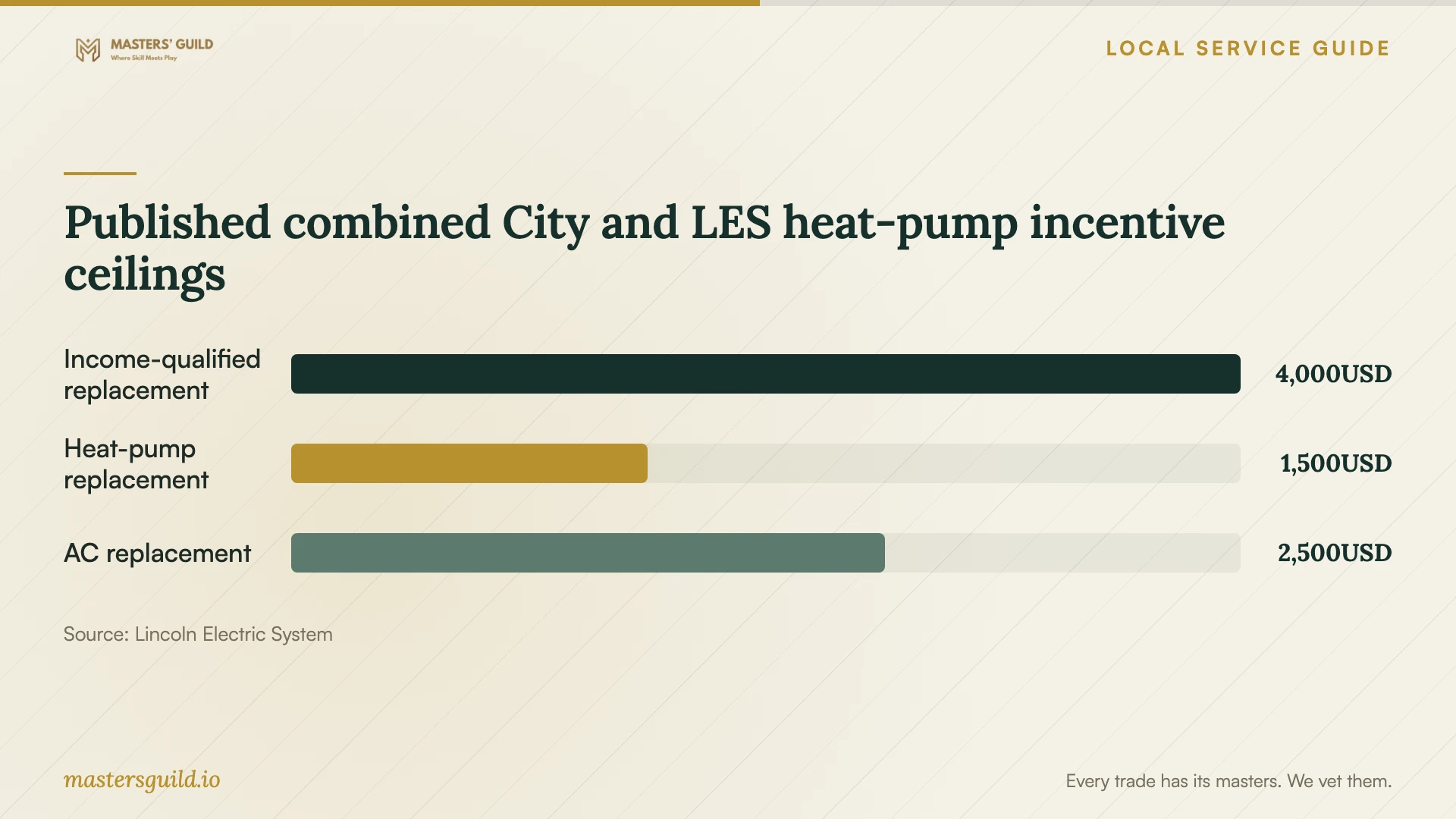
LES publishes a City of Lincoln and LES heat-pump combination beginning September 1, 2026. Listed combined amounts are $4,000 for qualifying low- and moderate-income households, up to $1,500 for general-population households replacing a heat pump, and up to $2,500 for general-population households replacing an air conditioner. Confirm your address, household category, equipment eligibility, and remaining funding before treating an incentive as part of your budget. [2]
The City portion has property and replacement restrictions. The program generally requires replacement of an existing heat pump or central air conditioner at least five years old; it also allows replacement of a window air conditioner where the property has no central air conditioning. City exclusions include properties outside city limits, new residential construction, mobile homes, and ground-source heat pumps. LES describes its own qualifying heat-pump incentive separately, so a City exclusion does not by itself settle LES eligibility. [2]
For the low- and moderate-income pathway, contact Urban Development for approval before installation and use a participating contractor. For the general-population pathway, check the address-based City incentive amount and ask a participating contractor to handle the application. LES describes incentive credits on the contractor’s invoice. Ask the contractor to show the full price, proposed credits, and your payment obligation if a credit is unavailable. [2]
Compare replacement proposals on the same scope
Ask each bidder to explain the proposed equipment capacity, how they assessed the house, and whether they included changes to ducts or electrical service. For a heat pump, request the matched-system efficiency documentation and an explanation of the proposed furnace pairing. LES requires qualifying City-combination systems to have an AHRI rating and either inverter operation or the specified minimum SEER2 and EER2 ratings. [2]
Request a written installation schedule, expected interruption to heating or cooling, warranty terms, and responsibility for follow-up service. Before the crew arrives, agree on equipment access, furniture protection, and disposal. At handover, ask the installer to demonstrate the controls and give you model numbers, maintenance instructions, warranty paperwork, and any outstanding inspection arrangements.
Published combined City and LES heat-pump incentive ceilings
Local details that affect your job
Replacement and minor repair have different permit paths
Lincoln’s section 25.06.050 exempts defined minor HVAC repairs while requiring permits for regulated replacement and installation. Ask your bidder to identify the applicable category and include the permit responsibility in the written scope. For emergency work requiring a permit, the application must follow on the next working business day. [1]
Income-qualified incentives require action before installation
For the combined low- and moderate-income heat-pump pathway, LES says household income must be at or below 80% of Lincoln Area Median Income. Applicants must obtain Urban Development approval before installation and use a participating contractor. Establish eligibility before booking the installation. [2]
Keep final inspection on the completion list
Lincoln requires final inspection of permitted mechanical equipment. If the contractor expects you to request it, the contractor must provide instructions and you must arrange access. Ask for that responsibility in writing before work begins. [1]
Choose the next step for your HVAC job
| Situation | Next step | Point to confirm |
|---|---|---|
| Maintenance or component repair | Request a diagnosis and authorized repair scope | Ask whether the work falls within Lincoln’s defined minor-repair exception |
| Furnace or cooling-system replacement | Request an itemized installation proposal | Identify permit and final-inspection responsibilities |
| Emergency replacement requiring a permit | Agree on the emergency work and permit follow-up | Lincoln requires the application on the next working business day |
| Income-qualified heat-pump proposal | Seek Urban Development approval before installation | Use a participating contractor for the combined incentive pathway |
| General-population heat-pump proposal | Check the address-based City amount and request a participating-contractor bid | Distinguish heat-pump replacement from air-conditioner replacement eligibility |
Your hiring checklist
- Describe symptoms, affected rooms, equipment labels, and fault codes before requesting a visit.
- Confirm the diagnostic charge and the spending limit that requires your approval.
- Request the supervising master contractor’s name, city registration number, and insurance certificate.
- Compare written scopes with equipment models, required supporting work, and disposal included.
- Ask who obtains any required permit and who arranges final inspection.
- Check incentive eligibility and approval requirements before authorizing installation.
- Retain the diagnosis, invoice, equipment documents, and applicable inspection approval.
Frequently Asked Questions
Does a furnace replacement need a Lincoln mechanical permit?
Lincoln requires a permit for regulated mechanical replacement. Ask the contractor to include permit handling and final inspection in the proposal. The code treats defined minor repairs separately. [1]
Can I install equipment in my own home?
Lincoln allows homeowner installation in a single-family residence the owner occupies, subject to the code’s restrictions on compensated labor. The owner must file plans, obtain a permit, pay fees, and arrange inspections. Discuss your proposed scope with the city before proceeding. [1]
Can I assume I will receive the maximum heat-pump incentive?
Confirm eligibility first. LES lists different combined amounts by household and replacement category, plus property, equipment, approval, and funding conditions. Ask for the confirmed credit and the full installation price in writing. [2]
Must I use a participating contractor for LES incentives?
The combined low- and moderate-income pathway requires a participating contractor. For the broader residential LES program, LES tells customers choosing a nonparticipating contractor to contact it for application instructions. Confirm the pathway before hiring. [2]
Sources and scope
This guide combines the sources below with practical planning guidance. Figures apply to the stated geography and period; request a written quote for your property.