
Local service guide
Warehouse Organization in Laval, QC
Arrange Warehouse Organization in Laval by defining the stock to sort, the equipment needed to move it and the materials to remove before requesting quotes. Ask each provider to price the same zones, handling tasks, labels and disposal work. Check with the City if you plan to change the premises’ use or the floor area occupied by that use; Laval lists both as occupation-certificate triggers. [1]
Define the work before comparing providers
Choose a measurable finish: designated receiving and returns areas, labelled storage locations, an updated stock-location list and removal of approved discards. Identify which zones the crew must leave operational during the work. Give bidders the same photos, floor sketch and stock list so you can compare their proposed labour and equipment.
Ask providers to explain their relevant commercial work, show proof of insurance and identify any subcontractors handling transport or disposal. Clarify whether the crew will count items, update your inventory system or move goods according to instructions from your staff. Keep rack alterations and elevated stock retrieval as explicit tasks requiring a separate plan.
Set approval rules for damaged, obsolete and unidentified goods. Use a holding area for stock awaiting a decision, and keep it separate from approved waste. Ask the provider to demonstrate the proposed location-label format on a small area before applying it across the premises.
Compare the full project cost
Request itemized charges for crew labour, supervision, labels, bins, equipment, transport and disposal. For hourly work, ask for the crew size, expected hours, minimum booking and a spending limit that requires your approval to exceed. For a fixed quote, record the inventory volume and access conditions on which the provider based it.
Ask bidders to explain how they will handle an unexpected stock discrepancy or a delay while your staff approve disposal. Assign responsibility for ordering supplies, clearing the loading area and updating stock records. Agree on an end-of-shift handover so your employees know which locations changed.
Treat waste transport as a defined part of the quote. Laval requires businesses that exceed municipal collection limits or cannot meet its conditions to arrange private collection. Its business service excludes pallets, wood offcuts and bulky items; the City provides a narrow bulky-item exception for certain registered nonprofit organizations. [2]
Plan stock movements and operating hours
Provide load weights and dimensions, travel distances and details of ramps or uneven floors before the provider chooses handling equipment. CNESST advises selecting a pallet truck according to the load and site conditions. Its guidance describes motorized hand pallet trucks as equipment for horizontal movement with low lifting height. [5]
CNESST advises operators to plan the route, clear obstacles, keep loads stable and use a signaller when the load blocks their view. Ask the provider to explain how the crew will coordinate stock movements with your employees and delivery drivers. [5]
Choose work windows around your receiving and dispatch commitments. Start with a contained zone if you want to test the layout before committing to the remaining space. At handover, walk through a sample receiving, put-away and picking task with the crew, then record any corrections before approving completion.
Build a disposal plan before clearing space
Separate reusable stock, cardboard, wood, metal and materials requiring special handling before loading a vehicle. Ask the hauler to name the receiving facility and confirm acceptance of each material. Request disposal receipts and record which items your business authorized the crew to remove.
Include recycling and organics in the layout. Laval’s waste-management rules apply to industries and businesses and require service for these streams as well as sorting. Place the collection points where your staff can use them without storing waste bins in exits or stairwells, which the City warns against. [2] [3]
Check the destination before arranging an ecocentre trip. Laval reserves its centres for local residents and businesses, requires identification and address documentation, and expects visitors to unload their own materials. Confirm the documents your business and hired hauler must bring rather than assuming the driver’s identification will suffice. [4]
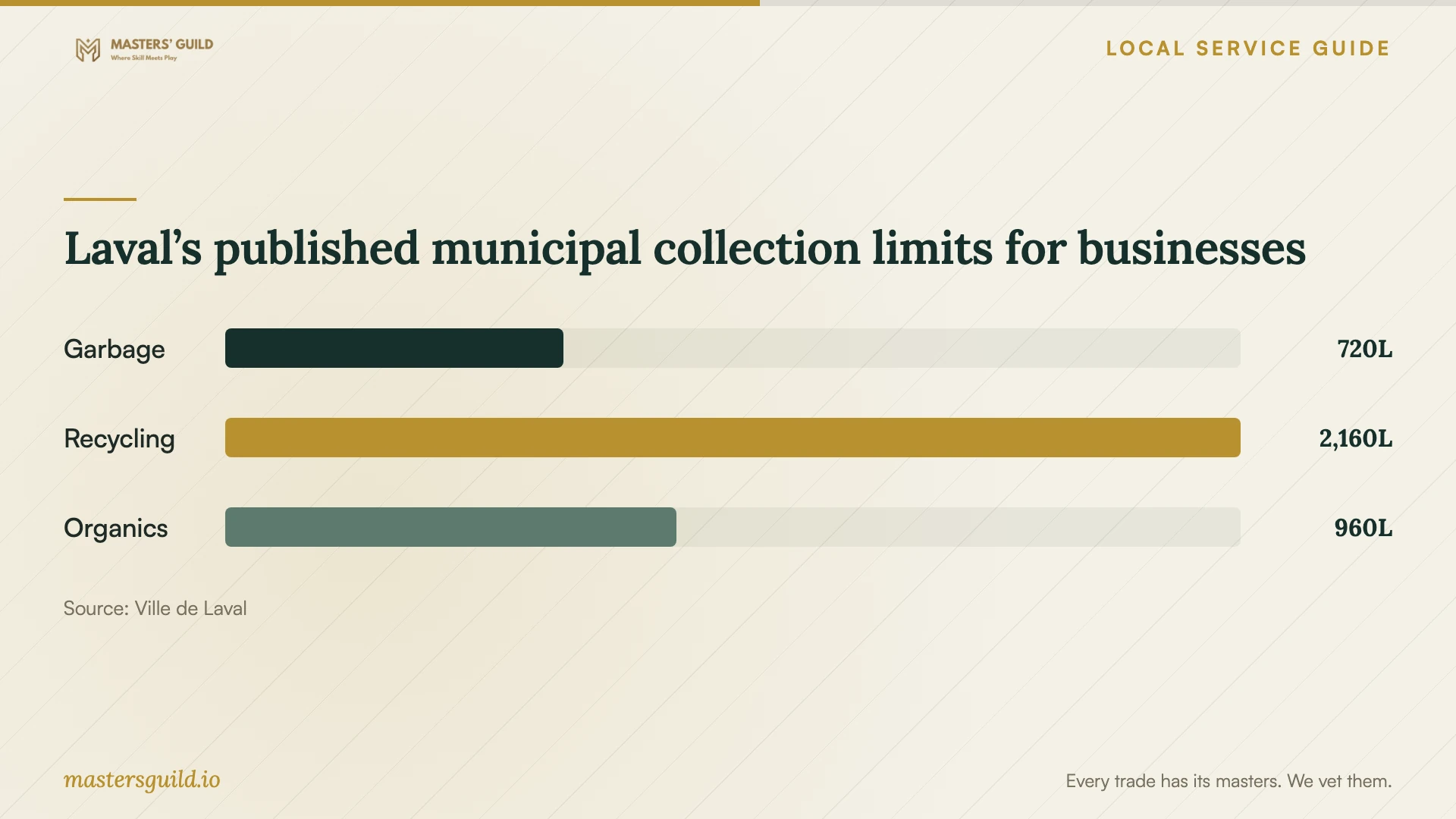
Laval’s published municipal collection limits for businesses
Local details that affect your job
Check occupation approval before expanding the storage use
Laval requires an occupation certificate for a new or changed principal or additional use, and for a change to the floor area occupied by that use. If your reset includes one of these changes, confirm the requirement before scheduling stock relocation. The City asks for a scaled layout showing the area and location of the proposed use, plus lease documentation for tenants and a power of attorney where applicable. It says it will send an application-status email within five business days; that is not a promise of approval within five days. [1]
Allow for the limits of municipal business garbage service
Laval offers eligible businesses garbage collection once every two weeks, with no more than two rolling bins and lids that close. The City collects only material inside the bins. If your cleanout exceeds these conditions, arrange private collection rather than leaving surplus beside the bins. Keep pallets and production waste out of this stream. [2]
Match the disposal trip to the correct Laval centre
Laval lists its Vimont ecocentre at 1205 boulevard Dagenais Ouest and its Fabreville dry-material reception site at 4026 boulevard Dagenais Ouest. The City accepts household hazardous residues only at Vimont and earthwork residues only at Fabreville, subject to its acceptance rules. It caps accepted material at 3 cubic metres per visit and bars dump trucks and dump trailers. Confirm the material, vehicle and business documentation before booking a trip. [4]
Choose the scope that fits the work
| Your planned work | What to arrange | Question for the quote |
|---|---|---|
| Sort loose stock and label existing locations | A defined organization scope and inventory handover | Who approves stock decisions and updates the location list? |
| Move palletized goods at floor level | Equipment matched to loads and site conditions, with required operator training | Which equipment and trained operator will you provide? |
| Remove pallets, offcuts or bulky discards | A confirmed disposal outlet outside ordinary municipal business garbage | Where will each material go, and what does removal include? |
| Change the use or occupied floor area | An occupation-certificate check with Laval | Who will prepare the scaled layout and coordinate the application? |
Your hiring checklist
- Mark the zones included in the quote and the areas that must remain operational.
- Provide stock quantities, load dimensions and known weights.
- Name one employee who can approve disposal and resolve unidentified stock.
- Agree on location labels and inventory-record updates before moving goods.
- Confirm handling equipment, operators and the route through the premises.
- List disposal destinations, transport charges and required documentation.
- Set the handover checks, spending limit and approval process for extra work.
Frequently Asked Questions
Do I need an occupation certificate just to reorganize stock?
Laval’s published triggers include a new use, a change of use and a change to the floor area occupied by a use. Describe your proposed layout to the City if you are unsure whether the project crosses one of those boundaries. Do not assume a sorting quote includes municipal review. [1]
Can the crew put unwanted pallets in the municipal garbage?
Laval excludes pallets and other production residues from business garbage collection. Ask the provider to identify a suitable receiving facility and include transport and disposal in the written scope. [2]
Can I send the whole cleanout to the ecocentre?
Check eligibility and materials first. Laval limits accepted material to 3 cubic metres per visit, refuses some materials and does not admit dump trucks or dump trailers. Its staff provide guidance but do not help unload. Have the hauler confirm the proposed load and vehicle before departure. [4]
What should I ask about motorized pallet trucks?
Ask who will operate the truck, how they meet training requirements and how the equipment suits your loads, floors and ramps. CNESST calls for operator training and advises checking load weights, dimensions and site conditions when selecting this equipment. [5]
Sources and scope
This guide combines the sources below with practical planning guidance. Figures apply to the stated geography and period; request a written quote for your property.