
Local service guide
HVAC services in Laval: hiring and installation
To arrange HVAC services in Laval, describe the repair or replacement you need, request a written scope and verify the contractor’s RBQ licence for that work before signing. For a heat pump, confirm equipment eligibility and outdoor-unit placement before buying. Québec’s conversion guidance and Hydro-Québec’s LogisVert conditions list different licence combinations for central installations, so confirm the required subclasses for your actual scope with RBQ before hiring or rejecting a bidder. [4] [5]
Arrange the visit and agree on repair approval
For a repair, send the contractor the equipment make, model, error code and a description of what happens when you request heating or cooling. Mention affected rooms and when the problem started. Ask whether the contractor services that equipment and what the diagnostic visit includes.
Agree on diagnostic, travel and after-hours charges before booking. Ask the technician to explain the fault and provide a repair price before proceeding. If the technician recommends replacement, request the reason in writing and ask about repair and warranty options.
For planned replacement, give bidders the same room list and comfort concerns. Request their sizing basis, proposed equipment locations and approach to existing ducts or controls. Ask who will perform startup checks and explain operation before the installer leaves.
Resolve the licence requirements for your scope
Québec advises homeowners to obtain the contractor’s RBQ licence number before signing and verify the relevant categories in the official register. Its guidance also requires the contractor’s licence number on the invoice. Ask each bidder to identify the businesses performing the heating, refrigeration and electrical work. [5]
The provincial page on converting oil or propane heating lists subclass 15.1 together with either 15.9 or 15.10 for central heat-pump installation. For wall-mounted installation, it lists one of 15.1, 15.7 or 15.8 together with either 15.9 or 15.10. That page offers conversion guidance and states that Chauffez vert has ended. [5]
Hydro-Québec’s current LogisVert installer conditions group wall-mounted and central heat pumps together. They allow one of 15.1, 15.7 or 15.8 together with either 15.9 or 15.10. Both sources identify subclass 16 for electrical work. The central-installation combinations therefore differ between the two pages. [4] [5]
Before hiring or rejecting a bidder because of that difference, describe your actual installation or conversion scope to RBQ and confirm which subclasses the businesses doing the work need. Check LogisVert eligibility with the program separately. Ask the bidder to record who will do each part of the work, then request insurance evidence and written equipment and labour warranty terms.
Compare complete installation quotes
Request model numbers, equipment capacity, labour, electrical work, supports, piping, drainage, controls and removal of existing equipment in each quote. Have bidders identify exclusions and explain how you must approve extra work. Resolve differences in scope before comparing totals.
Keep the contract price, taxes, payment schedule and expected grants separate. Ask whether you must pay the full invoice before receiving funding. Compare each proposal against your room layout, heating needs, equipment access and warranty expectations.
For an oil conversion, identify who will dismantle the old system and remove the tank. Laval’s grant application requires certification of appropriate dismantling and disposal, including the tank, by a business or person holding the required RBQ licence. [3]
Check heat-pump funding before purchase
Hydro-Québec requires ENERGY STAR certification for heat pumps installed from November 26, 2025. Its LogisVert conditions cover a complete eligible system, including an outdoor unit with at least 12,000 BTU/h nominal cooling capacity. Verify the exact indoor and outdoor equipment combination through its eligible-equipment search before purchasing. [4]
LogisVert lists CAD 50 per 1,000 BTU/h of heating capacity at minus 8°C for an eligible ENERGY STAR heat pump, or CAD 120 for a qualifying cold-climate model. Hydro-Québec determines the grant according to the installation date and program requirements. Ask the bidder to identify the capacity used in any funding estimate. [4]
Apply within nine months after installation. Retain proof of ownership, purchase and installation invoices, and a clear photograph of the outdoor unit’s model and serial-number plate. Hydro-Québec requests invoice details including the installation date, contractor’s RBQ number and AHRI or ENERGY STAR identifier. [4]
As of October 16, 2026, Hydro-Québec states that LogisVert remains in effect. It also reports that details of federal heat-pump grants announced for 2027 are not yet known. Base your budget on confirmed eligibility and check funding-combination rules before subtracting multiple grants. [4]
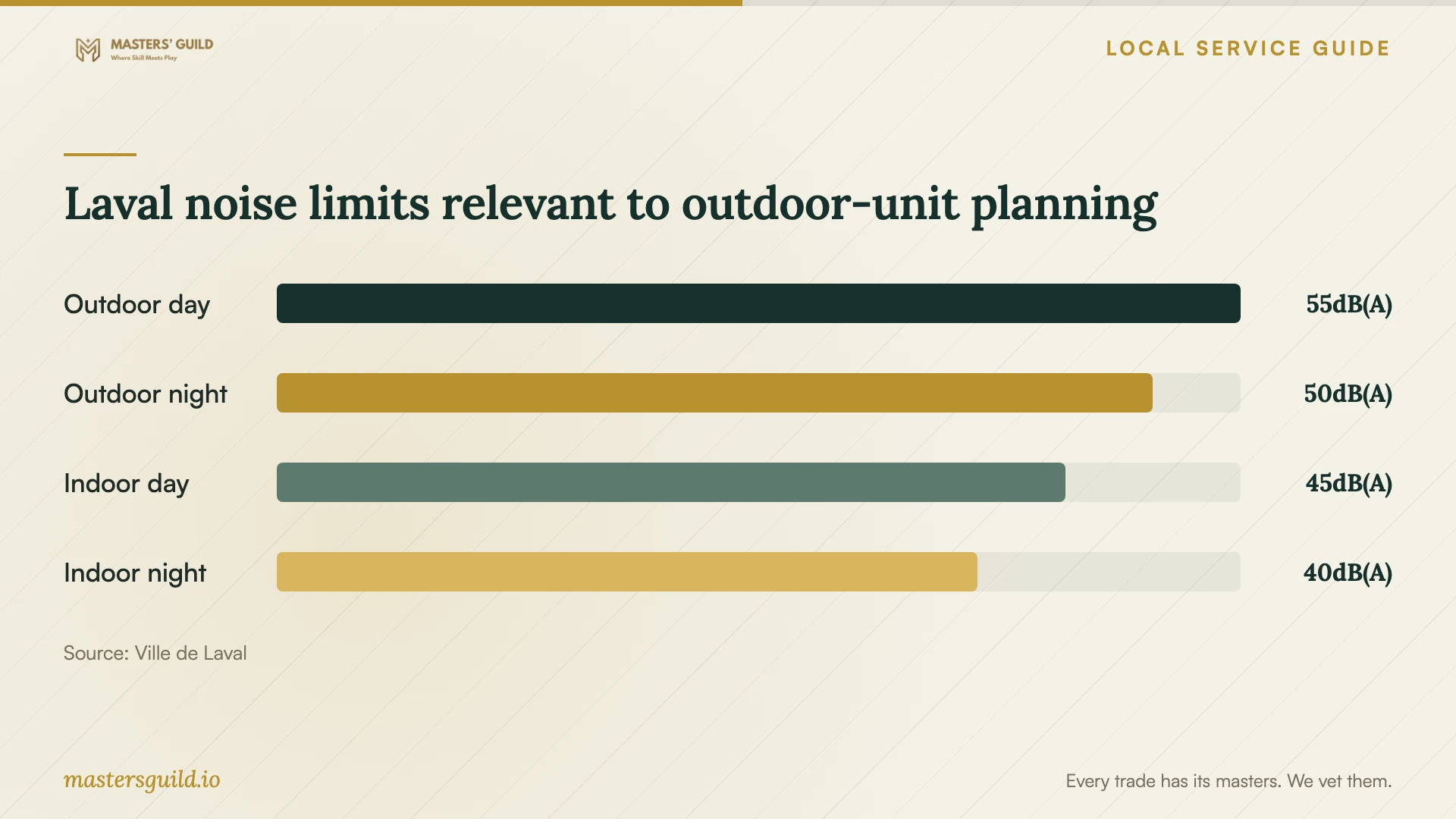
Laval noise limits relevant to outdoor-unit planning
Local details that affect your job
Check the address before scheduling exterior work
Laval directs owners to check permit requirements before exterior renovations. Its Info-règlements address search identifies applicable PIIA architectural-review provisions. Ask the city about your proposed equipment location and associated exterior changes before fixing the installation date. If the work requires a permit, Laval instructs you to wait for issuance before starting. [1]
Plan around noise at neighbouring living spaces
Laval regulates air-conditioner noise. From 21:00 to 07:00, it lists maximum levels of 50 dB(A) in outdoor leisure or relaxation spaces and 40 dB(A) inside occupied rooms, excluding garages. Discuss the proposed unit location and affected spaces with the installer. Ask how the installer will assess compliance rather than relying on an equipment rating alone. [2]
Keep the records for Laval’s oil-conversion grant
Laval lists CAD 2,000 for an eligible single-family home replacing oil-only heating, or CAD 1,000 for an oil-and-electricity dual-energy system. The replacement must use electricity alone or renewable energy; natural gas and propane replacements do not qualify. Complete the work before applying through Mon dossier. Retain the requested oil-purchase, electricity, equipment, installation and disposal records, and confirm eligibility before budgeting the grant. [3]
Choose the next step for your project
| Your situation | Next step | Point to resolve |
|---|---|---|
| Existing equipment has a fault | Arrange a diagnostic visit | Agree on visit charges and approve the repair price before work proceeds. |
| A central heat-pump bidder has a different licence combination | Confirm the actual scope with RBQ | Provincial conversion guidance and LogisVert installer conditions list different combinations. |
| You plan a heat-pump purchase | Check the complete equipment combination | Confirm eligibility before including LogisVert in your budget. |
| An outdoor unit will sit near living spaces | Review placement and noise with the installer | Account for Laval’s daytime and nighttime limits. |
| You plan to remove oil heating | Include dismantling and disposal records in the scope | Laval requests tank-disposal certification for its grant. |
Your hiring checklist
- Send model numbers, fault details and photographs before the service visit.
- Agree on diagnostic, travel and after-hours charges before booking.
- Confirm the required licence subclasses with RBQ for your actual scope.
- Identify the businesses performing installation, refrigeration and electrical work.
- Compare exact equipment models, itemized work and exclusions.
- Resolve outdoor-unit placement, noise assessment and municipal requirements.
- Check grant conditions before purchase and retain invoices and equipment photographs.
- Record warranties, startup responsibilities and the contact for return service.
Frequently Asked Questions
Which licence combination should I accept for a central heat pump?
Confirm the required subclasses with RBQ for your actual work before hiring or rejecting a bidder. Québec’s oil and propane conversion guidance lists 15.1 plus either 15.9 or 15.10. LogisVert’s installer conditions allow one of 15.1, 15.7 or 15.8 plus either 15.9 or 15.10 for central and wall-mounted installations. Check grant eligibility with LogisVert separately. [4] [5]
How should I check municipal requirements before installation?
Ask Laval about the complete scope and equipment location at your address. The city provides an Info-règlements search for PIIA provisions and directs owners to check exterior-work permit requirements. Discuss noise compliance with the installer as part of placement planning. [1] [2]
Can I claim LogisVert for replacing only the outdoor unit?
Hydro-Québec excludes replacement of a single indoor or outdoor unit, as well as a single coil. Ask for separate repair and complete-system proposals if you want to compare those options. [4]
Does Laval’s oil-heating grant cover conversion to natural gas?
No. Laval excludes natural gas and propane replacements. Its program covers eligible conversions to electricity alone or renewable energy, subject to dwelling, contractor and documentation conditions. [3]
Sources and scope
This guide combines the sources below with practical planning guidance. Figures apply to the stated geography and period; request a written quote for your property.