
Local service guide
Warehouse Organization in Kitchener, ON
For Warehouse Organization in Kitchener, hire an organizing crew for sorting, stock locations and labels, and ask for a separate scope for hauling or rack changes. Before approving changes to mechanically loaded racks, establish whether you need an engineer’s pre-start health and safety review or documented exemption. Ontario identifies new rack installation and modifications in factories as review triggers, and Kitchener provides a separate industrial and commercial permit inquiry process. [1] [4]
Define the organizing job before choosing a crew
Start with a walkthrough and identify the problem you want the crew to solve. Mark receiving, active picking, reserve stock, returns and items awaiting a disposal decision. Choose a manager who can approve stock moves and write-offs during the work. Ask bidders to describe the finished layout and their method for recording each changed stock location.
Separate sorting and labeling from equipment operation, rack installation and waste removal in the quote. Ask who will supply bins, labels and scanners, who will update your inventory records, and who will handle elevated stock. Request evidence of insurance covering the proposed commercial work and identify any subcontractors before agreeing to the schedule.
Resolve rack changes before moving stock
Ontario’s rack guidance covers structures designed for mechanical loading, including industrial pallet racks and cantilever racks. In factories, installing a new rack or modifying an existing one triggers a pre-start health and safety review requirement unless an exemption applies. Changes to lift trucks or loads outside the original design parameters may also trigger a review. An engineer must conduct an Item 3 review. [4]
Ask the rack supplier or engineer to identify the documentation that supports the proposed arrangement. Ontario lists capacity information, structural drawings, component identification and installation instructions among acceptable exemption documents. Documentation for individual components may not establish that the assembled rack system qualifies. The province also states that a building permit does not replace a required review or exemption. [4]
For light shelving intended for low-weight storage and hand loading from the ground, Ontario excludes the shelving from Item 3 review requirements. That exclusion does not establish a shelf’s capacity or condition. Keep damaged equipment outside the organizing crew’s routine reset scope and ask the appropriate supplier or specialist to assess it. [4]
Compare complete quotes and plan the shutdown
Request separate amounts for labor, storage products, equipment, hauling and disposal. For an hourly quote, ask for the crew size, billable hours, minimum charge and a spending limit that requires your approval to exceed. For a fixed quote, record the stock volume, work area, exclusions and process for approving extra work.
Ask each bidder to propose a sequence that fits your receiving and dispatch commitments. Reserve a staging area and agree which zones can close during the reset. Decide how staff will find urgent orders while stock moves. Include a reconciliation step before the crew leaves so your team can check labels against the location list.
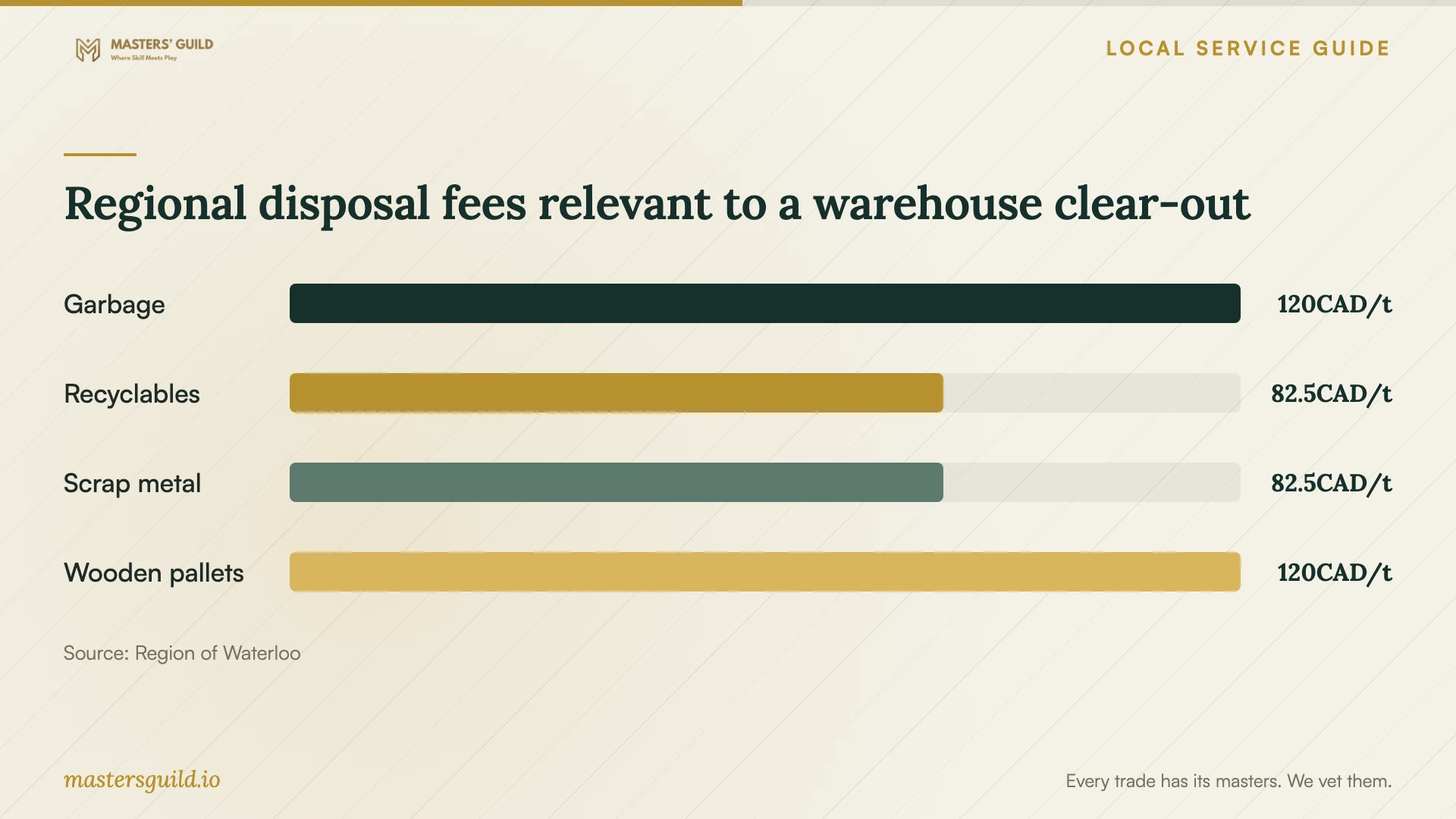
Use the published disposal fees below to review the hauling allowance. Treat them as regional facility charges, not an organizing service price. Ask the hauler to identify the material categories, expected load weight, destination and any separate transport or handling charges. [3]
Sort outgoing materials before the haul
Assign someone from your business to approve disposal before the crew loads anything. Separate usable stock, returns, recycling and garbage, and photograph items awaiting approval. For wooden pallets going to regional sites, remove metal or plastic banding, plastic wrap and other garbage; the Region lists those exclusions for its pallet stream. [3]
Identify chemicals and other potentially hazardous materials before requesting a clear-out quote. Regional sites cannot receive hazardous waste from industrial or commercial sources. The Region also requires disposal approval for certain manufacturing by-products and construction or demolition wastes. Ask the hauler to confirm an appropriate destination before including those materials in the job. [2]
Regional disposal fees relevant to a warehouse clear-out
Local details that affect your job
Use Kitchener’s industrial and commercial permit process
Before booking rack alterations or related construction, send the City your proposed scope to confirm permit requirements and application documents. Kitchener accepts industrial, commercial and institutional applications through its online portal and directs permit-requirement questions to staff by email. The City requires qualified design professionals for submitted plans. Its promised contact within two business days after a portal application is a status update, not permit approval. [1]
Schedule a business haul using commercial hours
For waste generated at your Kitchener premises, the Region lists commercial sites at 201 Savage Drive in Cambridge and 925 Erb Street West, Gate 1, in Waterloo. Both list weekday hours of 7 a.m. to 5 p.m. Waterloo also accepts commercial customers on Saturdays from 7 a.m. to 3 p.m.; Cambridge closes to commercial customers on Saturdays. Confirm holiday access before scheduling a haul. [2] [3]
Match the scope to the work
| Proposed work | Who to involve | Question before booking |
|---|---|---|
| Sorting, labels and stock locations | Organizing crew and your inventory lead | Who approves moves and updates inventory records? |
| Light shelving loaded by hand from the ground | Organizing crew; supplier for capacity questions | Does the work stay within Ontario’s light-shelving exclusion from Item 3? |
| New or modified mechanically loaded racks in a factory | Rack supplier or installer and an engineer as required | Who establishes the PSR requirement or documented exemption? |
| Rack alterations or related construction | City permit staff and a qualified designer as needed | What permit and drawing requirements apply to this scope? |
| Commercial clear-out | Hauler with a confirmed disposal destination | Which streams need separation, special approval or another destination? |
Your hiring checklist
- Photograph the work area and supply a stock list with dimensions and handling needs.
- Mark stock that staff must approve before relocation or disposal.
- Collect rack capacity information, drawings and supplier instructions for specialist review.
- Agree who operates lifting equipment and handles elevated stock.
- Request itemized labor, products, equipment, hauling and disposal charges.
- Reserve staging space and agree receiving and dispatch arrangements during the reset.
- Check the location list, labels and remaining disposal items with the crew before sign-off.
Frequently Asked Questions
Can an organizing crew move pallet-rack beams?
Treat beam relocation as a rack modification requiring assessment before work. Ontario identifies modifications to mechanically loaded racks in factories as PSR triggers unless an exemption applies. Ask the supplier or engineer to resolve the review and documentation requirements, and use installers with adequate rack assembly training. [4]
Does a building permit cover the rack safety review?
A building permit does not override the requirement for a pre-start health and safety review or documented exemption. Ontario notes that permit documentation may help support either process. Confirm the permit scope with Kitchener and resolve the rack review with the appropriate specialist. [1] [4]
Can we use residential drop-off hours for a business clear-out?
Use the commercial schedule. The Region distinguishes residential and commercial hours, with Saturday commercial access at Waterloo and no Saturday commercial access at Cambridge. Give your hauler the vehicle details and confirm the destination, gate and operating hours before loading. [2] [3]
What should the crew leave at handover?
Specify a location map, updated stock location list, readable labels and a list of unresolved items. Walk through receiving, picking and returns with the crew leader. Ask staff to locate sample items using the new system before accepting the work.
Sources and scope
This guide combines the sources below with practical planning guidance. Figures apply to the stated geography and period; request a written quote for your property.