
Local service guide
Science and Math Tutoring in Kitchener
Arrange Science and Math Tutoring in Kitchener by matching the tutor to your child's grade, course and current difficulty, then agree on a trial session, written costs and a way to review progress. Send a recent assignment before booking. If you plan to meet at a library, confirm permission for paid tutoring with staff before committing to that location.
Match the tutor to the work your child needs to do
Start your enquiry with the grade, course code, teaching language and a concrete difficulty. For math, describe whether your child needs help understanding fractions, choosing a method, showing algebra steps or interpreting a word problem. For science, distinguish understanding concepts from calculations, graphing and explaining experimental results. Ask your child to identify a task they want to handle with less help.
Kitchener-Waterloo Collegiate's course descriptions illustrate why this matters. Grade 9 SNC 1WI includes biology, chemistry, physics, and Earth and space science, with research, experimentation and engineering design. Grade 11 SCH 3UI includes chemical reactions and quantitative relationships; SPH 3UI includes motion, forces and energy. Ask a candidate to demonstrate teaching relevant to the student's course, and confirm current assignments with the classroom teacher. [2]
Check qualifications and agree on session boundaries
If a candidate claims Ontario teacher certification, request the name they use in the Ontario College of Teachers register. The College says its Find a Teacher register includes qualifications, membership status, terms, limitations and conditions, and disciplinary history where applicable. Compare the entry with the candidate's claims. A credential check should accompany your assessment of how the tutor teaches the particular subject. [4]
Ask other candidates about their subject education, relevant tutoring work and references you can contact. During a trial, ask the tutor to let your child attempt a problem, explain their reasoning and correct an error. Agree on parent communication, supervision, online messaging and any recording before sessions begin. Share only the schoolwork and personal information needed for the teaching plan.
Choose a meeting place you can sustain
For home sessions, prepare a table where a parent or caregiver can remain nearby. For online sessions, test sound, the camera and how the student will share handwritten work. For an outside meeting, include travel and pickup arrangements in your plan. Ask the student which setting lets them speak, make mistakes and ask for help without feeling rushed.
Kitchener Public Library offers free study-room bookings, but the reservation rules require planning: you need a library card and can reserve at most two days in advance. The library also warns that rooms may have background noise. Its study-room page does not establish permission for paid tutoring, so ask staff about your intended use before arranging a session there. [1]
Compare written quotes before committing
Request the total price for the proposed session length, the number of students and the meeting format. Ask whether preparation, materials, travel or applicable tax adds to the bill. Get cancellation, rescheduling and package-refund terms in writing. Compare quotes for the same arrangement, and ask whether you can purchase a trial before paying for a longer package.
Agree on a review point and a specific learning goal, such as solving an equation and explaining each step without prompts. Ask the tutor to record what your child attempted, where they needed help and what to practise next. Review comparable work with your child before extending the arrangement. Request a revised approach if the sessions focus on finishing homework without checking understanding.
Use regional math results as context
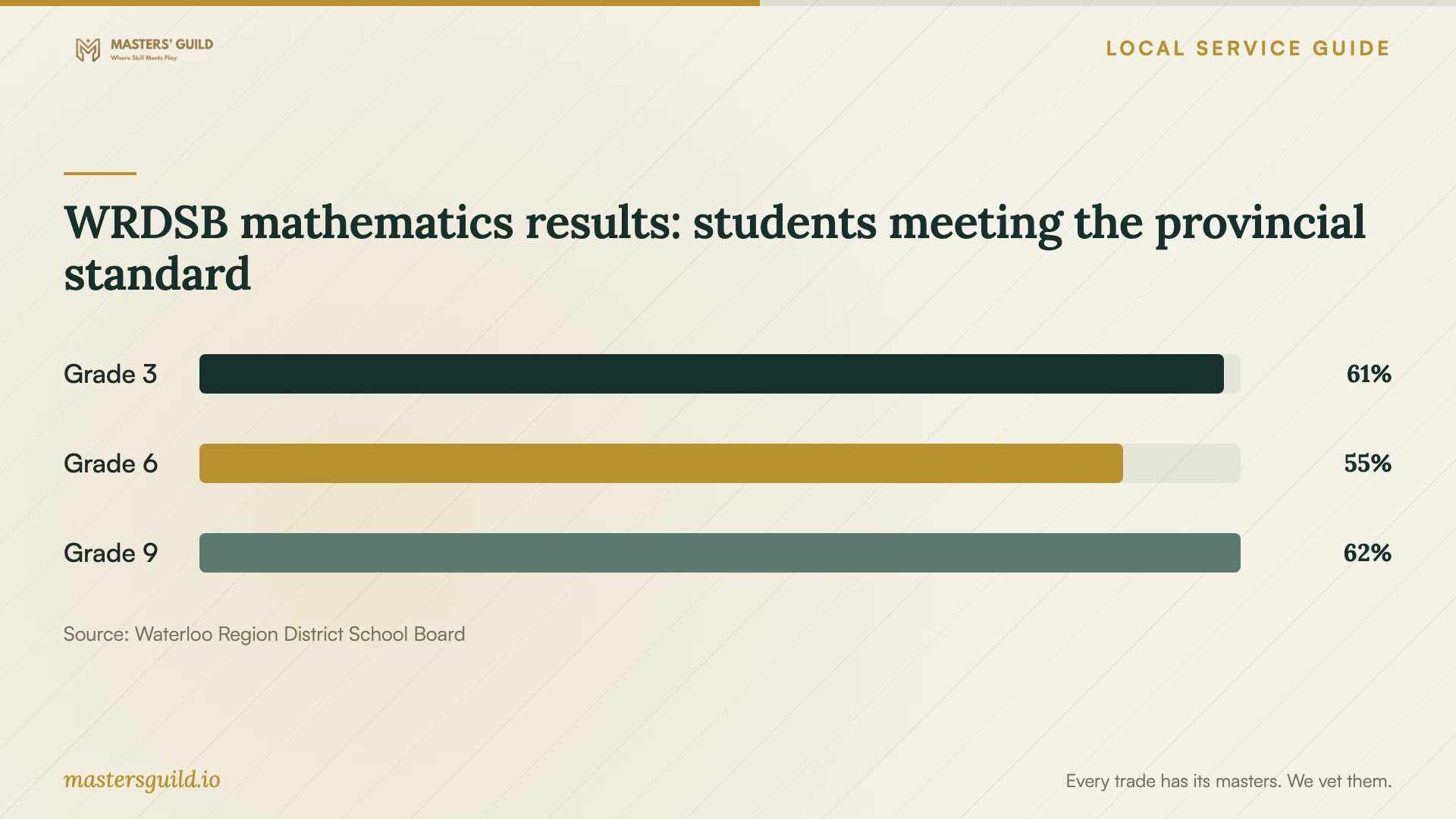
WRDSB reported that 61% of Grade 3 students, 55% of Grade 6 students and 62% of Grade 9 students met or exceeded the provincial mathematics standard in the 2025–2026 EQAO assessments. The board defines that standard as achieving level 3 or 4. These are board-wide results, not Kitchener-only figures or a measure of your child's needs. [3]
Use your child's marked work and teacher feedback to decide what support to request. Ask the teacher which concepts need attention and what support you should explore at school. WRDSB describes math facilitators and intervention teachers working with classroom educators to support individual learning needs. Ask your school how that support applies to your child before choosing a private tutoring plan. [3]
WRDSB mathematics results: students meeting the provincial standard
Local details that affect your job
Country Hills and Stanley Park have school-day restrictions
Country Hills Library's six-person SMHS study room opens for reservations after 4 p.m. on school days; its two-person Study Pod is available during open hours. Grand River Stanley Park Library's three-person GRCI room opens after 3 p.m. on school days. Confirm paid-tutoring permission and choose a time that meets the branch's room restrictions. [1]
Central Library offers different room access options
At Central Library, rooms 1–4 accommodate up to four people and operate first come, first served. Rooms 5–7 accommodate up to six and require reservations, with a limit of two hours a day. Staff cancel a reservation if you miss the 15-minute arrival grace period. For a fixed tutoring appointment, confirm intended-use permission, reserve an eligible room and plan time to check in. [1]
Bring the KCI science course code
KCI separates Grade 11 university-preparation biology, chemistry and physics in its course descriptions. Its chemistry course includes solutions and quantitative relationships, while physics includes kinematics and electricity. Send the course code and current unit to prospective tutors so they can explain their relevant subject knowledge before you pay. [2]
Choose a tutor and session arrangement
| Your situation | What to request | Before booking |
|---|---|---|
| Your child struggles to explain math steps | A trial using current classwork, with the student explaining each step | Agree on a specific skill to practise and review |
| Your child takes KCI senior science | Teaching matched to the course code and current unit | KCI distinguishes biology, chemistry and physics; check the candidate's subject fit |
| A candidate claims Ontario teacher certification | Their registered name and relevant teaching qualifications | Compare qualifications, membership status and any conditions in the College register |
| You want library sessions | A location plan with a backup | Confirm paid-tutoring permission; KPL reservations require a library card and allow at most two days' advance booking |
| You are considering a prepaid package | A written total and refund, cancellation and rescheduling terms | Ask to complete a trial before committing |
Your hiring checklist
- Collect the course code, current unit, recent marked work and teacher feedback.
- Write one learning goal with your child and describe the help they need.
- Ask each candidate to explain a relevant sample problem.
- Verify any claimed teaching credential and contact references.
- Confirm supervision, communication and meeting arrangements.
- Obtain session costs, extra charges and cancellation terms in writing.
- Book a trial and agree on how you will review progress.
Frequently Asked Questions
How should I compare tutoring prices?
Ask for written quotes covering the same subject, session length, group size and format. Include preparation, materials, travel and any applicable tax in the comparison. These sources do not provide verified local tutoring rates, so obtain current quotes rather than treating an advertised starting price as your final cost.
Can we use a library study room for paid tutoring?
Confirm that use with library staff first. KPL's study-room page describes free room bookings and reservation rules but does not establish permission for commercial tutoring. You need a library card to reserve and can book at most two days ahead. [1]
How can I check a tutor's claimed teacher certification?
Ask for their registered name and compare their claims with the Ontario College of Teachers public register. The College lists qualifications, membership status, conditions and disciplinary history where applicable. Also assess their ability to explain your child's current work. [4]
Do the regional EQAO results mean my child needs tutoring?
Use your child's work and teacher feedback to make that decision. WRDSB describes EQAO as one measure among the data it uses to support learning. Its board-wide results do not assess your individual child or demonstrate the benefit of private tutoring. [3]
Sources and scope
This guide combines the sources below with practical planning guidance. Figures apply to the stated geography and period; request a written quote for your property.