
Local service guide
HVAC Services in Kitchener: Hiring and Permit Guide
For HVAC Services in Kitchener, start with a written diagnosis or replacement scope, check the contractor’s credentials for the work, and assign permit and inspection responsibilities before booking. For a heating-system change, the City requires a permit, a BCIN HVAC designer’s form and heat-loss/heat-gain calculations. For gas work, check the business’s TSSA registration and the technician’s applicable certification. [1] [4]
Choose a diagnostic visit or a replacement assessment
Tell the contractor whether you need a fault diagnosed, routine maintenance, or a replacement proposal. Describe the symptoms, affected rooms, thermostat settings and any displayed fault code. Send equipment-label photos if you can reach the labels without opening equipment. Ask what the visit includes and whether the contractor credits its diagnostic charge toward an approved repair.
For a repair, request the diagnosed fault, proposed part, labour charge and repair warranty in writing. For replacement, ask the contractor to explain the proposed capacity, duct changes, thermostat compatibility and removal of existing equipment. Compare a repair option with a replacement proposal when you need help deciding; ask each contractor to explain the reasons for its recommendation.
For a natural gas emergency, call 911, as Kitchener Utilities directs. Treat that situation separately from arranging an ordinary service appointment. [2]
Check credentials for the actual scope
For fuels-related work, check both the company and the person doing the job. TSSA registers fuels contractors and certifies individuals who work on regulated equipment. Registered contractors must employ certificate holders appropriate to the work. Ask for the business’s registration details and the attending technician’s applicable certificate before approving gas-furnace work. [4]
Ask who will perform each part of the installation and request proof of insurance. If the quote includes subcontracted gas work, identify those businesses too. TSSA states that a contractor arranging work and the contractor receiving the subcontract must meet the appropriate registration and certification requirements. [4]
Put design, permits and inspections in the quote
The City says you need a permit to change your HVAC heating system. Its application requirements include an application form, a Schedule 1 form completed by a BCIN HVAC designer, and heat-loss/heat-gain calculations prepared by a BCIN designer or professional engineer. Ask the installer to identify who prepares these documents and who submits the application. [1]
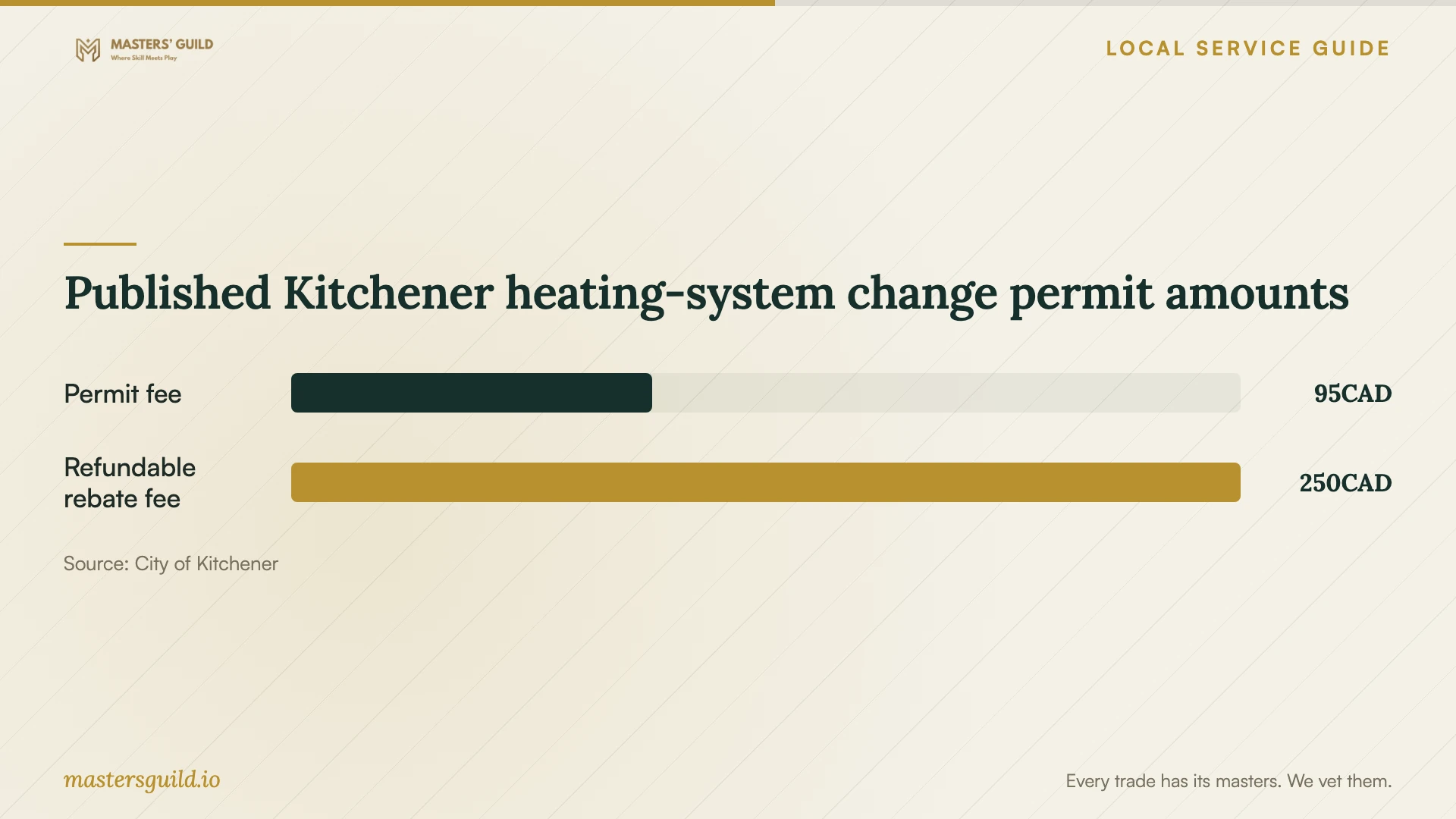
The City lists a $95 permit fee per residential suite plus a $250 rebate fee, which it refunds when the final building inspection receives approval. Confirm who pays the fees, who receives the refund and who arranges the final inspection. For uncertainty about your precise scope, contact the Building Division at 519-741-2312. [1]
Do not treat the City’s application-review period as a guaranteed installation date. The City publishes an initial review period of 10 business days and may request missing information. It states that further reviews have no legislated timeframe. Ask your contractor to distinguish its proposed installation date from the permit-review schedule. [1]
Resolve outdoor placement and fuel changes first
Before accepting an outdoor-unit location, have the contractor measure from the gas meter and regulator. Kitchener Utilities requires at least three feet of separation from heat pumps and air conditioners, along with opening doors and windows, dryer vents and fresh-air intakes. The utility also requires a visible, accessible meter and prohibits placement behind a house, bushes, gate or fence. [2]
If you are adding natural gas service, ask the heating contractor to coordinate the application, inside piping and meter readiness. Kitchener Utilities publishes about six to eight weeks from application for service installation, or up to six months on a regional road. Before requesting the meter set, its prerequisites include installed service and equipment, working electricity and a posted pressure-test tag. [3]
If you plan to stop using gas, confirm the consequences with the utility before authorizing removal. Kitchener Utilities states that it will disconnect and abandon the service when there is no intention to use gas in the near future. Returning to gas would then require new service and applicable new-service and previous-disconnection fees. [3]
Compare the complete installed scope
Ask competing contractors to price the same scope: equipment model and capacity, labour, controls, duct changes, electrical work, disposal, design documents, permits and inspection coordination. Request separate prices for optional work. Record taxes, payment stages, exclusions and the procedure for approving extra charges.
Use the published municipal amounts below as specific budget items. Obtain property-specific quotes for equipment, installation and utility work rather than treating these fees as a total HVAC price. Before the crew leaves, request operating instructions, warranty documents and a written list of outstanding inspection or follow-up tasks. [1]
Published Kitchener heating-system change permit amounts
Local details that affect your job
Heating-system changes need design paperwork
Ask prospective installers to include a BCIN HVAC designer’s Schedule 1 form and the required heat-loss/heat-gain calculations in their scope. Kitchener lists both for a heating-system change permit, so clarify responsibility before choosing an equipment package. [1]
Meter clearance can change your equipment location
Have the installer show the proposed heat-pump or air-conditioning location relative to the gas meter and regulator. The utility’s three-foot separation requirement can affect the layout; resolve placement before approving installation. [2]
New gas service needs a separate schedule
For a conversion to gas, confirm the utility schedule before agreeing to remove your existing heat source. The published service-installation timeframe reaches up to six months on regional roads, and the utility requires preparation before setting the meter. [3]
Match your project to the next step
| Your project | Next step | Confirm before booking |
|---|---|---|
| Fault diagnosis | Arrange a diagnostic visit | Visit charge, written findings and repair-approval process |
| Heating-system change | Assign permit and design responsibilities | BCIN designer form, heat-loss/heat-gain calculations and final inspection |
| Heat pump or AC near a gas meter | Have the installer measure the proposed location | At least three feet from the meter and regulator |
| Conversion to natural gas | Coordinate the utility application with the contractor | Service-installation timing and meter-set prerequisites |
| Ending gas use | Discuss removal and future use with the utility | Whether service abandonment and future reconnection costs apply |
Your hiring checklist
- Record symptoms, fault codes, equipment models and access constraints.
- Confirm the diagnostic charge and how you will approve repairs.
- Check fuels-contractor registration and the technician’s applicable certificate for gas work.
- Assign design-document, permit-payment and inspection responsibilities in writing.
- Have the contractor measure the proposed outdoor-unit location against meter clearances.
- Confirm utility coordination before a fuel conversion or gas-service removal.
- Compare itemized scopes, exclusions, warranties and payment stages.
Frequently Asked Questions
Does a heating-system replacement need a permit?
Kitchener states that changing an HVAC heating system requires a permit. Its listed requirements include a BCIN HVAC designer’s Schedule 1 form and heat-loss/heat-gain calculations. Ask the Building Division about your exact scope rather than assuming the same process applies to a repair or cooling-only project. [1]
What should I check before hiring someone for gas-furnace work?
Check the business’s TSSA fuels-contractor registration and ask for the technician’s applicable certificate. TSSA requires registered fuels contractors to employ appropriately certified technicians for regulated equipment. [4]
Can I put a heat pump beside my gas meter?
Kitchener Utilities requires at least three feet between the gas meter/regulator and a heat pump or air conditioner. Ask the installer to measure the proposed placement and identify any other applicable installation requirements. [2]
How long should I allow for a new gas connection?
Kitchener Utilities publishes about six to eight weeks from application, with up to six months for addresses on regional roads. Confirm your address-specific timing with the utility and ask the contractor to coordinate equipment installation and meter readiness. [3]
Sources and scope
This guide combines the sources below with practical planning guidance. Figures apply to the stated geography and period; request a written quote for your property.