
Local service guide
Warehouse Organization in Jacksonville, FL
Arrange Warehouse Organization in Jacksonville by defining the stock to sort, the locations to label, and the operations that must continue during the work. Ask providers to separate organizing labor, equipment, supplies, and hauling in their quotes. Before approving a storage redesign or relocation, check the building and fire-review implications: Jacksonville includes warehouse storage arrangements in its construction life-safety review and requires a converting-use permit when the building’s use or occupancy classification changes. [1] [4]
Define the reset before choosing a crew
Start with a written description of the problem: misplaced stock, mixed returns, crowded receiving space, or labels that staff cannot follow. Mark the zones you want the provider to handle and identify anything your staff must count or approve before someone moves it. Name one person who can authorize disposal and settle inventory questions during the job.
Request specific deliverables: sorted stock, assigned storage locations, readable location labels, a list of unresolved items, and a handover with your staff. Ask whether the provider will reconcile location changes with your inventory records. Agree on the label format before buying supplies, especially if staff use scanners or existing location codes.
Match the provider to the physical work
Describe stock weights, storage heights, loading access, and equipment needs when requesting quotes. Ask who will move pallets, who will operate equipment, and who will supervise work around active warehouse traffic. Request evidence of insurance appropriate to the agreed work and ask the provider to identify any subcontracted hauling or installation.
Separate sorting and labeling from proposed racking, construction, or fire-system work. For proposed construction, Jacksonville reviews paths of travel, building layout, required fire systems, and warehouse storage information. Ask the owner and the appropriate design professional to resolve review requirements before you approve a new arrangement. [1]
Compare quotes by scope and handover
Ask each provider to state crew size, scheduled hours, equipment charges, supplies, hauling, and exclusions. For an hourly proposal, clarify whether the rate applies to each worker or the whole crew. For a fixed proposal, list the zones and deliverables it covers, along with the approval process for extra work.
Choose a work sequence around your receiving and dispatch commitments. Consider completing a trial zone before approving the remaining layout and labels. At handover, walk through the finished area with a staff member who uses it: locate a sample item, check its recorded location, and confirm where returns and unidentified stock belong.
Arrange the purge and hauling
Create separate lists for stock you will retain, return, recycle, or discard. Ask the hauler to confirm which materials it accepts and how it will charge for containers, transport, and disposal. Require your approval before the crew removes saleable inventory, customer property, or records.
Jacksonville does not provide commercial dumpster service. For waste other than construction and demolition debris and recycled materials, the city says the collection company must hold a city franchise. Small commercial city-service accounts must arrange their own disposal of appliances, tires, and building materials. [2]
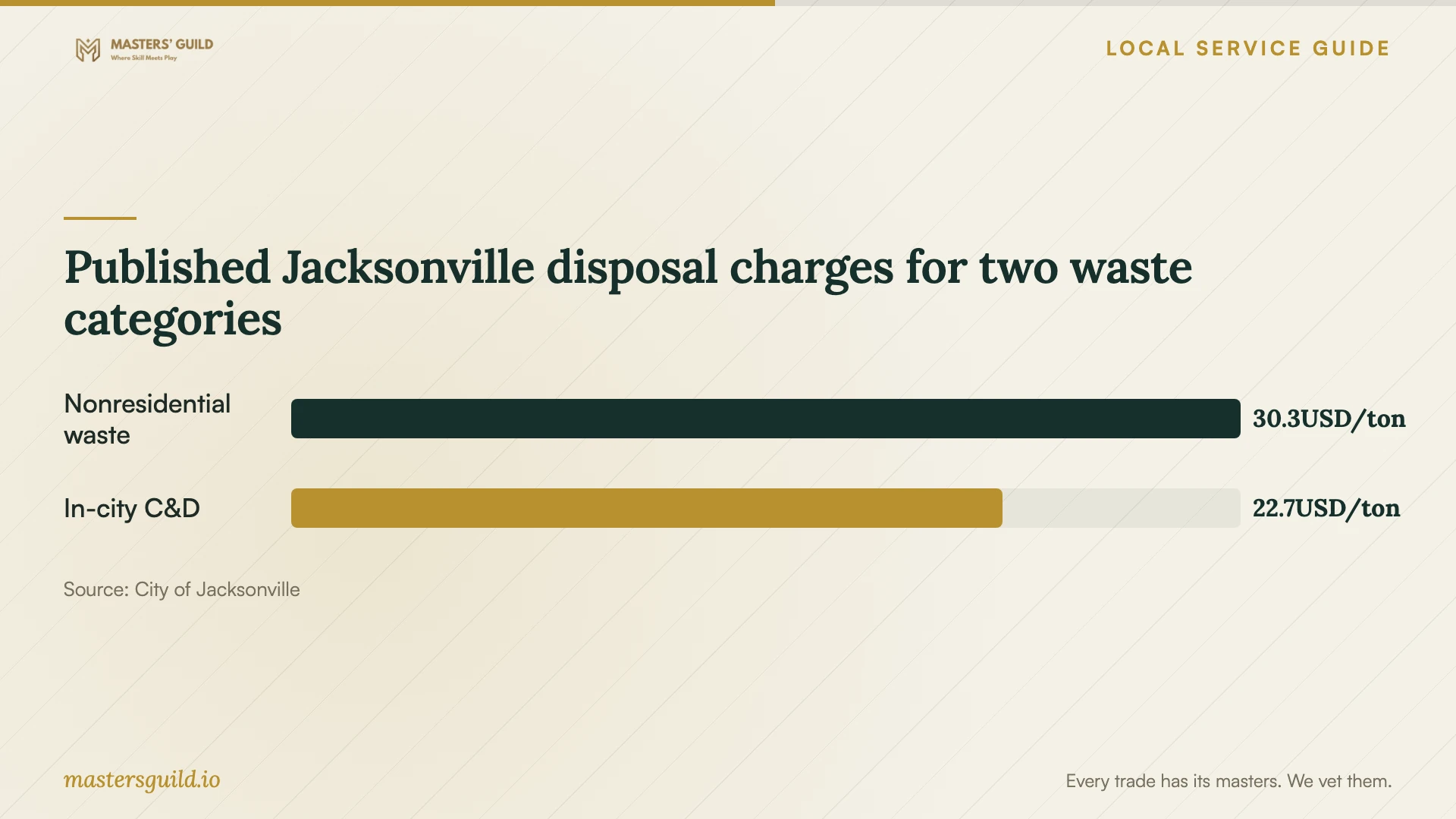
Use the published disposal figures below to question a disposal allowance. Ask the provider to identify the intended facility, waste classification, expected quantity, and any separate transport charge. Confirm acceptance and applicable charges before loading the vehicle. [3]
Check the premises before a relocation
Before buying or leasing warehouse space, Jacksonville advises checking the intended use with the Building Inspection Division. Suitable zoning alone does not establish the correct Building and Fire Code occupancy classification. The city requires a converting-use permit if that classification changes, and a Certificate of Use application for a new business, expansion, or change of use. [4]
For a converting-use permit, the city requires at least a life-safety plan and code summary from a Florida-licensed design professional. Have the owner resolve that scope before committing to a move-in reset. Ask the organizing provider to distinguish its stock-placement plan from any professional design or permit work you commission. [4]
Published Jacksonville disposal charges for two waste categories
Local details that affect your job
Storage information belongs in fire review
For proposed construction, Jacksonville requires reviewers to address storage information before building-permit issuance, including racking systems, material handling, storage arrangements, and special hazards. If your reset accompanies construction, give the owner and fire-protection engineer the proposed layout before the crew moves stock. [1]
Confirm commercial collection eligibility
Outside Downtown, Jacksonville limits its paid small commercial collection service to entities generating no more than one cubic yard of waste per collection. Downtown has separate collection procedures. Confirm your account and purge arrangements with Solid Waste at 904-630-2489 before assuming routine collection will cover the clear-out. [2]
Submit complete permit information
Jacksonville accepts permit application packages online and routes them through discipline reviews, including the fire marshal. For renovation plans, the city asks applicants to state when mechanical, electrical, or plumbing work will remain outside the project. Ask whoever prepares your plans to describe the full work scope. [4]
Choose the next step for your warehouse project
| Project situation | Next step | Clarify before booking |
|---|---|---|
| Sort and label stock within the existing arrangement | Request an organizing scope with defined zones and deliverables. | Who approves stock movements and updates inventory locations? |
| Redesign storage during proposed construction | Coordinate storage information with the owner and fire-protection design professional. | Who will supply racking, material-handling, and storage-layout information for review? |
| Move into space with a different occupancy classification | Resolve the converting-use permit and professional plan requirements. | Who handles the life-safety plan, code summary, and Certificate of Use application? |
| Purge waste beyond the routine collection arrangement | Arrange commercial hauling and confirm accepted materials. | Does the hauler need a city franchise for this waste stream? |
Your hiring checklist
- Mark the work zones and photograph their starting condition.
- Identify stock that needs counting, special handling, or owner approval.
- Provide weight, height, equipment, and loading-access information to bidders.
- Approve a location-label format and a method for updating inventory records.
- Agree on receiving and dispatch access during the work.
- Name the person who can authorize disposal and additional charges.
- Confirm hauling acceptance, charges, and collection arrangements.
- Include a staff walkthrough and unresolved-item list in the handover.
Frequently Asked Questions
Should we check permit requirements before organizing?
Confirm requirements with the Building Inspection Division when your scope includes racking, construction, fire-system or occupancy changes. Describe the proposed work before including it in the organizing contract. Jacksonville includes warehouse storage arrangements in construction fire review and requires a converting-use permit when the use or occupancy classification changes. [1] [4]
Can the crew use our regular city waste collection?
Confirm eligibility and the materials first. Outside Downtown, the city’s small commercial service covers entities generating no more than one cubic yard per collection. Even participating accounts must arrange their own disposal of appliances, tires, and building materials. [2]
How much should warehouse organization cost?
Request itemized quotes for your warehouse’s scope. Give bidders the same zones and deliverables, then compare labor, equipment, supplies, hauling, and any separate design or permit work. Ask each provider to identify minimum charges and explain how you will approve additional work.
How should we schedule the work?
Give bidders your receiving and dispatch windows, staff availability, and zones that must stay accessible. Ask for a phased schedule and agree on a checkpoint after the first completed zone before the crew continues.
Sources and scope
This guide combines the sources below with practical planning guidance. Figures apply to the stated geography and period; request a written quote for your property.