
Local service guide
Warehouse Organization in Honolulu: Planning and Hiring
For Warehouse Organization in Honolulu, hire a crew against a written scope covering inventory sorting, storage locations, labels, equipment, and removal of unwanted stock. Separate organizing labor from rack alterations and regulated storage work. Before approving a layout, check fire access and agree on a destination for each waste stream. Honolulu publishes storage and exit requirements, and businesses or commercial haulers need a city account to dispose at Waimanalo Gulch. [1] [2]
Choose the scope before choosing the crew
Describe the result you want: staff can locate stock, receive deliveries, pick orders, and return goods to a named location. Give bidders a marked floor plan, photos, inventory categories, and the areas they may use for temporary staging. Identify stock that must remain available during the work.
Ask the organizer to distinguish sorting and labeling from moving loaded pallets, handling stock on upper racks, and altering racks. Request proof of insurance appropriate to the proposed work and identify who supplies handling equipment. For rack changes, ask who will assess the proposed configuration and load requirements before the organizing crew proceeds.
Put disposal authority in writing. Name the employee who can approve scrapping, recycling, donation, or relocation. Keep uncertain stock in a hold area until that person decides, and require approval before anyone removes business records, customer goods, or saleable inventory.
Compare complete quotes and arrange work around operations
Request separate amounts for planning, organizing labor, labels and bins, equipment, hauling, and disposal. Ask whether the provider charges by crew hour or project, which tasks the price covers, and how you will approve extra work. Use a quote for your premises rather than treating household organizing rates as a warehouse budget.
Agree on work windows around receiving and dispatch. Ask the provider to describe how staff will reach active inventory while the crew sorts another area. For a phased project, define the condition in which the crew must leave each zone before moving to the next.
Include a location map, a label convention, and a walkthrough with your staff in the handover. Test the proposed system with actual receiving and picking tasks before approving the remaining labels. Decide who will maintain the location list after the crew leaves.
Check usable storage space before buying supplies
Honolulu Fire Department’s inspection guide prohibits combustible storage in electrical and mechanical rooms, along with storage in exit stairwells and corridors. Mark these exclusions on the proposed layout before ordering shelving or assigning overflow stock. [1]
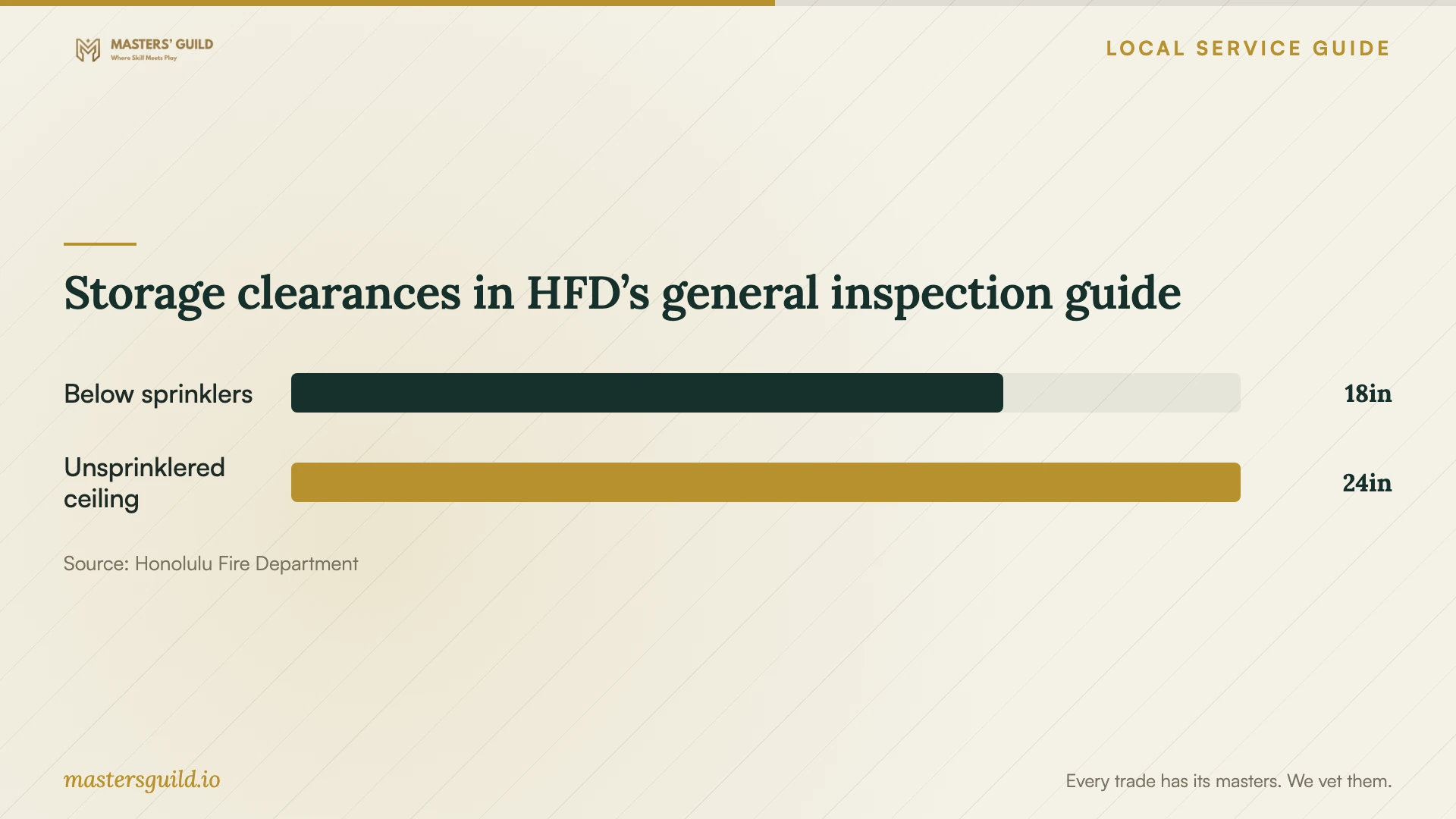
The inspection guide lists minimum clearances of 18 inches below sprinkler heads in sprinklered buildings and 24 inches below ceilings in buildings without sprinklers. HFD’s permit page identifies a newer fire-code adoption effective January 3, 2025. Treat the guide’s figures as planning references and confirm the applicable requirements for your stock and layout with HFD before increasing storage height. [1] [4]
Give the organizer details of chemicals, cylinders, and liquid storage before the walkthrough. HFD’s inspection guide requires secured compressed-gas cylinders and specifies a flammable-liquid storage cabinet when flammable or combustible liquid quantities exceed ten gallons. Ask HFD to resolve questions about your materials before approving their new locations. [1]
Plan removal before the cleanout starts
Honolulu identifies disposal restrictions or bans affecting cardboard, electronic waste, tires, auto batteries, white goods, and scrap metals, among other materials. Ask the hauler to name the receiving facility for each relevant stream and confirm acceptance before the crew loads it. [3]
Waimanalo Gulch requires businesses and commercial waste haulers to have a city disposal account. The landfill does not accept combustible waste, bulky items, tires, auto batteries, appliances, or scrap metals. Ask the hauler to revise any proposal that sends those materials there. [2]
Ask for removal charges, excluded materials, and disposal documentation in the quote. Reserve separate staging areas for recycling, approved discards, and items awaiting a decision. Confirm who will remove any rejected load and how you will approve that added expense.
Storage clearances in HFD’s general inspection guide
Local details that affect your job
Arrange access for an HFD inspection
To schedule a fire inspection, call the Fire Prevention Bureau at 808-723-7161. HFD requires an owner or representative to accompany the inspector and provide keys for locked spaces. If you are arranging an inspection alongside the reset, assign that representative and keep requested areas accessible. [1]
Separate tank work from the organizing contract
For flammable or combustible liquid tank installations, HFD requires DPP Zoning Division approval before the HFD permit application. Its application instructions call for plot and cross-sectional plans. If your reset includes this work, identify the party responsible for approvals and plans before setting the installation date. [4]
Check which recycling duties apply to the business
Honolulu requires specified recycling from liquor-serving establishments, large food establishments, and large office buildings. These category-specific duties do not establish an identical requirement for every warehouse. Ask the Recycling Branch at 808-768-3200 extension 6 about your operation; the city says a recycling specialist can help businesses requesting assistance. [3]
Match the work to the right scope
| Proposed work | Hiring or planning decision | Confirm before approval |
|---|---|---|
| Floor-level sorting and labels | Define an organizing scope | Zones, inventory authority, supplies, and handover |
| Loaded pallets or upper-rack stock | Specify handling tasks and equipment | Crew responsibilities, equipment, and insurance |
| Storage in corridors or service rooms | Revise the proposed layout | HFD prohibits corridor storage and combustible storage in electrical and mechanical rooms |
| Commercial cleanout | Require destinations by material | Landfill acceptance and the required city disposal account |
| Flammable-liquid tank installation | Arrange specialist and agency coordination | DPP zoning approval before the HFD permit application |
Your hiring checklist
- Mark the work zones, active inventory, receiving areas, and temporary staging space.
- Name one employee who can approve inventory disposal and location changes.
- Give bidders stock photos, approximate quantities, dimensions, and handling needs.
- Request separate prices for labor, supplies, equipment, hauling, and disposal.
- Confirm receiving facilities and acceptance arrangements for each waste stream.
- Assign responsibility for specialist review and any applicable approvals.
- Require a location map, label convention, and staff walkthrough at handover.
Frequently Asked Questions
How much should I budget?
Request a written quote for your premises. Ask bidders to separate organizing labor, materials, equipment, hauling, and disposal, then compare identical scopes. Set an approval limit for extra work and require the provider to explain exclusions before you accept.
Can the crew use the space above existing stock?
Confirm the applicable storage requirements before raising stock. HFD’s inspection guide publishes sprinkler and ceiling clearances, but those figures do not establish approval for a particular rack configuration or commodity. Ask HFD about the proposed layout. [1]
Can a hauler take everything to Waimanalo Gulch?
No. The landfill excludes combustible waste, bulky items, tires, auto batteries, appliances, and scrap metals. Businesses and commercial haulers also need a city disposal account. Require suitable destinations for excluded materials. [2]
What should I receive when the work finishes?
Specify a location map, consistent labels, an unresolved-inventory list, and a staff walkthrough. Ask the provider to demonstrate a receiving and picking task with your team, then record who will maintain the system.
Sources and scope
This guide combines the sources below with practical planning guidance. Figures apply to the stated geography and period; request a written quote for your property.