
Local service guide
Long-Distance Moving in Honolulu: Planning Guide
For Long-Distance Moving in Honolulu, compare written scopes, identify the companies handling pickup and delivery, and check the Hawaii household-goods motor carrier through the Public Utilities Commission. The commission regulates household-goods property carriers and provides active carrier records. For an inbound move with plants or pets, review entry requirements before committing to shipment and travel dates. [1] [2] [3]
Check the carrier handling your belongings
Ask the quoting company to name the businesses that will collect and deliver your belongings. Request their legal names and contact information in writing. If another company handles part of the move, establish who will answer questions about delays, missing items or damage.
The Hawaii Public Utilities Commission regulates property motor carriers, including household-goods carriers. Its responsibilities include certification and licensing, ratemaking and business regulation. Use its motor carrier page to reach active carrier records and check the Hawaii provider’s status. Limit that conclusion to the Hawaii motor carrier; ask for separate explanations of authority and coverage for other parts of your route. [1]
Before paying a deposit, keep the provider’s explanation of authority and coverage with your quote. For concerns involving the motor carrier, the PUC provides a way to report violations or submit a complaint. [1]
Compare the complete scope and delivery arrangements
Give each provider the same room-by-room inventory, addresses, preferred dates and packing instructions. Include photographs of large furniture and items you want the crew to dismantle or reassemble. Ask the provider to record inventory changes before you accept a revised price.
Request a written breakdown for collection, packing materials, transport, delivery and any storage you request. Ask whether delivery includes placement inside your home and who handles each transfer. Have the provider explain exclusions, changes to the shipment and charges for extra handling.
Describe stairs, elevator reservations, loading locations and building move-in instructions at both homes. Confirm arrangements with your building manager before promising the mover an appointment. Ask for separate pickup and delivery windows, then discuss what happens if you cannot accept the shipment within the proposed window.
Compare storage, redelivery, cancellation and payment terms alongside the quoted total. Ask who holds your belongings during storage and whom you should contact to arrange release. Keep essential medicines, documents and arrival-day supplies with you.
Decide which plants to bring into Hawaii
Hawaii requires inspection for all plants entering the state. Plants must appear free of insects and diseases. You can retain growing media, but it cannot contain soil. Review your plant list before asking the mover to include it in the shipment. [2]
For plants arriving by mail or cargo, label parcels Plant Materials or Agricultural Commodities. Include an invoice or packing manifest listing contents and quantities. Ask whether the mover accepts your plants and how it will keep labels and documents accessible for inspection. [2]
Check species restrictions before deciding to ship. Hawaii prohibits palm plants from the mainland United States. For orchids, the state requires a permit and certificate of origin for plants and propagative parts, with some plants requiring quarantine. Its orchid guidance lists seeds and deflasked tissue culture plants as unrestricted. Ask the Plant Quarantine Branch how the rules apply to your material. [2]
Coordinate pets with your arrival
Hawaii requires dogs and cats of all ages to meet its import requirements. Animals meeting the relevant requirements may qualify for direct release after inspection at Daniel K. Inouye International Airport. Animals that fail to meet all requirements for the 5 Day Or Less program can face quarantine for up to 120 days. [3]
Review the applicable Honolulu arrival checklist with your veterinarian before choosing a flight. The state lists minimum waits of 30 days after a successful FAVN rabies antibody test and 30 days after the most recent rabies vaccination for direct release. Ask your veterinarian to confirm the complete schedule and the requirements for your pet’s entry or re-entry. [3]
The state advises flight arrival by 3:30 p.m. Staff inspect dogs and cats from 8:30 a.m. to 4:30 p.m. daily, including weekends and holidays. Staff will not release pets that reach the airport holding facility after 4:30 p.m. that day. Plan accommodation and transport around a possible overnight hold. [3]
Arrange a vehicle that accommodates the intact crate with your pet inside. Owners must lift and transport released pets in their crates, and airport rules prohibit taking pets out of their crates on airport property. Keep these arrangements separate from your household-goods delivery appointment. [3]
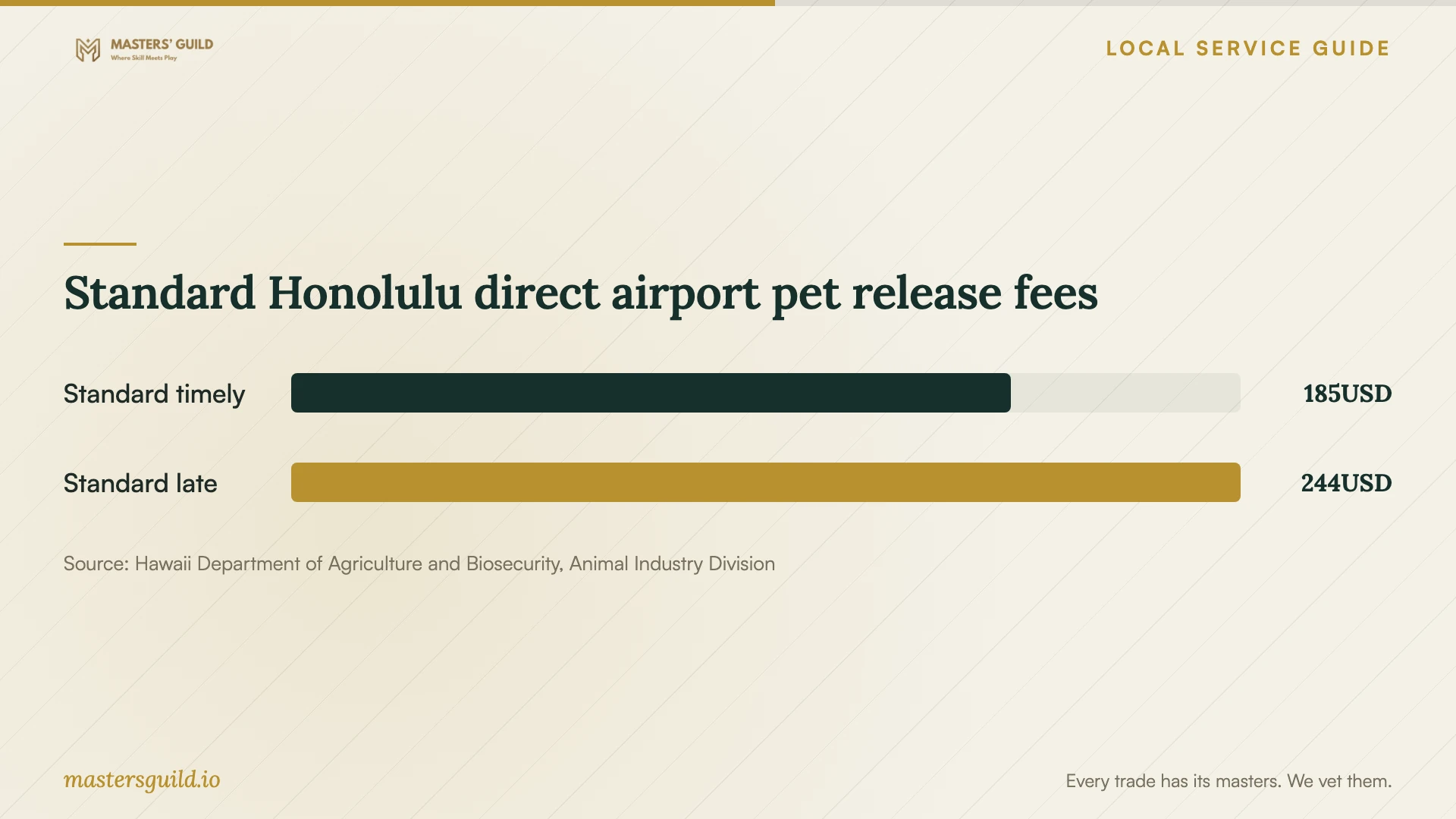
Standard Honolulu direct airport pet release fees
Local details that affect your job
Prepare inbound plant cargo before sealing it
Hawaii requires entry inspection, soil-free growing media, agricultural labeling for mail or cargo parcels, and a contents-and-quantities invoice or manifest. Check your species and prepare these documents before sealing the shipment. Confirm with the mover how you will accommodate inspection. [2]
Confirm the correct Honolulu pet release fee schedule
For standard Honolulu direct airport release, the state lists $185 per dog or cat when it receives documents at least 10 days before arrival, and $244 when it does not. Qualifying reduced-fee re-entry uses separate amounts: $98 with timely documents and $130 without them. Confirm your pet’s fee category, document receipt and release eligibility before travel. Payment alone does not establish eligibility. [3]
Resolve these questions before booking
| Your situation | Next step | Question to resolve |
|---|---|---|
| A company will handle Hawaii household-goods transport | Check its status through PUC active carrier records. | Which legal business will perform this part of the move? |
| You plan to ship plants into Hawaii | Review species restrictions, inspection and cargo documentation. | Will the mover accept these plants and accommodate inspection? |
| You plan to bring a dog or cat | Review the applicable Honolulu entry or re-entry checklist. | Which preparation dates and fee category apply to this pet? |
| You cannot accept delivery within the proposed window | Request written storage and redelivery terms. | Who will hold the shipment, and which charges would you authorize? |
Your hiring checklist
- Send the same inventory and requested services to each provider.
- Record the legal names and contacts of pickup and delivery companies.
- Check the Hawaii motor carrier through the PUC resource.
- Get written prices, exclusions, payment terms and cancellation conditions.
- Confirm building access, delivery windows and storage arrangements.
- Review plant eligibility and prepare cargo labels and documentation.
- Complete the applicable pet checklist and confirm the fee category.
- Arrange airport transport that accommodates your pet’s intact crate.
Frequently Asked Questions
How much should I budget for the move itself?
Request an itemized quote for your inventory, route and requested handling. Compare the same scope across providers. Budget for pet entry, travel and any storage you choose as separate items, and ask each provider to identify charges you might incur beyond the quoted total.
Can I pack houseplants with my furniture?
Check entry rules and obtain the mover’s agreement before packing. Hawaii requires inspection, soil-free growing media, cargo labeling and a contents manifest. Species restrictions also apply. For orchids, the state lists seeds and deflasked tissue culture plants as unrestricted, while other orchid material can require permits, certificates or quarantine. [2]
Will my dog or cat leave the Honolulu airport with me?
Direct release depends on meeting the state’s requirements and completing inspection. The state advises flight arrival by 3:30 p.m. Staff will not release pets that reach the holding facility after its 4:30 p.m. cutoff that day. Arrange a vehicle large enough for the pet inside its intact crate. [3]
Sources and scope
This guide combines the sources below with practical planning guidance. Figures apply to the stated geography and period; request a written quote for your property.