
Local service guide
Warehouse Organization in Halifax, NS
Arrange Warehouse Organization in Halifax by defining the stock to sort, the locations to label and the operations you must keep running. Ask providers to quote the same work and identify who will move pallets or reach stock on upper shelves. Nova Scotia requires competent lift-truck operators and appropriate equipment and training for hazardous lifting or moving. Confirm those arrangements before booking. [1]
Define the work before comparing providers
Write a brief that identifies the problem you want the crew to solve: mixed returns, unidentified cartons, overflow pallets or stock that staff cannot locate. Name the zones involved and decide who can approve disposal, stock adjustments and new locations. Ask the provider to inspect the space before committing to a whole-warehouse price.
Specify what the provider must hand over. Request a location map, readable bay and bin labels, an updated inventory-location file and a list of unresolved items. Agree on a sample label and test a small section with staff before applying the scheme across the premises.
Ask how the provider will handle heavy stock and items on upper shelves, and who supplies the equipment. Under Nova Scotia's Occupational Safety General Regulations, employers must provide appropriate equipment and training where lifting or moving presents a hazard. Employers must also ensure competent people operate lift trucks. [1]
Compare quotes by work and staffing
Request separate amounts for planning, sorting, physical moves, labels, storage products, inventory entry and removal of approved waste. For hourly work, ask whether the rate covers one worker or the crew, how many workers will attend and how the provider records time. Agree on a spending limit and a process for approving extra work.
Ask the provider to list equipment rental, delivery, travel, disposal and applicable tax as separate items. Confirm whether you must supply a forklift operator or inventory-system access. For a fixed price, ask which quantities and site conditions the provider has allowed for and which changes would require a revised quote.
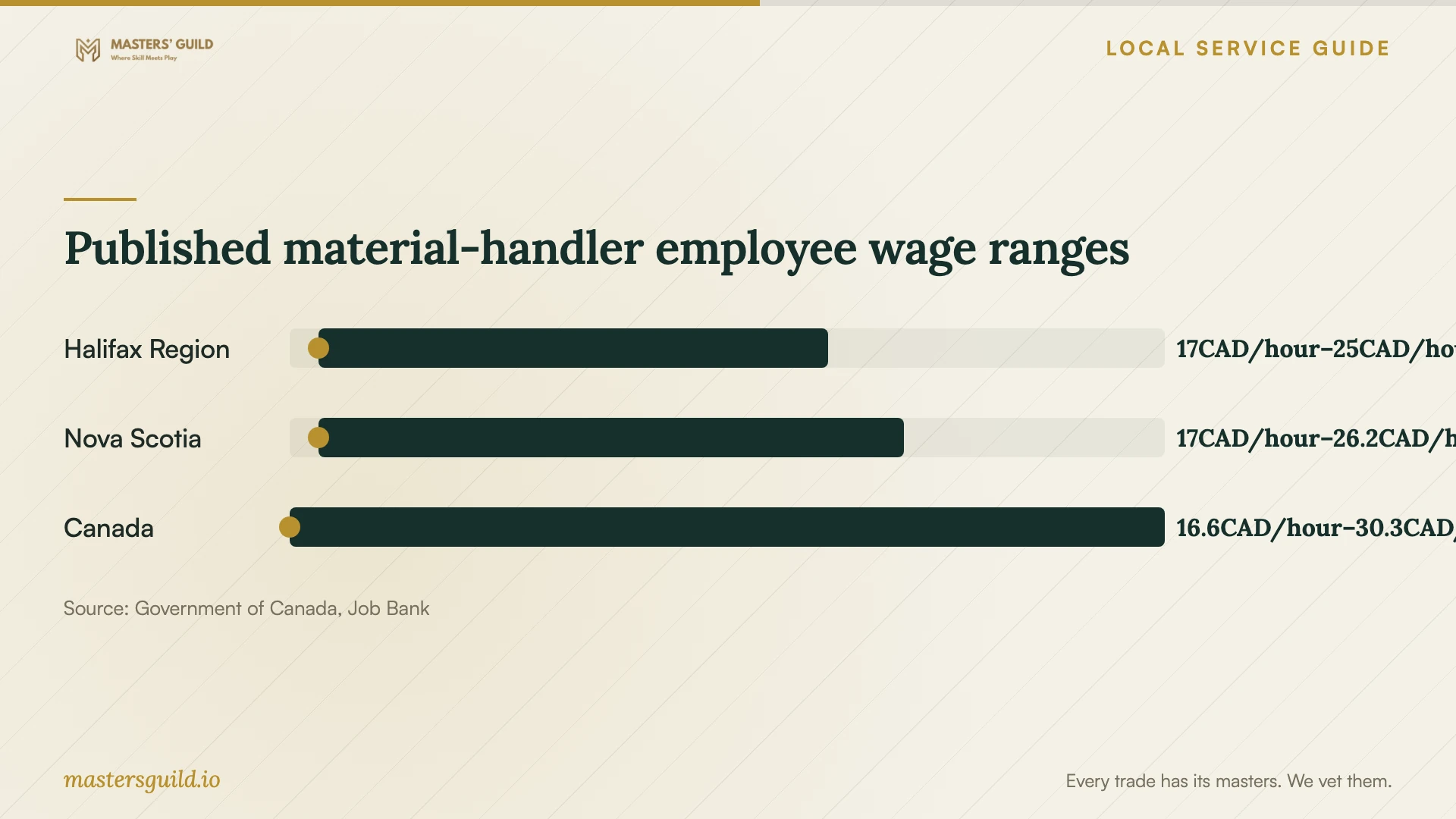
Job Bank reports Halifax Region material-handler hourly wages of CAD 17.00 low, CAD 20.00 median and CAD 25.00 high for 2023 to 2024. These employee wage figures do not establish a warehouse-organization contractor's charge. Use them as labour-market context, then assess the provider's proposed crew, equipment and finished work. [4]
Plan the reset around warehouse operations
Choose a work window with your receiving and dispatch staff. Divide the reset into zones and name one person to approve location changes. For each zone, agree on when to stop counting, where to hold stock during the work and when staff can resume picking. Record movements during the reset so your team can reconcile physical stock with its records.
Include temporary stock piles in the layout review. Nova Scotia requires employers to keep piled material from interfering with exits, passageways, traffic lanes, sprinklers, firefighting equipment and electrical panels. Employers must also arrange piles for stability and inspect them for hazards. Choose a holding area that preserves those clearances. [1]
Before accepting the work, have a staff member locate selected items using the new labels and inventory file. Walk the receiving-to-storage and picking-to-dispatch routes with the provider. Record remaining discrepancies, assign someone to resolve them and agree on who will maintain labels after future stock moves.
Keep chemical identification separate from stock labels
Tell the provider about hazardous products before work starts. Nova Scotia's WHMIS provisions require applicable labels, safety data sheets and employee education and training for hazardous products. Employees who may face exposure need training in the workplace's storage, handling and emergency procedures. [3]
Use bay and bin labels alongside required hazard identification. Provincial rules prohibit removing, defacing, modifying or altering supplier labels while product remains in its original container, subject to stated exceptions. Ask the provider to preserve hazard labels and refer unidentified containers to your designated safety contact before handling them. [3]
Published material-handler employee wage ranges
Local details that affect your job
Measure forklift aisles before adding storage
Apply Nova Scotia's lift-truck aisle rules when reviewing your Halifax layout. Section 82 requires a one-way aisle at least the width of the vehicle or load, whichever is wider, plus 600 mm. For two-way traffic, it requires twice that wider width plus 900 mm. Ask the planner to record both measurements and check equipment manoeuvring needs before moving stock into proposed bays. Use these as aisle-width requirements within a broader layout review. [1]
Resolve commercial occupancy changes before move-in
If you are organizing premises for a new tenant, operator or activity, ask HRM Planning & Development to confirm the occupancy process before scheduling move-in. HRM requires occupancy permissions after commercial tenant or use changes and states that renovation projects obtain occupancy permissions through the building permit. For commercial occupancy applications, prepare a floor plan showing leasehold dimensions, adjacent uses, exits, emergency lighting and fire extinguishers. Include this step in your schedule if the reset accompanies a business move or conversion. [2]
Choose the work to request
| Your situation | Work to request | Confirm before booking |
|---|---|---|
| Mixed cartons and unclear locations | Sorting, zoning and location labels | Sample labels, disposal authority and inventory updates |
| Pallet moves or forklift work | Material handling with a competent operator | Operator arrangements, equipment and measured aisle widths |
| Hazardous products among stock | Organization coordinated with your safety contact | Applicable hazard labels, safety data sheets and workplace training |
| New commercial tenant or changed activity | Organization coordinated with occupancy planning | HRM occupancy requirements and any renovation permit process |
Your hiring checklist
- Photograph the work zones and prepare a stock list with quantities, dimensions and handling concerns.
- Identify who can approve disposal, inventory adjustments and location changes.
- Request a written crew plan, equipment responsibilities and evidence of insurance suitable for the work.
- Agree on the label format and inventory-file handover before the full reset.
- Mark temporary holding areas and review vehicle and pedestrian routes.
- Provide applicable site procedures and hazardous-product information before work begins.
- Set a spending limit, an approval process for extras and an acceptance walkthrough.
Frequently Asked Questions
How long should I book the crew for?
Ask the provider to estimate time after reviewing stock quantities, access and the required handover. Consider a pilot zone before approving the remaining work. State whether staff will continue receiving and picking during the reset, and agree on what the crew must finish before leaving each zone.
Can my staff sort stock and hire help for pallet moves?
Consider splitting the work that way, with clear responsibility for counts and location updates. For hazardous lifting or moving, Nova Scotia requires appropriate equipment and training. Employers must ensure competent people operate lift trucks, so confirm operator arrangements before either team starts. [1]
Does a stock reset require an occupancy permit?
The cited HRM guidance identifies commercial tenant, operator and use changes as occupancy triggers. It does not establish a permit requirement for routine stock sorting. If you are changing the business activity, taking over the premises or renovating, confirm the applicable process with HRM before setting the work date. [2]
Can the crew replace chemical labels with inventory stickers?
Preserve required hazard identification when adding inventory stickers. Nova Scotia restricts alteration or removal of supplier labels while hazardous product remains in the original container, subject to exceptions. Have your safety contact approve the approach to hazardous-product identification. [3]
Sources and scope
This guide combines the sources below with practical planning guidance. Figures apply to the stated geography and period; request a written quote for your property.