
Local service guide
HVAC Services in Greensboro, NC: Hiring Guide
To arrange HVAC Services in Greensboro, book a diagnostic visit for an unexplained fault or request written proposals for a planned replacement. Check the contractor through North Carolina’s heating-license search, agree on responsibility for any permits and inspections, and confirm Energy Saver North Carolina eligibility before authorizing a rebate-dependent installation. Give bidders the same equipment details, symptoms and requested work so you can compare their offers. [1] [2] [3]
Choose the appointment that fits your problem
Describe the problem when you call: no heating or cooling, uneven room temperatures, an unusual sound, water near the equipment or a planned upgrade. Explain when you noticed it and which rooms it affects. Ask whether the appointment covers diagnosis, maintenance or replacement estimating, and confirm the charge before booking.
For a diagnostic visit, ask what the visit charge includes and how the technician will seek your approval for additional work. Request a written diagnosis, proposed repair and price. If the technician recommends replacement, ask which findings support that recommendation and whether they can quote a repair option. Avoid approving an open-ended scope.
Check the contractor and permit responsibilities
North Carolina’s State Board of Examiners of Plumbing, Heating and Fire Sprinkler Contractors provides a search with company-name, license-number and heating-classification fields. Ask the bidder which classification applies to your proposed work. Match the record to the business named on your estimate, and ask the board to clarify a classification you cannot interpret. [1]
For replacement or alteration work, ask the contractor to identify the inspection office responsible for your address and explain whether the proposed scope needs a permit. Greensboro’s Building Inspections Scheduler supports permit and inspection lookup by address or permit number. Its help page explains the lookup process; it does not establish permit requirements or exemptions for your installation. [2]
Put responsibility for applications, inspection scheduling and any corrections in the proposal. For a project handled through the city system, request the permit number and review the inspection record with the contractor before accepting completion paperwork. Ask them to explain any remaining inspection steps and provide the relevant documents with your invoice. [2]
Investigate rebates before selecting an installer
DEQ lists Guilford County in Energy Saver North Carolina’s December 2025 expansion phase. The program supports income-eligible home efficiency and electrification upgrades, including heating and cooling improvements. Confirm eligibility and ask about qualified contractors serving your address before treating a rebate as part of your installation budget. [3]
For HOMES, the program directs eligible applicants to schedule a free home assessment. For HEAR, it directs applicants to use the registered contractor finder, filter for their intended products and obtain quotes. Energy Saver North Carolina requires registered-contractor installation and excludes self-installation projects. Ask a bidder to explain their program participation before accepting a rebate-dependent proposal. [3]
DEQ flags program changes following updated federal guidance issued on May 29, 2026. Confirm current equipment requirements, your approved amount and the application sequence with the program before signing. HEAR retroactive rebates are unavailable. HOMES has separate retroactivity requirements, so ask about that pathway rather than assuming both programs follow the same rules. [3]
For hurried replacement of broken equipment, DEQ recommends investigating HEAR because it does not require a full home energy assessment. DEQ also says Energy Saver North Carolina serves proactive upgrades rather than emergency assistance. Ask about the approval sequence and your immediate replacement needs without assuming the program can provide emergency funding. [3]
Compare the complete replacement scope
Ask each bidder to name the equipment models, proposed capacity and reason for that sizing choice. Have them describe any duct, electrical, thermostat or drainage work they propose. Request a breakdown of included work, optional upgrades and conditions that could trigger an additional charge. Ask bidders to explain differences in scope before comparing totals.
Request the appointment sequence, access needs and expected period without heating or cooling. Ask for equipment and labor warranty terms, payment stages and startup checks in writing. For rebate-dependent work, request the full project price, the proposed rebate and your payment obligation if the program declines the application or approves a different amount.
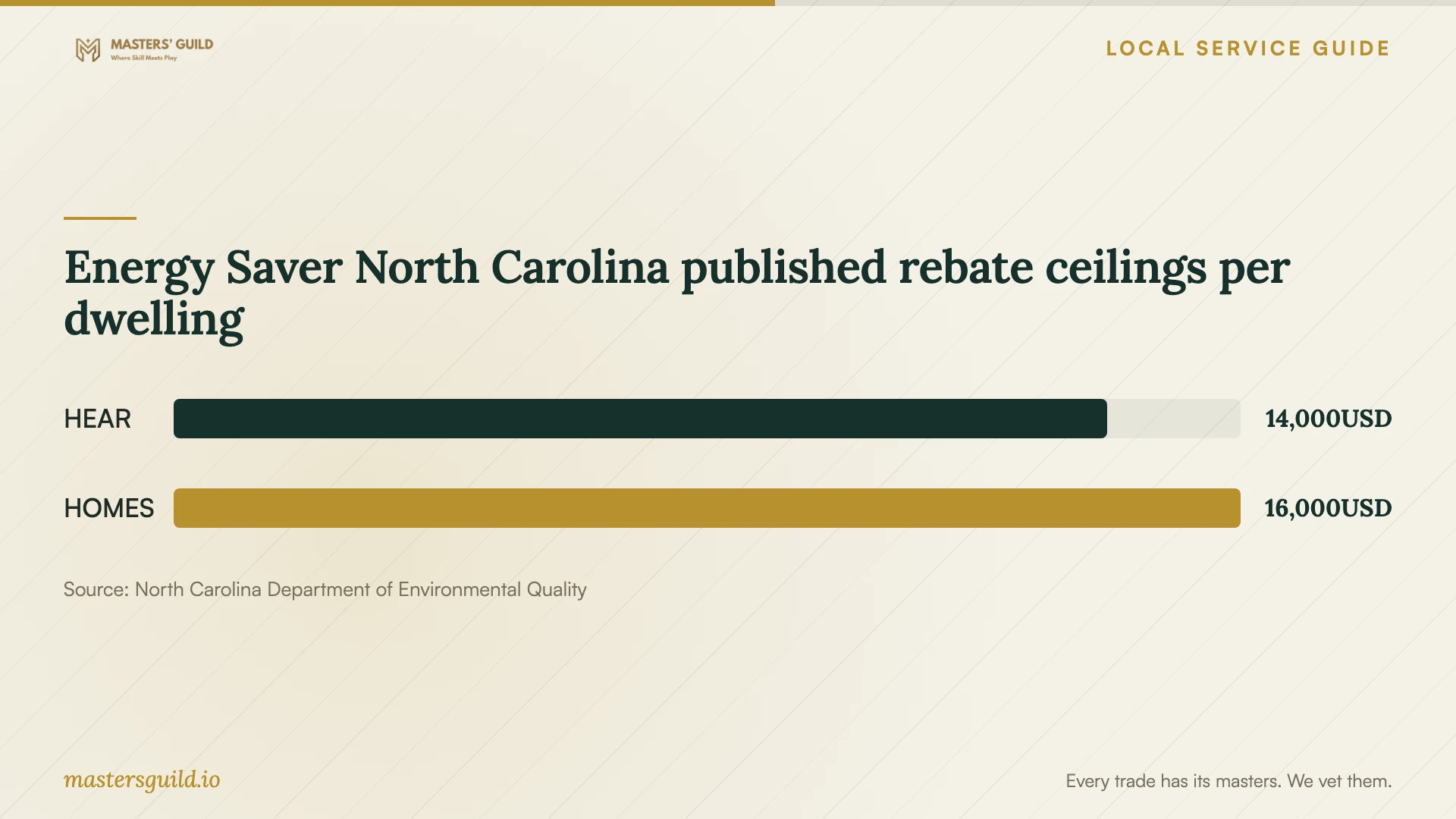
The chart compares DEQ’s published maximum rebates per dwelling for the two program pathways. These are program-wide ceilings rather than heat-pump installation prices or promised HVAC discounts. DEQ makes the applicable maximum dependent on income and qualified needs. Ask the program to confirm your project’s eligibility and amount before subtracting anything from a contractor’s quote. [3]
Energy Saver North Carolina published rebate ceilings per dwelling
Local details that affect your job
Look up the Greensboro project record
For work under a City of Greensboro permit, obtain the permit number and use the Building Inspections Scheduler to look up permits and inspections by address or permit number. Save the relevant record with your completion documents. The city lists Development Services at (336) 373-2155 for problems using the application. Direct scope-specific permit questions to the inspection office responsible for your address. [2]
Plan around the Guilford County rebate pathway
DEQ includes Guilford County in the program’s December 2025 expansion phase. Confirm eligibility and contractor availability for your home, then follow the appropriate pathway: a free assessment for HOMES or registered-contractor quotes for HEAR. HEAR excludes retroactive rebates, so checking before installation can change whom you hire and when you authorize the work. [3]
Choose your next HVAC appointment
| Your situation | Next step | Clarify before proceeding |
|---|---|---|
| Unexplained heating or cooling fault | Arrange diagnosis and request a written repair proposal. | Visit charge, findings and approval for additional work. |
| Planned replacement | Request installation proposals covering the same requested work. | Sizing rationale, supporting work, exclusions and completion checks. |
| Possible HOMES eligibility | Confirm eligibility and schedule the program’s free home assessment. | Qualifying work and current program requirements. |
| Possible HEAR project | Confirm eligibility and obtain registered-contractor quotes. | Application sequence before installation; HEAR excludes retroactive rebates. |
| City-permitted work nearing completion | Obtain the permit number and look up the inspection record. | Remaining inspection steps and completion documents. |
Your hiring checklist
- Record equipment models, symptoms, affected rooms and recent service history.
- Confirm the appointment type, visit charge and approval process for additional work.
- Request the business name, license number and relevant heating classification for verification.
- Ask who will confirm permit requirements, apply and schedule inspections.
- Confirm rebate eligibility and the program’s installation sequence before signing.
- Compare equipment, supporting work, exclusions, warranties and payment stages.
- Collect the diagnosis or startup report, invoice and applicable permit and inspection documents.
Frequently Asked Questions
How do I check an HVAC contractor’s license?
Ask for the company name, license number and heating classification. Use the state board’s Verify License Search, which includes those fields. Match the result to your estimate and ask the board about any uncertainty concerning the classification. [1]
Does my replacement need a Greensboro permit?
Confirm the requirement for your address and proposed scope with the responsible inspection office. The city scheduler’s help page explains permit and inspection lookup, but it does not determine whether your project needs a permit or qualifies for an exemption. [2]
Can I install a heat pump and apply for HEAR afterward?
Energy Saver North Carolina says HEAR retroactive rebates are unavailable. Confirm eligibility, equipment requirements and the registered-contractor process before installation. HOMES has a separate retroactivity policy; ask the program whether that pathway applies to your project. [3]
How should I compare replacement quotes?
Compare equipment models, capacity rationale, supporting work, exclusions and warranty terms. Ask each bidder to explain their proposed scope and payment stages. For rebate-dependent work, get your payment obligation in writing for the possibility that approval or the amount differs from the proposal.
Sources and scope
This guide combines the sources below with practical planning guidance. Figures apply to the stated geography and period; request a written quote for your property.