
Local service guide
HVAC services in Garland, TX: Hiring and Permits
For HVAC services at a Garland business, ask bidders to document the diagnosis, proposed work, permit responsibility and expected interruption before you approve a repair. Garland requires permits for specified air-conditioning repairs as well as condenser or heating-unit replacement. For commercial mechanical repairs, the city allows only a state-licensed HVAC contractor to obtain the permit. Start by checking the contractor’s credentials and asking how they will handle your project’s permit. [1] [2]
Define the service visit before booking
Tell the contractor whether you need fault diagnosis, a planned repair, maintenance or a replacement proposal. Describe the affected rooms, operating hours, thermostat settings and when you first noticed the problem. Send equipment-label photos if you can reach the labels without opening panels or climbing.
Ask what the diagnostic charge covers, whether the contractor credits it toward approved work and who can authorize additional spending. Set a written approval limit. Request a diagnosis and repair proposal before authorizing parts replacement, and ask the technician to explain what they tested.
If you lease the premises, establish who may authorize equipment changes and who will pay. Ask the landlord for equipment records and any access restrictions. Arrange access to locked rooms or roof areas through the person responsible for the property.
Check credentials against the proposed equipment
TDLR distinguishes license classes by equipment capacity. Class A permits work on any size unit. Class B covers cooling systems of 25 tons and under and heating systems of 1.5 million BTUs per hour and under. Ask the bidder to identify the equipment capacity and the license covering the work. [3]
Check the endorsement as well as the class. TDLR’s Environmental Air Conditioning endorsement covers temperature, humidity, cleanliness, ventilation and circulation for human comfort. The agency describes Commercial Refrigeration and Process Cooling or Heating as separate scopes. If your business also has coolers, freezers or production equipment, ask the bidder to identify the appropriate scope for each task. [3]
TDLR requires contractors to maintain commercial general liability insurance while their licenses remain active. Request a current certificate naming the license holder and business, then compare those names with your proposal. Use TDLR’s license-search option to check the credential before hiring. [3]
Build a quote you can approve
Request separate descriptions for diagnosis, repair and any optional replacement. Have the contractor identify proposed parts or equipment, labor, permit handling, access arrangements, disposal and exclusions. Ask who will coordinate any electrical, duct or control changes included in the proposal.
For a replacement, ask the contractor to explain the proposed capacity and whether they will retain existing ducts, controls and other components. Request written equipment and labor warranty terms, including who handles a callback. Ask what completion checks and operating instructions you will receive.
Agree on the interruption window before scheduling. Identify rooms that must remain usable and ask the contractor to distinguish the first visit from the repair or installation date. For a business-critical system, request a contingency plan if parts or access delay completion.
Plan maintenance around regional conditions
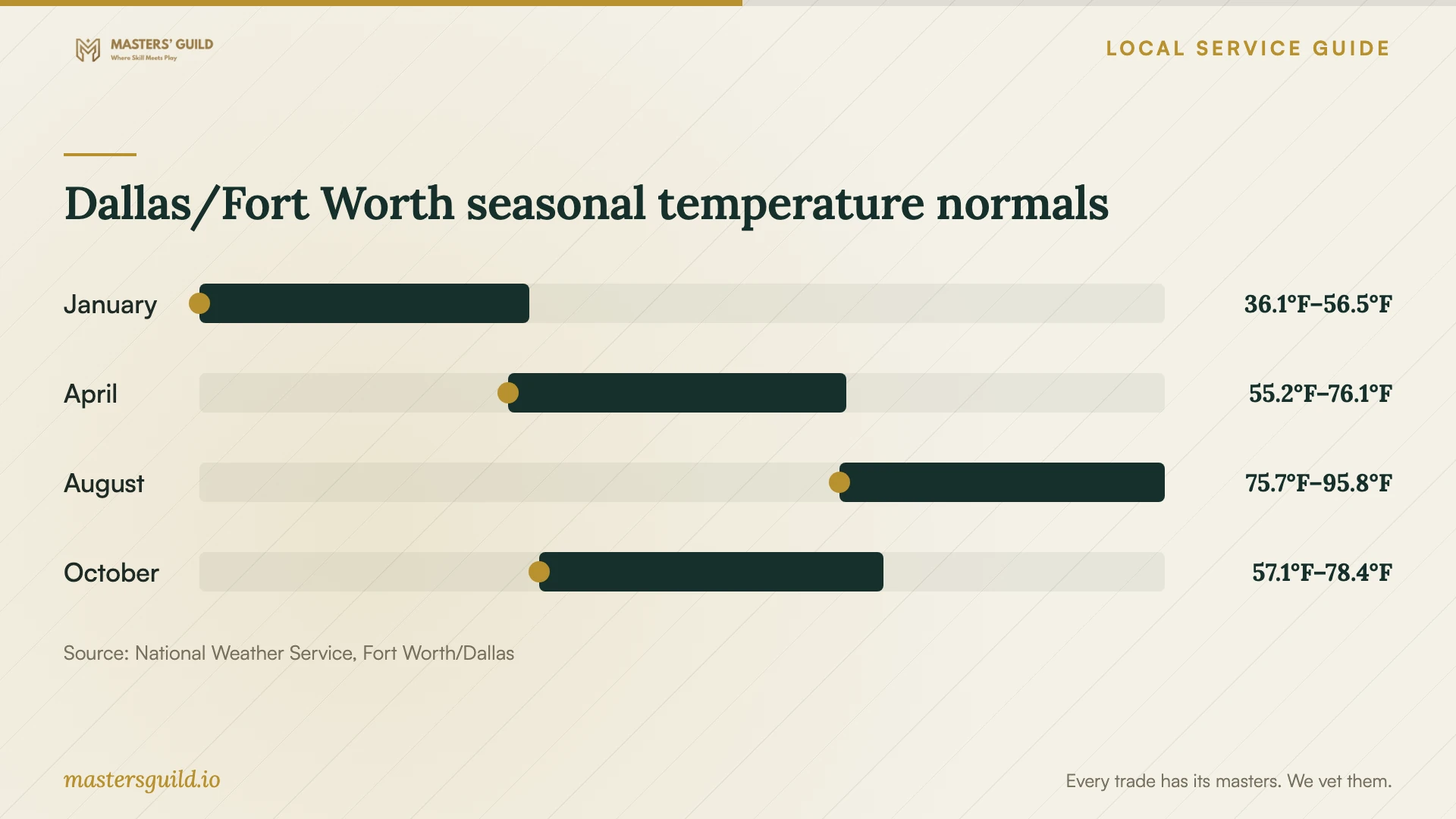
The National Weather Service’s Dallas/Fort Worth station normals provide regional planning context: the August normal high is 95.8°F, while the January normal low is 36.1°F, based on 1991–2020 observations. These are regional station values, rather than measurements at your premises. Use them as a reason to discuss both cooling and heating readiness with your contractor. [4]
Schedule planned checks around your business calendar and the equipment manufacturer’s maintenance instructions. Ask the contractor to document the work performed and any unresolved findings. Keep those records with repair invoices so the next bidder can review the history before recommending replacement.
Dallas/Fort Worth seasonal temperature normals
Local details that affect your job
Garland requires permits for specified repairs
The city’s Air Conditioning Repairs guidance includes coil replacement, contactor replacement and refrigerant charging among repairs requiring a permit. It also requires a permit for replacement of condensing or heating units. Ask the bidder to include permit handling in the scope even when you are arranging a component repair. [1]
Commercial permit handling depends on the general contractor
Garland says only a state-licensed HVAC contractor may obtain a commercial mechanical-repair permit. Its standalone mechanical permit applies when no general contractor is on the job. If a general contractor already holds a construction permit, the city directs the HVAC contractor to contact its office at 972-205-2300 to validate the permit, assuming city registration. Ask which route applies before approving the schedule. [2]
Choose the next step for your situation
| Situation | Next step | Question before approval |
|---|---|---|
| The cause of poor performance is unclear | Authorize diagnosis with a spending limit. | What testing and written findings does the visit include? |
| The proposal includes a coil, contactor or refrigerant charge | Include Garland permit handling in the repair scope. | Who obtains the permit and coordinates the required city steps? |
| A general contractor already holds a construction permit | Ask the HVAC contractor to confirm city registration and permit validation. | Have you confirmed coverage under the existing permit? |
| The proposal covers comfort cooling and refrigeration equipment | Check the license endorsement for each scope. | Which licensed contractor will perform each task? |
| The contractor recommends replacement | Request the diagnosis and a detailed replacement scope. | Why do you recommend replacement, and what existing components will remain? |
Your hiring checklist
- Write down symptoms, affected rooms, operating hours and your spending-approval limit.
- Gather equipment-label photos, service records and landlord authorization if needed.
- Request the contractor’s license details and current insurance certificate.
- Ask the bidder to identify the applicable permit route and who will coordinate it.
- Compare parts, labor, access, disposal, exclusions and warranty terms in writing.
- Agree on the interruption window, completion checks and callback contact.
Frequently Asked Questions
Does a small AC repair need a permit?
Garland lists coil replacement, contactor replacement and refrigerant charging as examples of repairs requiring a permit. Ask the contractor to confirm the requirements for your exact scope before approving the work. [1]
Can I obtain the commercial mechanical-repair permit myself?
Garland states that only a state-licensed HVAC contractor may obtain a mechanical-repair permit for a non-residential project, with no exceptions. Have the contractor explain whether your job needs a standalone permit or validation under an existing construction permit. [2]
Does commercial work always require a Class A license?
TDLR defines Class A and Class B by equipment capacity. Class B covers cooling systems of 25 tons and under and heating systems of 1.5 million BTUs per hour and under. Check capacity and endorsement rather than choosing by the word commercial alone. [3]
How should I compare repair and replacement proposals?
Ask each bidder to explain the diagnosis, proposed work, retained components, warranty terms and interruption window. Request an explanation of the replacement recommendation and compare the complete scope before deciding.
Sources and scope
This guide combines the sources below with practical planning guidance. Figures apply to the stated geography and period; request a written quote for your property.