
Local service guide
Warehouse Organization in Fremont, CA
Arrange Warehouse Organization in Fremont by defining storage zones, stock decisions, labels, and work hours before requesting quotes. Ask each provider to separate organizing labor, supplies, equipment, and disposal responsibilities. If you need hazardous-waste disposal, assign transport before booking: Alameda County’s business programs require an owner or employee to deliver waste and prohibit for-hire haulers from delivering another company’s waste through those programs. [2] [3]
Define the reset before choosing a crew
Write down the problem you want the organizer to solve: mixed stock, unmarked locations, returns awaiting decisions, or overflow around receiving. Mark the boundaries of the work and identify stock that must remain available during the reset. Include photographs and a simple floor sketch with your quote request.
Ask the provider to describe how the crew will handle sorting, location labels, inventory records, and exceptions. For heavy stock or work involving racking, request a separate description of equipment, operator responsibilities, and exclusions. Keep rack alterations outside the organizing scope until you have reviewed them with an appropriate specialist.
Choose a person on your staff who can approve stock moves and disposal. Give that person a decision list before work begins: retain, relocate, return, investigate, or discard. Tell the crew how to record items they cannot identify.
Compare written scopes and costs
Request an itemized quote that identifies crew size, proposed hours, supplies, equipment, and any hauling. Ask whether the provider charges by worker-hour, crew-hour, or project. For hourly work, agree on a spending limit and the point at which the provider must request approval to continue.
Ask each bidder to price the same deliverables: agreed zones sorted, approved stock relocated, location labels installed, and a handover record completed. Identify who will buy bins and labels, enter inventory changes, and remove packaging. Request insurance documentation and ask the provider to explain its experience with commercial stock and your handling requirements.
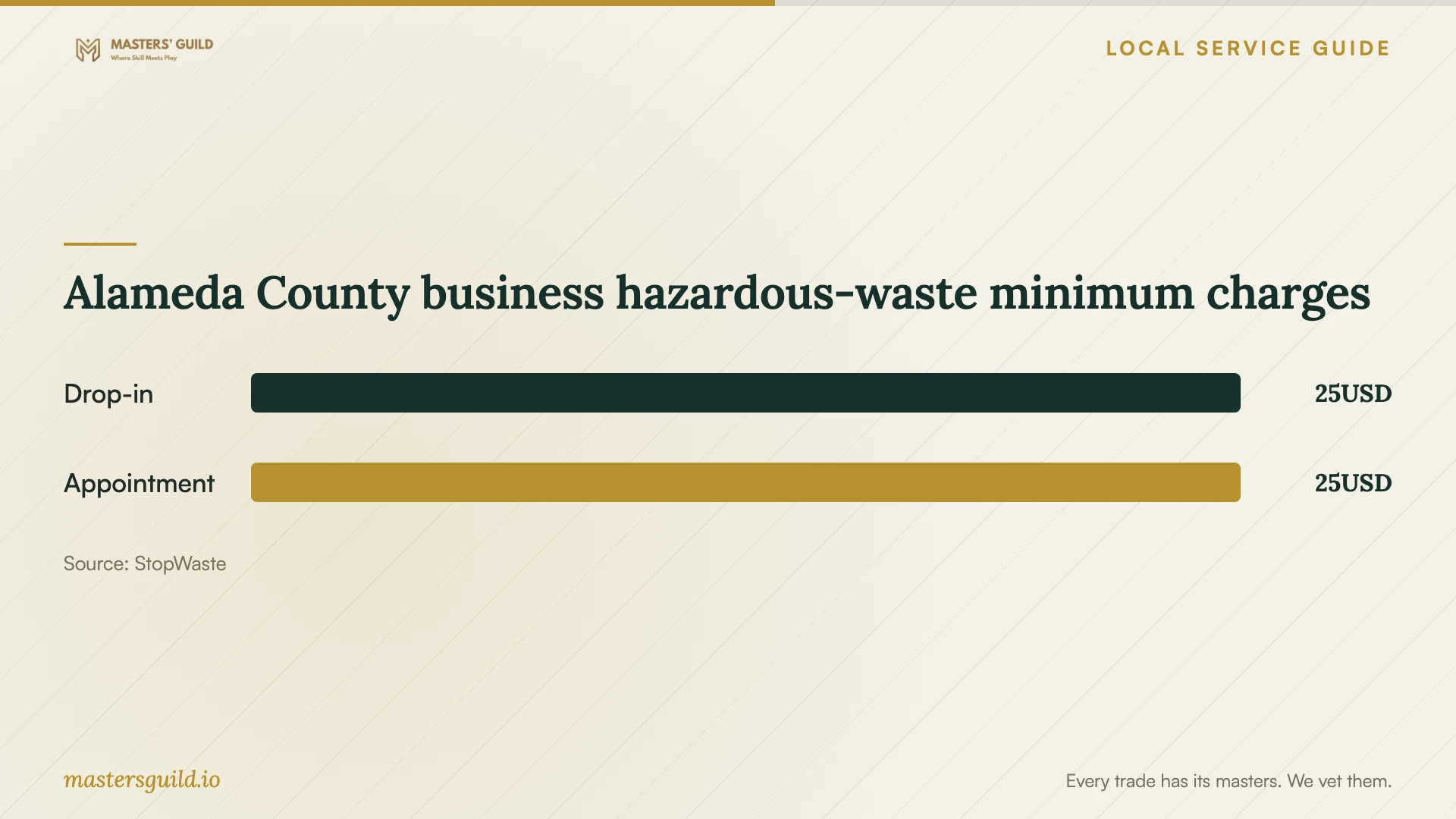
Keep county hazardous-waste fees separate from the organizer’s quote. StopWaste lists a USD 25 minimum for business drop-in disposal and a USD 25 minimum per delivery for the appointment service. The appointment program determines costs at delivery based on materials. These minimums do not establish a warehouse organizing rate or a total cleanout price. [2] [3]
Choose the hazardous-waste route before clearing stock
For Alameda County businesses, the drop-in service accepts specified latex paint, aerosol cans, fluorescent lamps, and batteries without an account or appointment. The program requires a completed Bill of Lading and delivery during scheduled hours. Oil-based paint does not qualify for this drop-in route. [2]
For a broader range of materials, review the Small Business Hazardous Waste Service. Applicants must qualify, submit an inventory for preapproval, establish an account, and schedule an appointment after account confirmation. The program requires an active EPA ID, except for sites delivering only latex paint and universal waste batteries, lamps, and aerosol cans. [3]
The appointment program requires businesses to generate less than 220 pounds of hazardous waste and less than 2.2 pounds of extremely hazardous waste per month, and to store less than 2,200 pounds of hazardous waste. StopWaste excludes latex paint, aerosol cans, household batteries, and lamps from the stated 220-pound monthly and 2,200-pound storage limits. Ask the program to confirm eligibility before arranging a delivery. [3]
The appointment program excludes unidentified or uncharacterized industrial wastes and unlabeled containers. It requires additional documentation for industrial chemicals absent from its fee schedule, mixtures or manufacturing waste, and contaminated materials. Keep these items separate while you prepare the inventory and confirm a disposal route. [3]
Schedule the work and agree on handover
Plan the reset around receiving, picking, and dispatch commitments. Identify a temporary holding area and agree on which zones the crew can close. Ask the provider to explain how staff will locate stock while the crew works, and who will update records after each approved move.
Before the crew leaves, walk the completed zones with the person who manages inventory. Check sample locations against the labels and records. Review unresolved items, photographs, and disposal responsibilities. Assign an employee to maintain the location list and decide how staff should report misplaced or unidentified stock.
Alameda County business hazardous-waste minimum charges
Local details that affect your job
County disposal requires your own transport
Both Alameda County business hazardous-waste routes require an owner or employee to transport the waste. Neither accepts delivery by a for-hire hauler acting for another company. For a Fremont warehouse using these programs, assign an employee and vehicle before accepting a quote that includes hazardous-waste removal. [2] [3]
Business drop-in does not include a Fremont facility
StopWaste lists business drop-in locations in Oakland, Livermore, and Hayward. The published 2026 Hayward schedule includes October 21 from 9 am to noon at 2091 West Winton Avenue. Confirm the schedule before assigning an employee’s delivery trip; do not assume a residential collection day or a Fremont location accepts business drop-in waste. [2]
Prepare the account before setting a disposal deadline
The county appointment service requires account confirmation before you telephone to book a delivery. It does not offer online appointment booking or business deliveries on residential collection days. Complete the waste inventory and account steps before making disposal part of a fixed completion deadline. [3]
Match the scope to the work
| Situation | Planning decision | Responsibility to confirm |
|---|---|---|
| Sorting and location labels | Request an organizing scope with a sample label and location record. | Name the employee who approves stock moves. |
| Eligible paint, aerosols, lamps, or batteries | Review the county business drop-in material limits and complete a Bill of Lading. | An owner or employee must deliver during scheduled hours. |
| Broader hazardous-waste inventory | Check appointment-service eligibility, preapproval, account, and EPA ID requirements. | Assign paperwork and employee transport before scheduling removal. |
| Unidentified or uncharacterized industrial wastes, or unlabeled containers | The appointment program excludes these materials. Arrange identification and a suitable disposal route. | Keep these items outside the general discard scope. |
| Other chemicals you cannot identify | Arrange identification and confirm acceptance with the program before planning delivery. | Assign an employee to resolve the inventory questions. |
Your hiring checklist
- Photograph each work zone and identify stock that must remain accessible.
- Name an employee who can approve relocation and disposal decisions.
- Give bidders the same sorting, labeling, and inventory-record requirements.
- Request separate labor, supply, equipment, and disposal charges.
- Flag chemicals, lamps, batteries, and unknown containers for disposal review.
- Confirm the disposal program, paperwork, delivery date, and employee transporter.
- Agree on a completion walk-through and an unresolved-items record.
Frequently Asked Questions
How much should I budget for the organizing crew?
Use an itemized site-specific quote. Define zones, stock handling, labels, equipment, and record updates before comparing prices. The published county disposal minimums cover hazardous-waste delivery services; they do not establish organizing labor prices. [2] [3]
Can the organizer take hazardous waste to the county program?
The county business programs require an owner or employee to deliver the waste. They prohibit for-hire haulers from delivering another company’s waste through these routes. Assign transport separately when agreeing on the organizing scope. [2] [3]
Can I use residential hazardous-waste drop-off for warehouse waste?
No. StopWaste states that businesses cannot use residential household hazardous waste drop-off. Select a business disposal route based on the materials and program eligibility. [1]
Can the crew discard old stock without checking with me?
Set an approval rule in writing. Give the crew a designated holding area for uncertain items and require your named employee to approve discards. Include a record of unresolved stock in the handover.
Sources and scope
This guide combines the sources below with practical planning guidance. Figures apply to the stated geography and period; request a written quote for your property.