
Local service guide
HVAC Services in Fort Worth: Hiring and Planning
To arrange HVAC Services in Fort Worth, agree on a diagnostic charge and spending limit, check the responsible Texas contractor’s license and insurance, then approve a written scope. Texas requires contractors providing non-exempt air-conditioning work to carry the required liability insurance. If the contractor recommends replacement, request separate repair and replacement proposals before deciding. [1]
Book the visit with clear approval limits
Describe the problem before booking. Record whether the system starts, which rooms feel uncomfortable, when the problem began and whether you see water or ice. Send photos of accessible equipment labels and the thermostat display. Describe your observations without guessing which part needs replacement.
Ask what the diagnostic charge includes, whether an after-hours fee applies and whether the contractor credits the visit charge toward an approved repair. Set a spending limit and require approval before the technician adds work. Give the company the name and contact details of the person who can authorize repairs.
After diagnosis, request the fault description, proposed repair and total price in writing. Ask the contractor to explain how the repair addresses your symptoms. For a replacement recommendation, request a repair option alongside the installation proposal so you can weigh both scopes before committing.
Check credentials and insurance separately
TDLR licenses contractors by class and endorsement. Class A allows work on any size unit. Class B covers cooling systems of 25 tons or less and heating systems of 1.5 million BTUs per hour or less. The environmental air-conditioning endorsement covers air treatment for human comfort, including temperature, humidity, ventilation and circulation. [2]
Request the license holder’s name, license number and business affiliation. Use TDLR’s license search to check the credential, then ask the contractor to confirm that their class and endorsement cover your equipment. Match the proposal’s business name to the insurance documentation. [2]
Check insurance apart from license renewal. TDLR’s application guidance requires commercial general liability insurance. Its FAQ allows a license holder who is not working in the industry to request an insurance waiver and continue renewing the license. Contractors providing non-exempt work must carry the required liability insurance. Request current coverage documentation for the business performing your job. [1] [2]
Compare the complete installation scope
Give each contractor the same comfort concerns and requested scope. Ask for equipment model numbers, proposed capacity, the sizing basis, thermostat work, duct changes, drainage work, removal of old equipment and startup checks. Have each contractor identify exclusions and explain how you must approve added work.
For a mini-split, review indoor-unit locations, outdoor-unit placement, line routing and drain routing. Ask for marked photos or a drawing before approving wall penetrations.
If your project includes drilling closed-loop wells, confirm that the contractor holds a Closed Loop Water Well Driller license or contracts for those drilling services with a licensed driller. TDLR states that an air-conditioning contractor’s license alone does not authorize closed-loop well drilling for a geothermal air-conditioning system. [1]
Before signing, identify who will handle any required permit applications and inspections. Ask for permit charges as a separate line item. Confirm requirements for your address and scope, and request warranty terms, payment stages and completion checks in writing.
Plan seasonal checks using DFW conditions
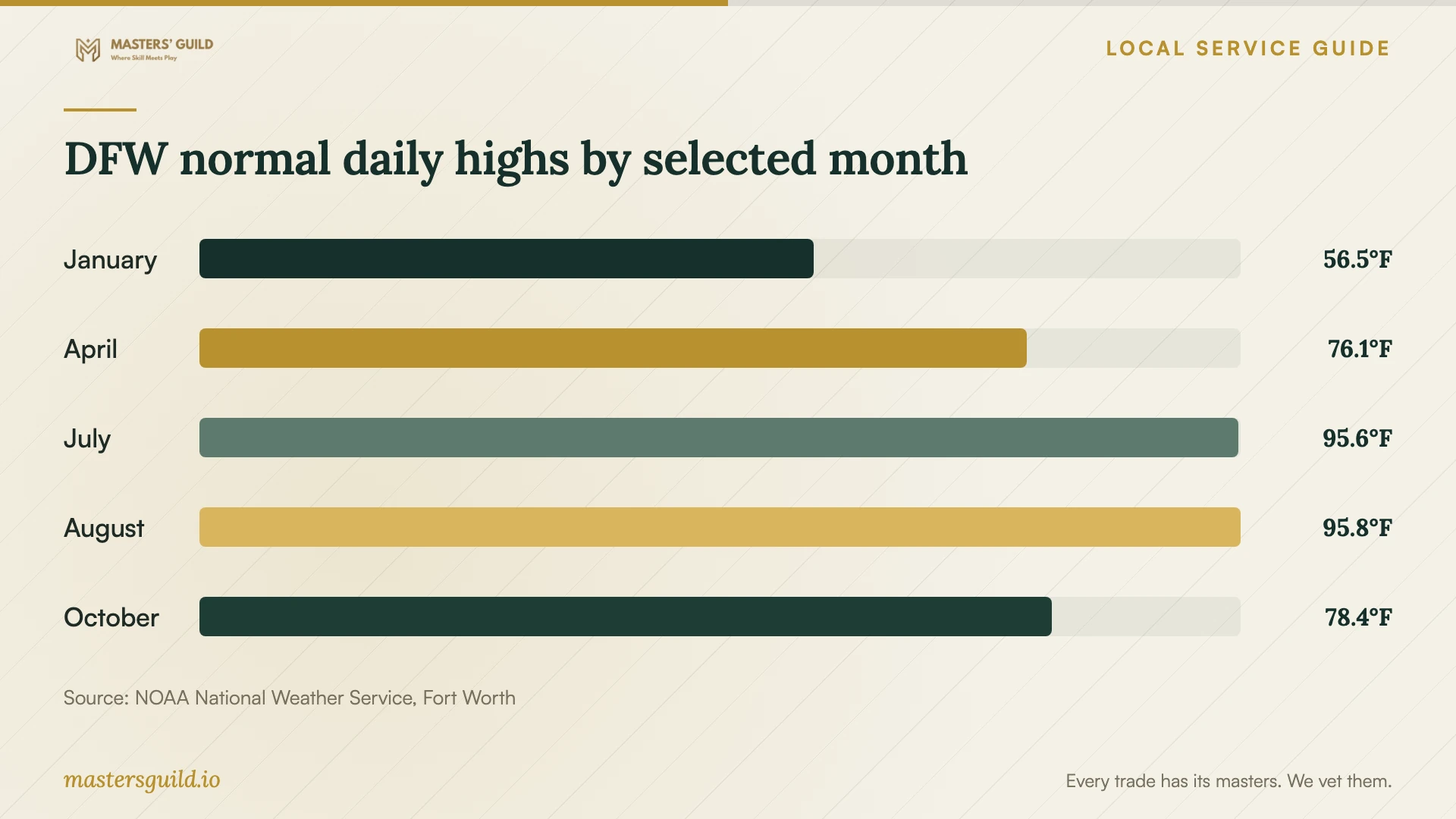
The National Weather Service reports DFW normal daily highs of 95.6°F in July and 95.8°F in August, plus a January normal daily low of 36.1°F, for 1991–2020. Use this regional seasonal pattern to plan cooling checks before summer and heating checks before winter. [3]
Prepare a room-by-room comfort list before the appointment. Note thermostat settings, rooms that lag behind and changes since previous service. Ask the contractor to address those observations in the proposal and explain how you will check the result together before closing the job.
DFW normal daily highs by selected month
Local details that affect your job
Texas mini-split rules change whom you hire
For mini-split work at a Fort Worth home, check the responsible Texas air-conditioning contractor’s license before accepting the proposal. TDLR distinguishes mini-splits from certain exempt portable or self-contained ductless products. Because a mini-split is a split system, contracting work for the public requires an air-conditioning contractor’s license. This statewide rule applies to installation, maintenance and repairs. [1]
Question municipal registration charges
Since September 1, 2021, Texas law has prohibited municipalities from charging registration fees to TDLR-licensed air-conditioning and refrigeration contractors. Municipalities may collect building permit fees. If your proposal includes a Fort Worth registration charge, ask the contractor to identify its purpose and issuing authority. This statewide distinction helps you question charges; it does not establish which permits your project needs. [1]
Choose the scope before approving work
| Your situation | Request | Resolve before approval |
|---|---|---|
| System stopped or performs poorly | Diagnostic visit with written findings | Visit charge, repair total and spending limit |
| Contractor recommends replacement | Separate repair and replacement proposals | Reason for replacement, sizing basis and included work |
| Planning a mini-split | Texas-licensed air-conditioning contractor | License responsibility, unit locations and drain routing |
| Project includes drilling closed-loop wells | Confirm the contractor holds a Closed Loop Water Well Driller license or contracts for those drilling services with a licensed driller | Name and drilling credential of the party performing the drilling |
Your hiring checklist
- Record symptoms, thermostat settings and when the problem began.
- Photograph accessible equipment model and serial-number labels.
- Agree on the diagnostic charge, after-hours fees and approval limit.
- Check the responsible contractor’s license and current insurance.
- Compare repair and replacement proposals with clear inclusions.
- Identify responsibility for any required permits and inspections.
- Get warranty terms, exclusions and payment stages in writing.
- Keep the diagnosis, invoice and installation or startup records.
Frequently Asked Questions
How should I budget for a diagnostic visit?
Ask for the diagnostic charge and any after-hours charges before booking. Confirm what the visit includes and whether the contractor credits that charge toward a repair. After diagnosis, request the written repair total and approve the scope before work proceeds.
Does an active license establish insurance coverage?
Check insurance separately. TDLR allows license holders who are not working in the industry to request an insurance waiver while continuing to renew their licenses. Contractors providing non-exempt work must carry the required liability insurance. Request current documentation covering the business that will perform your job. [1]
Can a Class B contractor work on my home’s system?
Compare your equipment with the license limits and endorsement. Class B allows cooling systems up to 25 tons and heating systems up to 1.5 million BTUs per hour. Ask the contractor to confirm that their endorsement covers the proposed comfort-system work. [2]
What should I resolve before accepting a replacement quote?
Ask for the diagnosis, repair option, equipment models, sizing basis and installation scope. Resolve duct and drainage changes, removal, startup checks, warranty terms and responsibility for any required permits. Ask the contractor to explain exclusions and how you will approve added work.
Sources and scope
This guide combines the sources below with practical planning guidance. Figures apply to the stated geography and period; request a written quote for your property.