
Local service guide
Warehouse Organization in Durham, NC
Arrange Warehouse Organization in Durham by defining who approves stock decisions, who moves heavy loads and where discarded material goes. Request a site-specific quote for cost and completion time, including equipment, disposal and receiving access. North Carolina guidance requires trained and certified forklift operators. Durham County convenience sites reject commercial waste, including waste hauled for payment. [2] [3]
Define the reset before requesting quotes
Give each bidder the same scope: zones to organize, stock to leave in place, items requiring your approval and hours when staff need access. Include photos, a rough floor plan and a description of receiving and dispatch activity. Ask the provider to inspect the space before committing to heavy-stock movement.
Assign someone from your business to approve returns, disposal and inventory exceptions. Designate holding areas for unknown items, damaged stock and products awaiting a decision. Tell the crew how to record each move so staff can reconcile shelf locations with inventory records.
Request separate quote lines for sorting labor, labeling, equipment, storage products, hauling and disposal. Specify who supplies labels and who updates your inventory system. Ask whether the quote includes counting stock or only arranging it. Request a site-specific quote for cost and completion time, and require approval before the crew expands the scope.
Match the crew to the handling work
Choose a crew whose responsibilities match your loads and equipment. The North Carolina Department of Labor identifies forklift traffic, material handling, ergonomics, hazardous chemicals and slips or falls as warehouse hazards. It identifies overexertion during lifting and lowering, and strikes by handling equipment, among the most common injuries. [1]
For forklift work, ask who employs and authorizes the operator, which truck they will use and how the employer has evaluated their performance at the workplace. NCDOL describes required training as formal instruction, practical training and workplace performance evaluation. Its training topics include load stability, pedestrian traffic, narrow aisles and surface conditions. Ask for confirmation of those qualifications before assigning equipment work. [2]
Ask the crew lead to explain pedestrian separation and the sequence for moving stock while your business operates. NCDOL directs operators to maintain clear visibility, handle stable loads within rated capacity and avoid lifting people with forks. Identify chemicals before sorting them; the department advises workers to consult labels and safety data sheets for protective equipment requirements. [1] [2]
Plan disposal and loading access together
Approve the disposal route before the crew removes stock from shelves. Durham County cannot accept commercial waste at its convenience sites and treats waste hauled for payment as commercial. Ask the bidder to name a destination that accepts your material, confirm vehicle access and explain the disposal charges in the quote. [3]
Walk the route from the sorting area to the truck with the crew lead. Choose a temporary holding area and agree on haul pickup times. Durham’s online ordinance publishes requirements for unobstructed access to required off-street loading spaces and for loading spaces to avoid hindering traffic or pedestrians. It also prohibits using allocated loading spaces, accessory drives or aisles to satisfy trash-handling space requirements. [4]
Treat the online loading provisions as planning references. The publisher states that the electronic text is not the official ordinance and may omit recent amendments. Confirm applicable requirements with Durham City-County Planning before changing an outdoor loading arrangement or relying on the published delivery window. [4]
Agree on the work window and handover
Select a work window after reviewing receiving, staff access and disposal pickup. Ask the provider to propose a sequence by zone so you can decide which operations to pause. Record who can authorize changes during the job and how the crew will handle stock that staff need before the reset ends.
At handover, have a staff member locate a selection of items using the new labels and location list. Check returns, quarantine stock and unresolved inventory against the exception record. Request photographs of completed zones and assign responsibility for maintaining labels after future deliveries. Use the final walkthrough to find misplaced items and agree on remaining work.
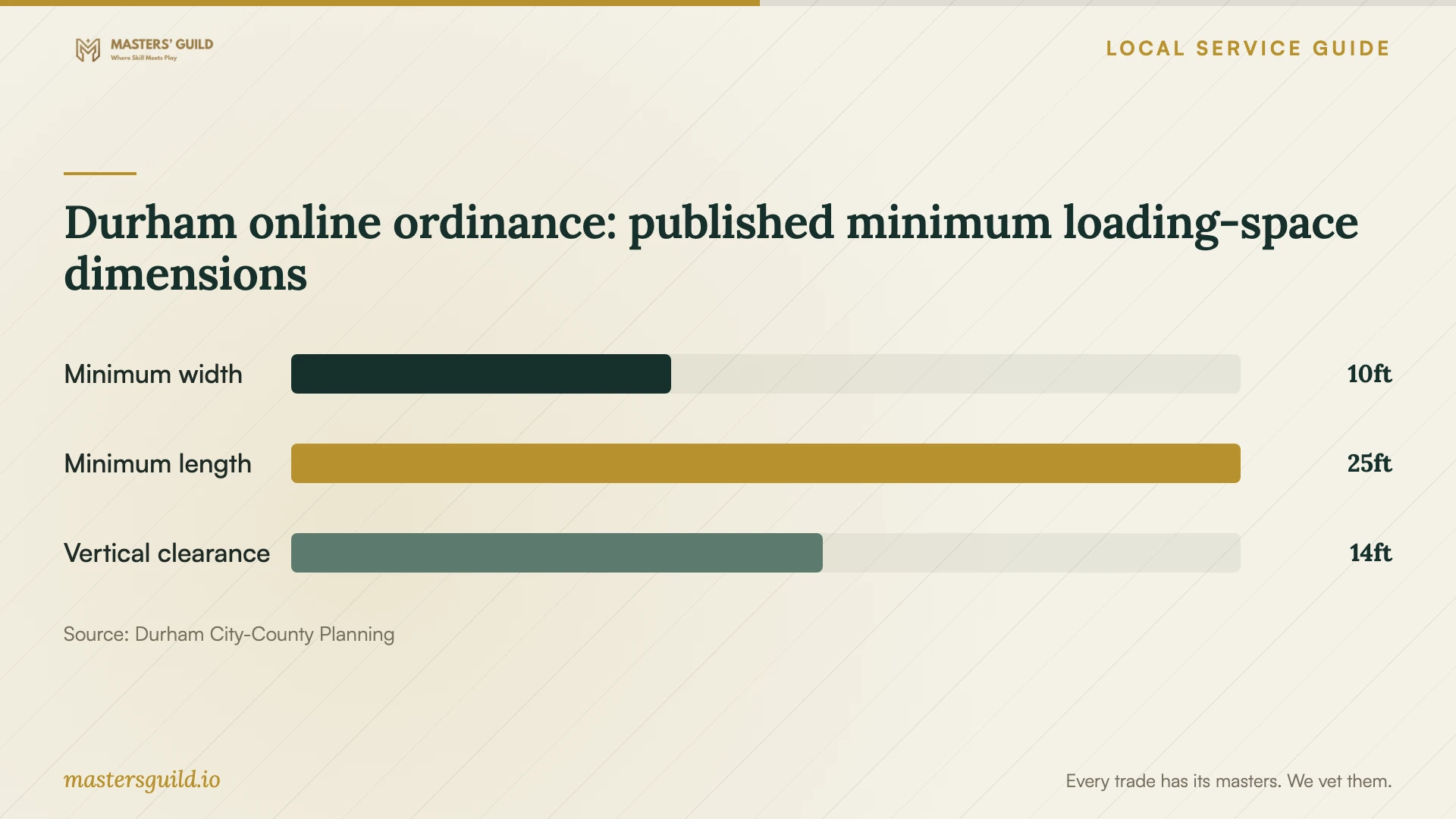
Durham online ordinance: published minimum loading-space dimensions
Local details that affect your job
Arrange commercial disposal before the clear-out
Durham County limits convenience sites to residential waste and rejects commercial waste, including waste someone has been paid to haul. The county also excludes box trucks, enclosed trailers and commercial vehicles. Require your contractor to confirm an eligible disposal destination before booking hauling. A residential decal does not remove these waste and vehicle restrictions. [3]
Check overnight arrivals at loading areas beside residences
The online Durham ordinance publishes a prohibition on deliveries between 11 p.m. and 6 a.m. to loading areas outside the DD District that are adjacent to a residential use. Check your site’s district and neighboring uses before scheduling an overnight truck arrival. Confirm the current provision with Planning because the publisher warns that the electronic text is unofficial and may omit amendments. Assess indoor work scheduling separately from delivery timing. [4]
Confirm surfacing before changing outdoor loading
The online ordinance lists properly compacted crushed stone at least six inches thick among Rural Tier loading-area surfacing options and requires permanent edging for loose materials. For other tiers, it publishes a paving requirement using an all-weather material such as concrete or asphalt. Ask Planning which tier and current provisions apply before proposing a new outdoor loading area; the online text does not establish current legal completeness. [4]
Match the hiring scope to the work
| Work involved | Hiring approach | Confirm before scheduling |
|---|---|---|
| Light sorting and labels | Request an organizing scope | Stock approvals, label format and location records |
| Pallet movement by forklift | Include trained and certified operators | Equipment type, workplace evaluation and pedestrian controls |
| Commercial waste removal | Include a confirmed commercial disposal route | Destination acceptance, hauling charges and disposal charges |
| Deliveries to loading areas adjacent to residential uses | Check the site district and current delivery provision with Planning | The online ordinance publishes an 11 p.m. to 6 a.m. delivery prohibition outside the DD District; its unofficial text may omit amendments |
| Outdoor loading-area changes | Confirm applicable provisions with Planning | Development tier, surfacing and current amendments before relying on the online ordinance |
Your hiring checklist
- Mark the quoted zones and photograph their starting condition.
- Name your stock-decision contact and identify items the crew must leave untouched.
- List heavy loads, elevated stock and equipment needs for the site review.
- Confirm who supplies and operates lifting equipment.
- Request the disposal destination and separate hauling and disposal charges.
- Agree on truck access, temporary holding areas and receiving interruptions.
- Define the label format, inventory updates and exception record.
- Schedule a staff walkthrough before accepting completion.
Frequently Asked Questions
Can our staff handle the sorting?
Consider assigning staff familiar with inventory to approve categories, labels and disposal decisions. Scope physical handling separately. NCDOL identifies lifting overexertion and equipment strikes among common warehouse injuries, so review loads and traffic before deciding who will move stock. [1]
Does an organizer need forklift training?
Anyone assigned to operate a forklift needs training and certification under NCDOL guidance, including formal instruction, practical training and workplace performance evaluation. Ask the provider to confirm the operator’s suitability for your equipment and workplace before including forklift work in the assignment. [2]
Can a hauler use Durham County convenience sites?
Durham County prohibits commercial waste at its convenience sites and classifies waste hauled for payment as commercial. Require the hauler to identify an eligible destination for your warehouse material and confirm acceptance before loading the truck. [3]
How should we compare quotes?
Compare the same zones and deliverables. Ask each bidder to state crew responsibilities, equipment, stock counting, labels, inventory updates and disposal arrangements. Request cost and completion time for your site. Agree on approval for extra work and define the records and walkthrough you expect at completion.
Sources and scope
This guide combines the sources below with practical planning guidance. Figures apply to the stated geography and period; request a written quote for your property.