
Local service guide
HVAC Services in Columbus, GA: Hiring and Planning
For HVAC Services in Columbus, GA, request the contractor’s Georgia conditioned-air credential, a written scope and a permit plan before approving installation. Georgia’s conditioned-air rules define license classes and require the qualifying licensee’s registration number on proposals and invoices. Ask the contractor to explain the diagnosis, identify the proposed equipment and confirm permit responsibilities. If you have a Georgia Power residential account, check project and installer eligibility before counting a rebate toward your budget. [1] [2] [4]
Choose a contractor whose license fits the equipment
Request the qualifying licensee’s name, license number and license class. Ask the Georgia Secretary of State’s licensing office how to confirm current status and any disciplinary history before accepting the proposal. Request proof of insurance as a separate hiring step, and make sure the proposal identifies the business that will perform your work.
Georgia restricts Class I conditioned-air licenses to systems or equipment that do not exceed 175,000 BTU of heating and 60,000 BTU of cooling. Class II licenses are unrestricted. The rule treats each complete system in an installation as an individual job. Ask the bidder to compare the proposed system’s capacity with the license class. [2]
Georgia requires conditioned-air businesses to display the qualifying licensee’s number, including its CN or CR prefix preceded by GA. REG., on proposals and invoices. Check that number against the credential you confirm. Apply the same check if you consider a company based across the state line. [2]
Settle the Columbus permit plan before installation
Ask the contractor to identify permits for the full scope, including wiring or gas-piping changes. Columbus publishes separate mechanical, electrical and gas-piping applications. Confirm the requirements for your address and proposed work with Inspections and Code rather than assuming every listed application applies to your job. [1]
Put submission responsibility, permit charges and inspection coordination in the written agreement. Ask when you will receive the permit number and completion paperwork. Columbus Inspections and Code lists 706-225-4126 as its phone number and office hours of 8:00 AM to 5:00 PM, Monday through Friday. [1]
Georgia Consumer Ed’s July 18, 2016 guidance warned that installation or service by an unlicensed contractor might void an equipment warranty. Read the equipment manufacturer’s actual warranty terms before purchase. Ask who handles registration and future claims, and compare the manufacturer’s coverage with the contractor’s separate labor warranty. [3]
Compare the diagnosis and complete job price
For a repair visit, describe the symptom, when it started and which rooms you notice it in. Gather equipment labels, previous service paperwork and any displayed error message. Ask the company to state its diagnostic charge, whether it credits that charge toward a repair, and how it obtains approval for additional work.
For replacement, request model numbers, proposed capacity and an explanation of equipment sizing. Have each bidder identify duct changes, thermostat work, electrical work, removal of existing equipment and exclusions. Ask for the total you must pay before rebates so you can compare proposals on the same basis.
If a technician recommends replacement, request a written diagnosis and ask whether a repair option remains available. Have the technician explain how each option addresses your complaint. For a nonurgent project, collect comparable proposals and agree on access, scheduling, payment milestones and responsibility for any unfinished work.
Check Georgia Power eligibility before choosing an installer
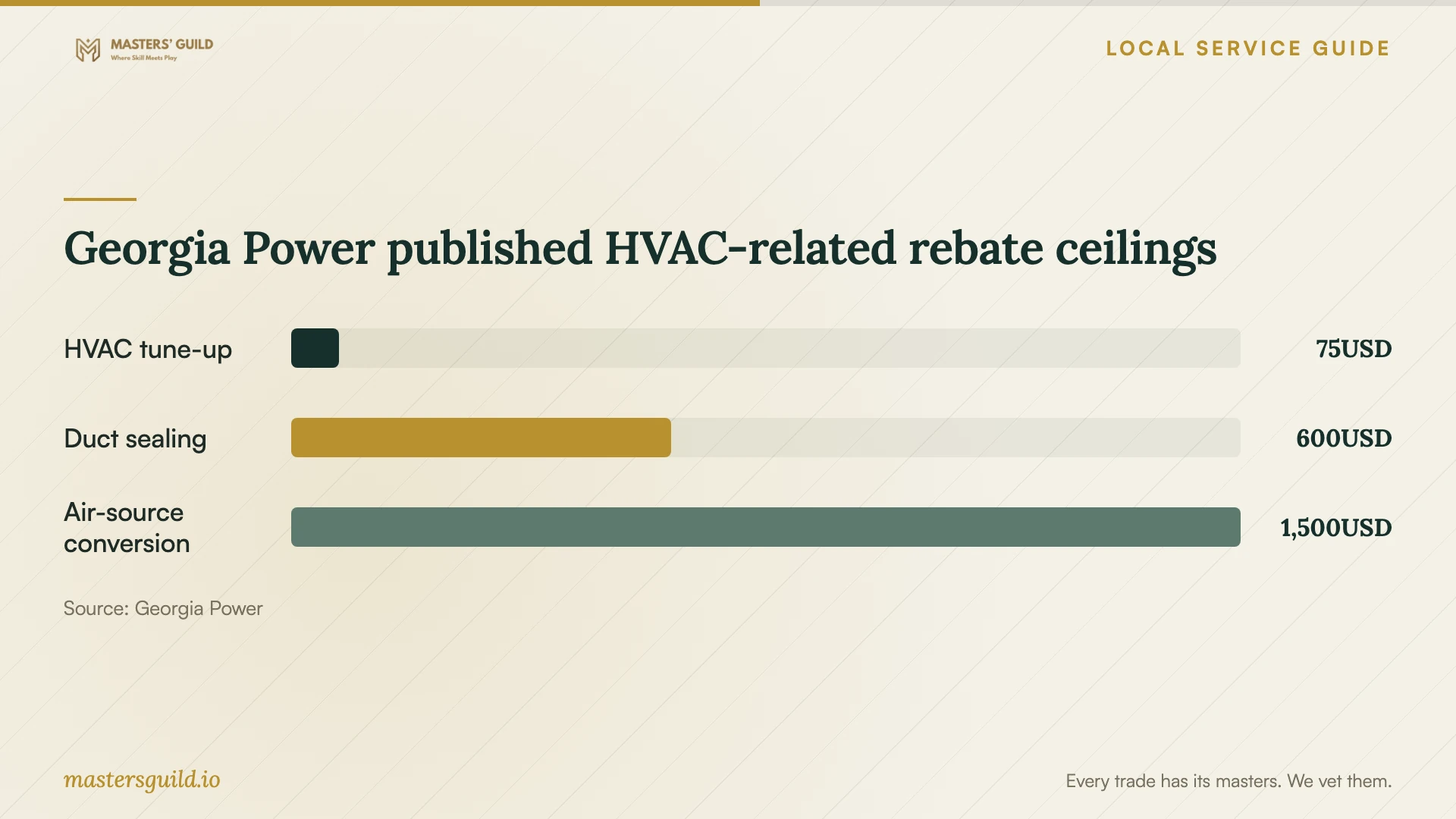
Georgia Power’s Home Energy Improvement Program lists up to $75 for HVAC maintenance and tune-up, up to $600 for duct sealing, and up to $1,500 for conversion to an air-source heat pump. These amounts are rebate ceilings. Confirm current terms and the requirements for your improvement with Georgia Power before including a rebate in your budget. [4]
Georgia Power requires a licensed installer for HVAC improvements. Its FAQ specifies a DET Verifier or Program Installer for duct sealing. Ask each bidder to identify the credential needed for your improvement and who will prepare the application paperwork. Check program qualifications alongside the contractor’s Georgia credential. [2] [4]
The residential program requires a Georgia Power residential account. Applicants need their meter number and must apply within 60 days of the date on the paid-in-full invoice or receipt. Keep the invoice, equipment details and installer information together, then set a reminder to submit the application. [4]
Georgia Power published HVAC-related rebate ceilings
Local details that affect your job
Choose the right Columbus submission route
Effective January 1, 2026, Columbus limits the plan and permit documents it accepts in person. Mechanical, electrical and gas permits remain among the accepted categories, while new commercial and residential plans must go through the online portal. If your HVAC project forms part of new construction, confirm the submission route before arranging an office visit. [1]
Utility requirements affect your installer shortlist
For eligible Georgia Power residential customers here, duct-sealing rebate work requires a DET Verifier or Program Installer, while HVAC improvements require a licensed installer. Ask about the applicable credential before choosing a bidder. Check the utility account serving your home; city residence alone does not establish eligibility for this residential program. [4]
Choose the next step for your HVAC project
| Your situation | Next step | Before approving work |
|---|---|---|
| You need a diagnosis | Book a diagnostic visit and describe the symptoms. | Agree on the visit charge and the process for approving repairs. |
| You are replacing equipment | Request comparable proposals and discuss the Columbus mechanical permit application. | Confirm the permits for the full scope and who submits them. |
| A system exceeds a Class I capacity limit | Request a Class II conditioned-air credential. | Compare the credential with that individual system’s heating and cooling capacity. |
| You want a Georgia Power duct-sealing rebate | Confirm residential account and improvement eligibility. | Ask whether the installer is a DET Verifier or Program Installer. |
| You want a Georgia Power HVAC improvement rebate | Confirm the improvement’s current requirements. | Use a licensed installer and plan to apply within 60 days of the paid-in-full invoice or receipt. |
Your hiring checklist
- Describe the symptom and gather equipment labels, error messages and previous service records.
- Request the qualifying licensee’s name, number and class, then ask the state licensing authority how to confirm current status.
- Ask the bidder to explain how the license class covers the proposed system.
- Request a written diagnosis and separate prices for repair and optional upgrades.
- Agree on permit submissions, charges, inspections and completion paperwork.
- Compare model numbers, included work, exclusions, warranties and payment milestones.
- Confirm rebate terms and installer eligibility with the utility before signing.
Frequently Asked Questions
Does a local business license establish an HVAC credential?
Georgia Consumer Ed’s 2016 guidance distinguishes a city or county business license from a state HVAC contracting license. Request the qualifying licensee’s Georgia conditioned-air credential and ask the state licensing authority how to confirm its current status. [3]
Which Columbus permit should I discuss for replacement?
Ask about the mechanical application and any electrical or gas-piping changes in the scope. Columbus publishes applications for those categories. Confirm your project’s requirements with Inspections and Code before work starts. [1]
Can I choose my own installer for a Georgia Power rebate?
Georgia Power’s requirements depend on the improvement. HVAC improvements require a licensed installer; duct sealing requires a DET Verifier or Program Installer. Confirm the current requirements for your project before hiring your preferred contractor. [4]
How should I budget without a local price estimate?
Request a written diagnostic charge or a complete installation quote for your equipment and scope. Compare the amount due before incentives. Georgia Power’s published figures describe conditional rebates, so confirm eligibility and terms before subtracting an incentive from your budget. [4]
Sources and scope
This guide combines the sources below with practical planning guidance. Figures apply to the stated geography and period; request a written quote for your property.