
Local service guide
Warehouse Organization in Cincinnati, OH
For Warehouse Organization in Cincinnati, hire a crew against a written scope covering inventory sorting, storage zones, labels, stock movement, and handover. Separate hauling and building modifications in the quote. If the job includes commercial waste collection, verify the hauler’s city franchise; ask Buildings & Inspections about proposed alterations before scheduling that work. [1] [3]
Define the work before requesting quotes
Start with the problem you want the crew to solve: mixed stock, unidentified cartons, crowded receiving space, or a backlog of returns. Mark the affected area on a floor plan and describe what staff should be able to find or do after the reset. Ask bidders to walk the space before committing to labor and equipment.
Specify who will count stock, approve disposal, update inventory records, and supply labels or bins. Give the crew a location-naming convention that matches your records. Ask for a sample label and a trial bay before approving the full reset, especially if your staff must enter locations into an existing inventory system.
Set aside a review area for unidentified items. Require your designated employee to approve their destination before the crew moves them into active stock or sends them away. Keep customer-owned goods and items awaiting a return decision outside the disposal scope.
Compare the full scope and cost
Request separate amounts for organizing labor, supervision, labels and storage products, equipment, hauling, and disposal. For hourly work, ask whether the rate covers one worker or the whole crew, what minimum applies, and who can authorize extra time. For a fixed quote, write down the inventory and areas it covers.
Agree on the procedure for discoveries during the job, such as damaged stock or an unlisted storage area. Require the provider to describe the added work and obtain your approval before proceeding. Ask who pays for replacement labels or bins if you reject the proposed format during the trial.
For the hauling portion, ask the provider to identify franchise-related charges. Cincinnati allows franchise holders to pass the franchise fee and related costs to customers. That permission does not establish a standard customer charge, so compare the amounts in your actual quotes. [2]
Plan stock movement around operations
Choose a work sequence with your warehouse lead. Identify the receiving, picking, packing, and dispatch activities that must continue during the reset. Agree on staging areas and the point at which your employee will release each completed zone back to use. Tell the crew how to handle urgent orders during the work.
Ask who will operate lifting equipment and move elevated or heavy stock. Request evidence of insurance appropriate to the proposed work and clarify responsibility for damage to inventory, floors, or equipment. If you plan to move or modify racking, ask the provider to describe that work separately and obtain a requirements check before approving it.
Arrange disposal before the cleanout
Cincinnati defines commercial waste collection service to include collecting, transporting, storing, disposing of, or separating commercial waste generated within the city. Its program covers commercial waste, including construction and demolition debris. Ask the provider how it will handle the waste portion and verify the responsible company’s franchise before work starts. [1]
Specify the destination for each material stream. The city excludes recyclable material taken to a material recovery facility, hazardous or infectious waste, and organics taken to a permitted compost facility from its definition of commercial waste. Do not assume that a recycling label settles how the city treats a particular load; ask about the material and receiving facility. [1]
The city’s facility list notes that accepted recycling materials vary and that the list can change. Ask the hauler to confirm acceptance before pickup and provide destination receipts as part of the handover. If the proposed facility does not appear on the city’s list, contact the city about approval. [2]
Check building changes and accept the finished work
Describe any proposed construction to Buildings & Inspections before committing to the schedule. Cincinnati lists building alterations, repairs, and changes of occupancy or use among permit triggers. It also requires separate permits for electrical work, fire alarms, and suppression systems. The published guide does not establish a blanket permit requirement for stock sorting and labeling. [3]
At handover, have an employee retrieve sample items using the new labels and location records. Reconcile stock moved during the reset, inspect the agreed areas, and record unresolved items. Ask the provider for a final location map, disposal documentation, and a short explanation of how staff should maintain the arrangement.
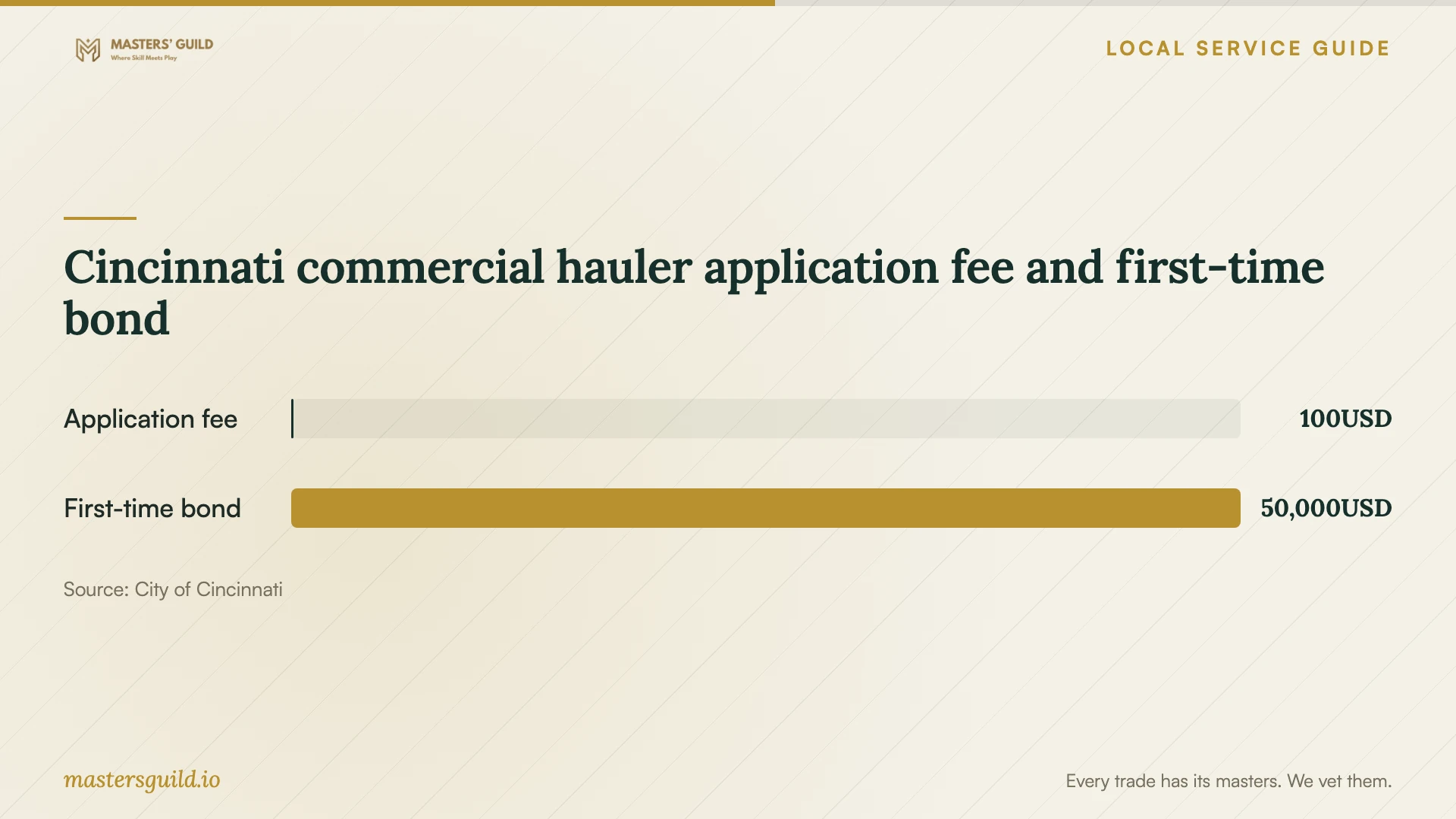
Cincinnati commercial hauler application fee and first-time bond
Local details that affect your job
Choose container space before booking pickup
Within Cincinnati, solid-waste dumpsters must be placed and stored on private property. Carts must be placed behind the curbline and stored on private property; neither may be placed or stored in the right-of-way. The city allows temporary construction and demolition debris roll-offs in the public right-of-way only after an open street permit through DOTE. Confirm the waste type and available space before choosing a container; a general warehouse cleanout does not give you permission to place a solid-waste dumpster in the street. [2]
Verify the hauling company, including subcontractors
Cincinnati requires companies providing commercial waste hauling within the city to obtain a franchise, including companies hauling commercial construction and demolition debris. Ask an organizer who subcontracts removal to name the hauler so you can check that company’s status. Apply this city program to a Cincinnati address; check the relevant jurisdiction for a warehouse outside city limits. [1]
Separate renovation approval from the organizing schedule
If your reset includes interior demolition, a change of use, or electrical or fire-system work, contact Cincinnati Buildings & Inspections before booking those tasks. The city identifies these categories in its permit guide and warns that work without a required permit incurs an investigation fee equal to the regular permit fee, in addition to that fee. [3]
Match the scope to the help you need
| Proposed work | Planning choice | Confirm before booking |
|---|---|---|
| Light sorting and labels | Consider staff work or an organizing crew | Location names, counting duties, and completion criteria |
| Heavy or elevated stock movement | Request a crew and equipment plan | Operators, insurance, access, and responsibility for damage |
| Commercial waste removal in Cincinnati | Verify the responsible hauler’s city franchise | Company name, waste type, destination, and charges |
| Solid-waste dumpster | Reserve space on private property | Placement and pickup access; no open street permit eligibility |
| Building or system changes | Ask Buildings & Inspections about required permits | Scope of alterations and electrical or fire-system work |
Your hiring checklist
- Mark the affected zones and provide photos or a floor plan.
- Name the employee who can approve stock movements and disposal.
- Approve a sample label and trial storage bay.
- Request itemized labor, materials, equipment, and hauling charges.
- Identify the hauling company and check its applicable city status.
- Agree on container space and pickup access.
- Clarify equipment operators, insurance, and responsibility for damage.
- Define handover checks, inventory updates, and required receipts.
Frequently Asked Questions
Can the organizing crew remove unwanted stock?
Include removal in the written scope and identify the company performing it. Cincinnati requires a franchise for commercial waste collection within city limits. Confirm the material and destination because the city’s definition excludes certain waste and recycling streams. [1]
Can I place a cleanout dumpster in the street?
Cincinnati requires solid-waste dumpsters to be placed and stored on private property and does not make them eligible for open street permits. Temporary construction and demolition debris roll-offs can use the public right-of-way after an open street permit through DOTE. [2]
Do sorting and labeling require a building permit?
The city’s permit guide does not identify ordinary sorting and labeling as a permit category. It does identify alterations, repairs, and changes of occupancy or use. Describe any proposed building, racking, electrical, or fire-system changes to Buildings & Inspections for a scope-specific answer. [3]
How should I check the result before accepting the job?
Have staff locate sample items from the updated records. Inspect the agreed zones, reconcile moved stock, and review disposal receipts. Record unfinished tasks and assign responsibility for maintaining labels and locations.
Sources and scope
This guide combines the sources below with practical planning guidance. Figures apply to the stated geography and period; request a written quote for your property.