
Local service guide
Warehouse Organization in Chula Vista, CA
Arrange Warehouse Organization in Chula Vista by hiring a crew for a defined storage zone, naming who approves inventory moves, and agreeing on labels, stock counts, and disposal exclusions before work starts. Ask for a walkthrough and a written quote. If the reset involves vehicle aisles or discarded chemicals, review California aisle requirements and San Diego County business hazardous waste guidance before approving the layout or hauling. [1] [2]
Define the job before comparing quotes
Start with one operational problem: staff cannot find parts, receiving stock blocks picking space, or returns lack an assigned location. Give each bidder the same zone boundaries, photographs, inventory information, and desired result. Ask them to describe how they would sort, relocate, label, and hand over that zone.
Separate sorting and labeling from equipment operation, rack changes, and waste removal in the written scope. Ask who will supply bins and labels, who will authorize disposal, and who will update your stock records. Request evidence of insurance appropriate to the proposed work and ask about experience in occupied commercial premises.
Ask the provider to state crew size, charging basis, minimum booking, materials, equipment, hauling charges, and exclusions. For an hourly quote, agree on a spending limit and the point at which the supervisor must seek approval. For a fixed quote, record the assumptions about stock volume and access so you can assess any proposed change.
Review movement routes before relocating stock
California requires permanent aisles and walkways to remain reasonably clear and in good repair. Where poor definition makes them hazardous, employers must define them with painted lines, curbing, or another marking method. Include route markings and a final clearance check in the plan rather than leaving them until the crew has filled the bays. [1]
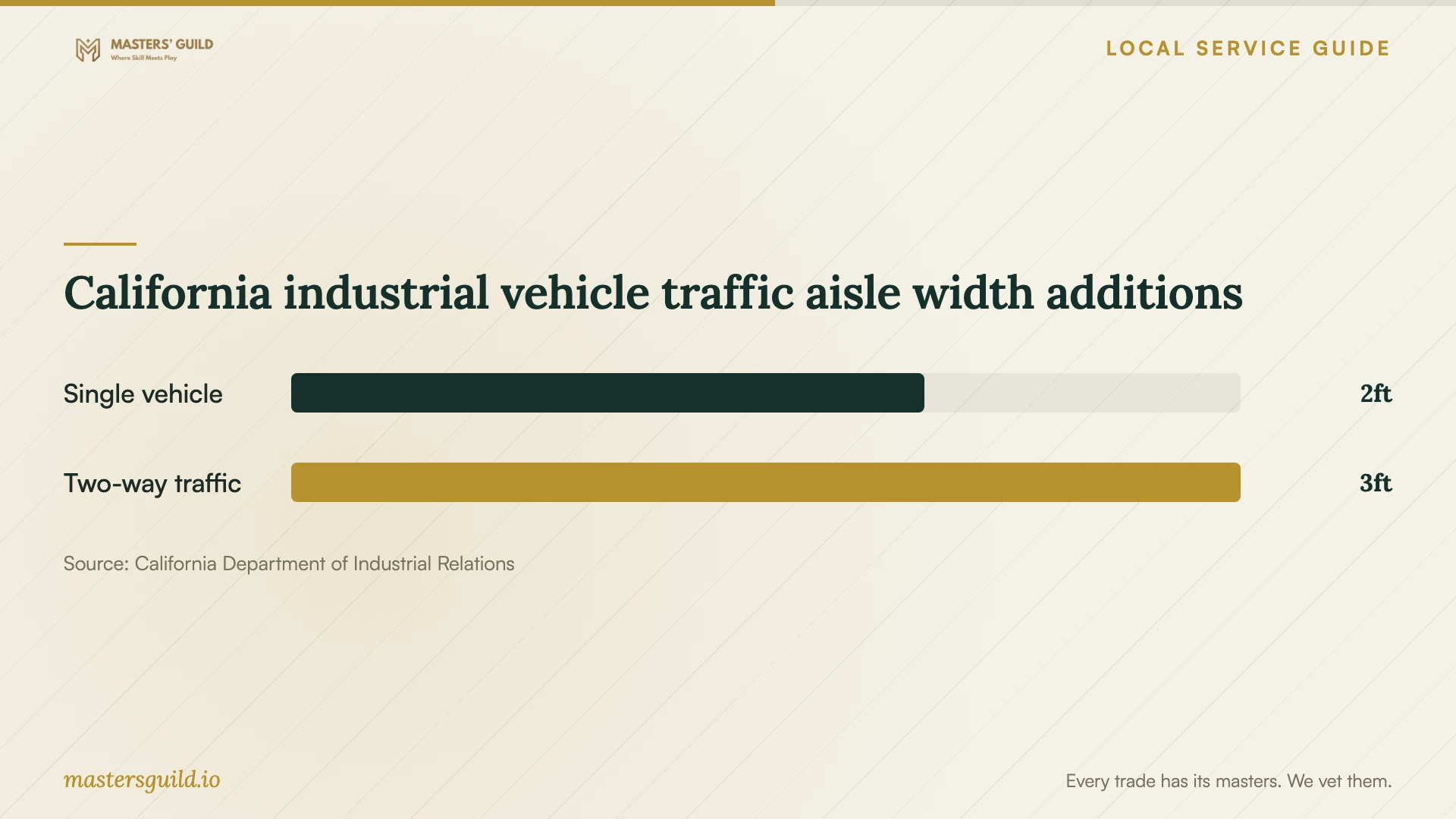
For industrial vehicles in customary use, Section 3272 specifies single vehicle traffic aisles at least 2 feet wider than the widest vehicle. Two-way traffic aisles must be at least 3 feet wider than twice the width of the widest vehicle. The section includes a storage access aisle exception; do not apply these formulas to every gap between racks without reviewing the aisle category. [1]
Ask your workplace safety lead to review equipment dimensions, turning movements, pedestrian routes, and the proposed stock positions. Treat the published aisle figures as part of that review. Avoid asking an organizing crew to approve a complete traffic layout unless you have established that responsibility and their qualifications.
Resolve business waste before booking hauling
San Diego County places hazardous waste determination on the generator. The business must assess toxicity, reactivity, ignitability, and corrosivity; questionable waste streams may need chemical or physical analysis. Set aside unidentified containers for assessment and assign someone in your business to resolve their status before the crew handles disposal. [2]
The County states that hazardous waste must go to state permitted treatment, storage, or disposal facilities and that California Registered Hazardous Waste Transporters must transport it. Its guidance prohibits disposal in regular trash, on the ground, or into storm drains. Ask bidders to exclude hazardous waste from ordinary hauling and identify any separate disposal arrangement. [2]
For a small business disposal route, the County lists qualification thresholds of less than 27 gallons or 220 pounds of hazardous waste per month and less than 1 quart or 2.2 pounds of acute hazardous waste per month. It provides 858-694-2456 for information. Confirm qualification, accepted materials, charges, and delivery instructions before committing the sorting crew to a disposal date. [3]
Keep stock records usable during the reset
Choose a labeling convention before anyone moves stock. Give each location an identifier and agree on how staff will record item codes, quantities, and exceptions. Keep returns, damaged stock, and items awaiting an owner decision in separate designated areas. Name the person who can release each category for reuse or disposal.
Plan work around your receiving and dispatch commitments. Ask the crew to finish and hand over a zone before opening the next one. Define temporary stock locations and tell staff how to find items during the change. If you want barcode labels, include a scan check using your own devices in the acceptance steps.
At handover, have a staff member retrieve selected items using the new location records. Check unresolved count differences, photograph completed areas, and record who owns the remaining decisions. Ask for an editable location list and a written description of the labeling convention so your staff can maintain the system.
California industrial vehicle traffic aisle width additions
Local details that affect your job
County business disposal qualification
For a Chula Vista business considering San Diego County's small business hazardous waste disposal service, qualification comes before scheduling. The County describes the service for qualifying Very Small Quantity Generators and lists monthly generation thresholds. Use its information number, 858-694-2456, to confirm whether your business and waste qualify; do not assume a household collection arrangement accepts business waste. [3]
County hazardous waste oversight
San Diego County identifies its Hazardous Materials Division as the local Certified Unified Program Agency implementing hazardous waste laws. Its guidance requires hazardous waste generators to report through the California Environmental Reporting System. If the reset reveals a questionable waste stream, assign the classification and reporting review to your business before authorizing the organizing crew to remove it. [2]
Match the scope to the work
| Situation | Arrange | Confirm before starting |
|---|---|---|
| Accessible stock needs sorting and labels | An organizing crew with a defined zone | Label convention, inventory approvals, and handover records |
| The reset changes vehicle traffic aisles | A layout review with your workplace safety lead | Applicable clearance rules and the storage access aisle exception |
| Discarded chemicals have uncertain status | Hazardous waste determination by the business | Classification before authorizing removal |
| The business may qualify for small quantity disposal | Eligibility review with the County program | Generation thresholds, accepted waste, and delivery arrangements |
| Hazardous waste needs transport to a disposal facility | A compliant hazardous waste transport arrangement | California transporter registration and a state permitted destination |
Your hiring checklist
- Photograph the work zone and list the stock, equipment, and access constraints for each bidder.
- Name one business representative to approve moves, count adjustments, and disposal.
- Agree on location identifiers, label materials, and an editable stock location record.
- Separate organizing, equipment operation, rack changes, and hauling in the quote.
- Have your workplace safety lead review the proposed routes before relocation starts.
- Identify uncertain waste and confirm its disposal route before booking removal.
- Agree on work windows, temporary stock locations, and spending approval points.
- Test item retrieval and any barcode labels before accepting the handover.
Frequently Asked Questions
How much should I budget for the reset?
Request a written quote after a walkthrough. These sources provide no verified local organizing prices. Compare bids using the same zone, inventory assumptions, materials, equipment, and disposal scope. Ask for separate charges and an approval process for additional work.
Can the organizing crew remove old chemicals?
Resolve their waste classification first. San Diego County makes the generator responsible for determining whether waste is hazardous. For hazardous waste transport, its guidance specifies California Registered Hazardous Waste Transporters and state permitted treatment, storage, or disposal facilities. [2]
Is a 24-inch aisle enough for the warehouse?
Do not use that figure as a universal warehouse layout standard. Section 3272 specifies a 24-inch minimum for required clear walkways or aisles leading to safe egress, alongside headroom requirements. It gives separate industrial vehicle traffic aisle formulas and a storage access aisle exception. Have your safety lead review the applicable requirements. [1]
What should I receive at completion?
Specify an editable stock location list, the labeling convention, count exceptions, and a list of unresolved stock or disposal decisions. Have a staff member test retrieval from the completed zone and check labels with your scanning devices if you use them.
Sources and scope
This guide combines the sources below with practical planning guidance. Figures apply to the stated geography and period; request a written quote for your property.