
Local service guide
HVAC services in Chula Vista: Hiring and Planning
To arrange HVAC services in Chula Vista, get a diagnosis and written scope, check the contractor’s license classification, and assign responsibility for permits and completion records. For single-family residential replacements, have the contractor identify applicable duct testing under California’s 2025 guidance. Check SDG&E assistance eligibility before committing to a paid upgrade. [1] [2] [3] [4] [5]
Start with a diagnosis and a defined visit
Describe the problem before booking: weak airflow, uneven room temperatures, unusual sounds or a system that stops before reaching the thermostat setting. Provide equipment model numbers, recent service history and photos of accessible labels. Confirm the diagnostic charge, what the visit includes and whether the company credits that charge toward an approved repair.
Have the technician identify the failed component and explain how the proposed repair addresses your complaint. Request separate repair and replacement options. For uneven temperatures, include an airflow and duct assessment in the diagnostic scope before approving larger equipment. Record the amount you authorize and require approval for additional work.
Check credentials and compare complete quotes
Collect the business name and contractor license number, then match them to the license record. CSLB defines C-20 as covering installation, maintenance, service and repair of warm-air heating, ventilation and air-conditioning systems, including associated ducts, registers, flues, thermostatic controls and filters. Have the contractor explain who will perform any work outside that scope. [1]
Give each contractor the same job description. Compare equipment model numbers, proposed capacity, duct work, electrical work, removal, permit handling, testing and warranty terms. Request insurance documentation and identify who will perform the installation. Put exclusions and the process for approving additional charges in the agreement.
The California Energy Commission’s 2025 single-family residential guidance states that new HVAC systems require load calculations. Have the installer explain the calculation and proposed capacity rather than relying on the old unit’s label. For other building types, have the contractor identify the applicable sizing and compliance requirements. [2]
Include testing and permit completion
For projects covered by the Commission’s 2025 single-family residential guidance, replacing either the indoor or outdoor split-system unit triggers duct sealing and field verification requirements, with alteration-specific requirements and exceptions. Include the applicable tests and corrective duct work in the quote. Owners of other building types should have the contractor identify the requirements for their building. [2]
Under California’s residential Energy Code Compliance program, the installing contractor and an ECC-Rater perform required field verification and diagnostic testing specified on the certificate of compliance. They record results in an ECC-Provider’s residential registry. If a test fails, the contractor must correct the feature or system until it passes. [3]
Name who will schedule the rater, cover corrective work and deliver owner documentation. The Commission identifies ECC verification as part of the permit process and requires completed documentation in the home for the owner. Include permit finalization and compliance records among the agreed completion items. The code version effective when the project was permitted remains applicable. [3]
Check assistance before paying for an upgrade
SDG&E’s standard Energy Savings Assistance program confirms eligibility and arranges an in-home assessment before offering upgrades. ESA Basic Plus lists gas furnace repair or replacement, room A/C replacement and duct sealing among potential services. Participants must provide additional income documentation for Basic Plus, and customers do not qualify for all listed services. [4]
Have the program assessor identify which services your household and existing appliances qualify for before signing a paid replacement agreement. Keep the contractor’s project price separate from assistance that the program has confirmed. Do not budget around an assumed reimbursement or a particular appliance until you receive a clear program decision.
Plan access and collect closeout records
Agree on access to indoor equipment, the outdoor unit and ducts. Confirm how long you will lack heating or cooling, which visits require you to be home and how the crew will protect occupied rooms. Name the person responsible for schedule updates and additional-charge approvals.
At handover, have the installer demonstrate thermostat settings and explain filter access and maintenance instructions. Collect model and serial numbers, warranty paperwork, the itemized invoice and applicable permit and compliance records. Identify who will respond if the original comfort problem continues.
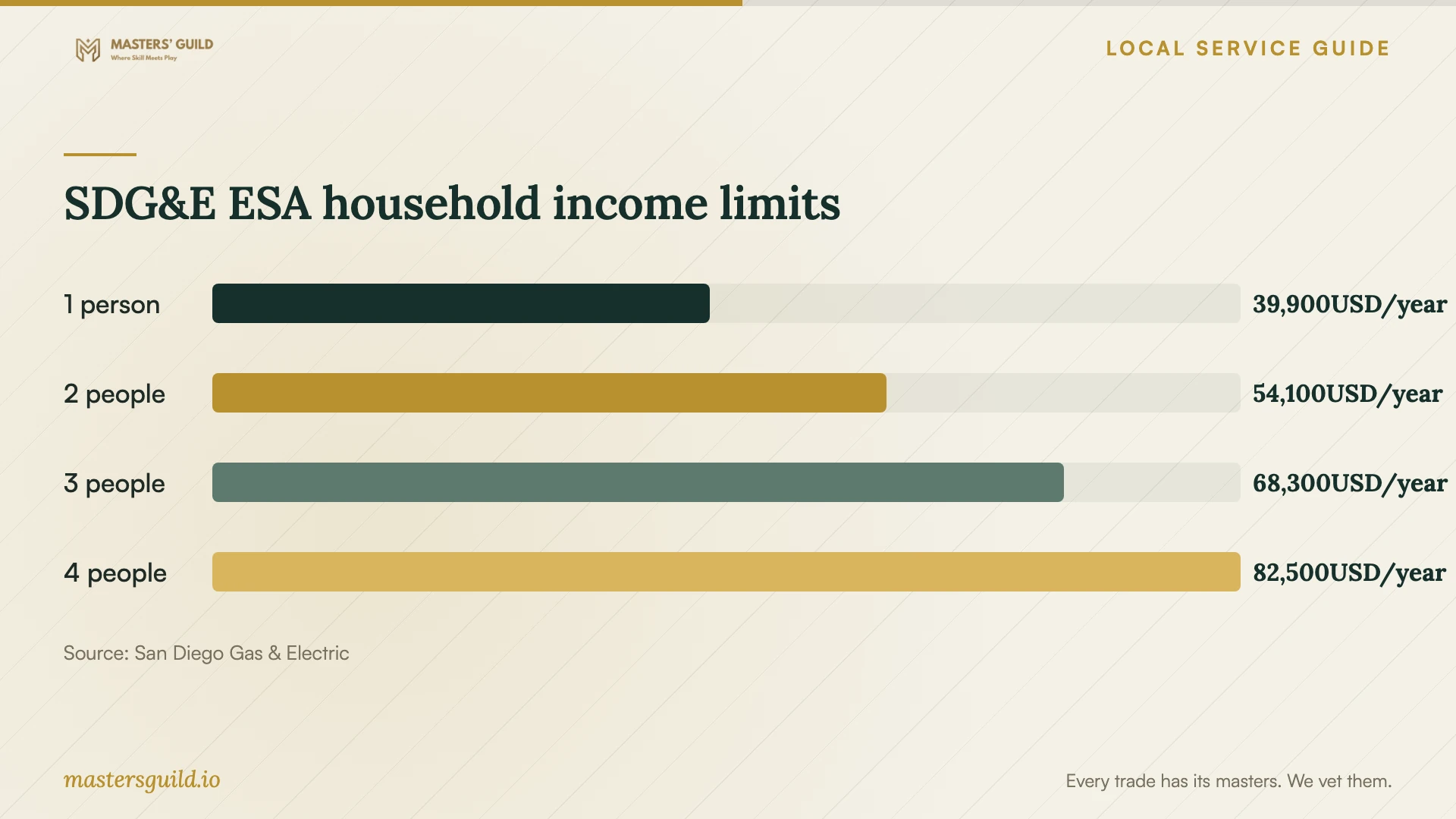
SDG&E ESA household income limits
Local details that affect your job
Standard SDG&E assistance includes smaller residential buildings
For a Chula Vista household with SDG&E service, consider standard ESA if you live in a duplex, triplex or fourplex. SDG&E treats residences with four or fewer units as single-family homes for this program. Applicants need an active account, residential metering and qualifying income or participation in a listed assistance program, plus service-specific eligibility. Owner approval may be necessary for upgrades. SDG&E also identifies possible co-pays for landlords who own appliances and pay tenant utility bills. Confirm approval and payment responsibilities before scheduling work. [4]
Whole Home requires a separate eligibility check
SDG&E’s regional Whole Home pilot lists heat pumps, central A/C and duct repair or replacement among potential upgrades. It limits participation to 250 customers. Applicants must meet income and appliance requirements, live in a qualifying ZIP code and a mobile or single-family home, and have an active individually metered residential account with 12 consecutive months of historical gas and electric energy data. Customers using propane for heating or cooling do not qualify. Renters need owner authorization before work begins. The supplied information establishes no eligible Chula Vista ZIP codes. Confirm your address and current availability with the program; funding follows a first-come, first-served process. [5]
Choose the next step for your project
| Your situation | Next step | Clarify before approval |
|---|---|---|
| Operating problem without a diagnosis | Arrange a diagnostic visit | Visit charge, findings and authorization limit |
| Replacing one split-system unit in a single-family residential project | Have the contractor identify applicable duct sealing and field verification under the 2025 guidance | Alteration requirements, exceptions and corrective work |
| Potential standard ESA eligibility | Confirm eligibility and arrange a program assessment | Approved services, documentation and owner approval |
| Considering Whole Home assistance | Confirm ZIP-code eligibility and pilot availability | Historical gas and electric data, housing requirements and approved upgrades |
| Urgent equipment changeout | Assign permit and compliance-document completion | Qualifying later certificate registration must precede permit finalization |
Your hiring checklist
- Record symptoms, model numbers and recent service history.
- Confirm the diagnostic fee and repair authorization limit.
- Match the contractor’s business name to its license record and request insurance documentation.
- Compare equipment, duct work, exclusions and warranties in writing.
- Have the contractor identify requirements for your building type and permit scope.
- Assign rater scheduling, corrective work and completion-document responsibilities.
- Confirm assistance eligibility and approved services before committing to paid upgrades.
- Collect closeout records and review system operation with the installer.
Frequently Asked Questions
Does replacing only the outdoor unit avoid duct testing?
The Commission’s 2025 single-family residential guidance says replacing either split-system unit triggers duct sealing and field verification requirements, subject to alteration requirements and exceptions. Have the contractor identify which apply. For other building types, request the applicable requirements for that building. [2]
Can an urgent replacement finish its paperwork later?
ECC guidance allows later certificate registration for qualifying urgent alterations such as HVAC changeouts, but requires registration before permit closure or finalization. Have the contractor name the remaining documents and schedule their completion. [3]
Can renters receive SDG&E heating or cooling assistance?
Both ESA pathways accept eligible renters. Standard ESA may require owner approval for some upgrades. Whole Home requires an owner authorization form before work begins. Confirm the pathway, service eligibility and approvals before scheduling installation. [4] [5]
Does meeting the income limit guarantee a replacement?
No. SDG&E applies account, housing and service-specific conditions alongside financial eligibility. Standard ESA includes an assessment and appliance replacement criteria. Whole Home adds ZIP-code restrictions, gas and electric account-history requirements and limited first-come funding. [4] [5]
Sources and scope
This guide combines the sources below with practical planning guidance. Figures apply to the stated geography and period; request a written quote for your property.