
Local service guide
HVAC services in Calgary: hiring and permit planning
Arrange HVAC services by identifying whether you need a repair, maintenance visit or installation, then confirm the technician, permit scope and complete price before agreeing. Calgary requires permits for furnace installations and replacements, and electrical and mechanical permits for central AC. For a condo or townhouse upgrade, discuss shared electrical capacity with your contractor and board or homeowner association before committing to equipment. [1] [2]
Describe the problem before booking
Give the contractor the equipment make and model, symptoms and any displayed fault code. Explain whether the problem affects the whole home or particular rooms. Mention recent renovations and previous repairs. Confirm the diagnostic charge, any after-hours charge and how the contractor will seek approval for additional work.
Request a written diagnosis and repair option before deciding on replacement. When comparing installation quotes, give each contractor the same comfort complaints and proposed scope. Request the equipment model, sizing rationale, controls, duct changes and warranty terms so you can compare the complete proposal.
For maintenance, confirm what the visit includes and request a record of findings. The City recommends annual checks and servicing of central heating systems and its listed gas appliances by a qualified service technician. It also advises homeowners to keep the furnace area clear and high-efficiency vents and air intakes free of debris. [1]
Match the contractor to the work
Identify who will perform the refrigeration, gas and electrical portions of your project. Alberta lists Refrigeration and Air Conditioning Mechanic as a compulsory certification trade. For restricted activities, the province authorizes registered apprentices, certified journeypersons and holders of recognized trade certificates. If an apprentice will do the work, ask the employer about mentorship arrangements. [4]
For electrical installation, confirm which contractor will obtain the permit and complete the work. Calgary requires contractor permit applicants to hold an Alberta Master Electrician Certificate, have a City business licence and complete its Qualified Trade application process. Include that contractor's work in your installation agreement. [2]
Request proof of insurance and the names of subcontractors. Get technician qualifications and warranty promises in writing. Confirm who handles a callback, which labour charges the warranty covers and whether you must register the equipment.
Settle permits and capacity before installation
Calgary requires permits for furnace installation and replacement. A qualified gas fitter's gas permit covers the appliance, venting and serving gas line. A qualified HVAC contractor's furnace replacement permit covers the appliance and venting. The City identifies a mechanical permit for major additions or alterations to related ductwork. Have the contractor specify the applicable permits and any separate gas-line work. [1]
For central AC, Calgary lists electrical and mechanical permits. Have an electrician assess the proposed AC or heat pump's electrical demand. The City identifies a service upgrade or energy management system as options when a home cannot support the added load. Its EMS/EVEMS guidance says models on its certified or accepted list do not require a load calculation, while other parts of the page give general load-calculation instructions. Confirm the requirements for your proposal with the electrician or City. [2]
Put permit responsibility, fees and inspection coordination in the agreement. Request permit numbers and retain inspection records with your invoice. Have the contractor distinguish equipment availability, installation time and approval time when proposing a schedule.
Compare quotes and prepare for handover
Use itemized quotes for your home's scope to set your budget. Request separate entries for equipment, labour, electrical work, gas work, venting, duct changes, controls, permits and removal of old equipment. Confirm exclusions, applicable taxes and the process for approving changes.
Before signing, have the installer mark the outdoor AC location and explain service access and neighbour noise. Calgary limits AC projection into a side setback to 1.0 m and prohibits projection into a specified 3.0 m setback reserved for a possible future driveway. Have the contractor check your parcel's layout and resolve any planning approval. [1]
At handover, request a thermostat demonstration and instructions for filter access, routine care and fault reporting. Collect model and serial numbers, manuals, warranty documents and permit records. For a heat pump proposal, request an explanation of cold-weather operation and how any backup heat will work.
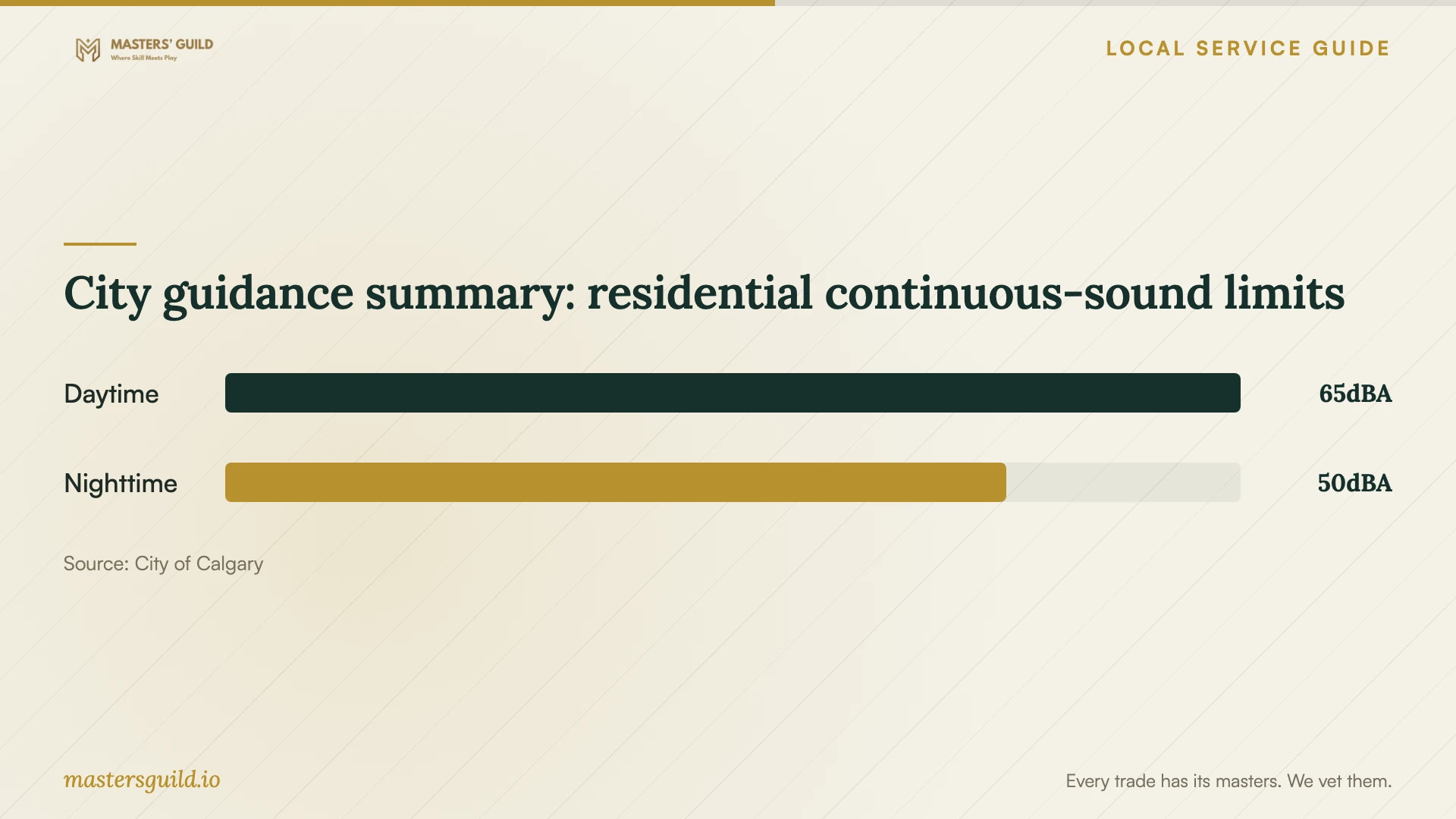
City guidance summary: residential continuous-sound limits
Local details that affect your job
Shared electrical service needs advance coordination
Calgary warns that heating and cooling additions can affect other units sharing an electrical service. Talk to your condo board or homeowner association before proceeding. For a rowhouse with a gang meter base, the City requires a signed Row Housing Electrification Authorization form with the permit submission. This form confirms the electrician's load calculation, sufficient overall service capacity and board or association approval of the added load. Resolve this requirement before paying an equipment deposit. [1] [2]
Check the side yard before choosing an AC unit
Calgary limits an AC unit's projection into a side setback to 1.0 m. Where a parcel has no lane or alley access and no front or side garage, the City requires a 3.0 m side setback for a possible future driveway to a rear garage. AC equipment cannot project into that area. Have the installer confirm a permitted location or resolve planning approval before installation. [1]
Plan for noise during nighttime operation
The City's residential noise summary includes air conditioners and gives continuous-sound limits of 65 dBA during daytime and 50 dBA during nighttime, measured over one hour. Discuss the proposed equipment and location with the installer, especially near neighbouring windows. The City directs readers to the actual bylaw for detailed requirements. A product's advertised sound rating alone does not establish compliance at your property. [3]
Choose the next step for your project
| Your situation | Next step | Resolve before agreeing |
|---|---|---|
| Repair or unexplained performance problem | Book a diagnostic visit and request written findings. | Diagnostic charge, repair approval and callback terms. |
| Furnace replacement | Confirm which furnace or gas permit scope applies. | Responsibility for appliance, venting, gas line and duct changes. |
| Central AC installation | Confirm electrical and mechanical permits and have an electrician assess capacity. | Outdoor location, electrical work and complete installed price. |
| AC or heat pump in a rowhouse with a gang meter base | Confirm the City's signed authorization form and its load-calculation requirements. | Board or association approval and sufficient shared-service capacity. |
| Outdoor AC close to neighbours | Have the contractor review setback rules and the City's noise guidance. | Placement and assessment of detailed bylaw requirements. |
Your hiring checklist
- Record equipment details, symptoms, fault codes and previous repairs.
- Confirm diagnostic charges and the approval process for extra work.
- Identify who performs refrigeration, gas and electrical work and request their qualifications.
- Request an itemized quote with models, exclusions, warranty terms and applicable taxes.
- Confirm permit responsibility and inspection coordination in writing.
- Have the electrician assess capacity and confirm the applicable documentation.
- Resolve board approvals, outdoor placement and operating-noise questions before ordering equipment.
- Collect manuals, warranty documents, permit numbers and inspection records at handover.
Frequently Asked Questions
Does replacing a furnace require a permit?
Yes. Calgary requires permits for furnace installations and replacements. A furnace replacement permit covers the appliance and venting; a gas permit also covers the serving gas line. Confirm which scope applies and who will obtain the permit. [1]
Do I need a load calculation before adding central AC?
Have an electrician assess capacity first. Calgary gives general instructions to calculate added load, but its EMS/EVEMS guidance exempts models on its certified or accepted list from a load calculation. Confirm the applicable requirement with your electrician or the City, including any shared-service documentation. Central AC requires electrical and mechanical permits. [2]
Does every AC technician need a Red Seal?
Alberta lists the Red Seal endorsement as optional. For restricted Refrigeration and Air Conditioning Mechanic activities, the province authorizes registered apprentices, certified journeypersons and holders of recognized trade certificates. Request the technician's applicable qualification and, for an apprentice, mentorship details. [4]
Who can clarify a permit or equipment-placement question?
Calgary directs heating, ventilation, air conditioning and related code questions through 311 to its Technical Assistance Centre. Its Planning Services Centre handles other inquiries, including Land Use Bylaw questions. Have your proposed location and work description ready. [1]
Sources and scope
This guide combines the sources below with practical planning guidance. Figures apply to the stated geography and period; request a written quote for your property.