
Local service guide
Warehouse Organization in Buffalo, NY
Arrange Warehouse Organization in Buffalo with a written scope for sorting, labels, inventory updates, equipment, and cleanup. Choose a crew whose proposed work fits your commercial premises, and assign someone to approve stock movement and disposal. Before booking removal, check material-specific destinations in Erie County’s recycling directory and confirm any hazardous-waste arrangements with the county. [1] [2]
Define the work and crew responsibilities
Describe the problem in terms your staff can check at completion: stock they cannot locate, returns mixed with saleable goods, or a receiving area you want to clear. Mark the affected area on a floor plan and identify fixtures and stock the crew must leave in place.
Give bidders photos, approximate quantities, known item weights, and details about stock on high shelves. Ask who will supply and operate lifting equipment. Request proof of insurance covering the proposed commercial work and ask how the crew will coordinate with receiving and dispatch staff.
Separate rack alterations, repairs, and equipment installation from sorting and labeling. Ask the provider to identify any specialist assessment or approval needed for those tasks. State whether the crew may move shelf contents, pallets, or storage fixtures.
Compare quotes against the same finish
Request separate amounts for labor, labels and containers, equipment, hauling, and disposal. For hourly work, establish whether the rate covers one worker or the crew, then agree on a spending limit and approval process for extra work. For a fixed price, describe the included area and completion criteria.
Distinguish sorting from counting. Decide whether your staff or the provider will reconcile quantities, investigate discrepancies, and update inventory software. Approve a sample label and location name before the crew repeats them across the work area.
Erie County’s hazardous-waste program page says the county calculates disposal costs from a completed certification form describing waste types and amounts. Obtain that cost before agreeing to a combined organization and disposal budget. Ask bidders to identify their coordination responsibilities and have the county confirm transport arrangements. [1]
Control inventory movement and disposal decisions
Choose a work window with receiving and dispatch staff. Either pause transactions in the affected zone or agree how staff will record each movement. Give the crew a named supervisor and reserve a review area for unidentified stock, damaged packaging, and items awaiting a decision.
Keep outgoing pallets, cardboard, electronics, and chemicals in separate groups pending acceptance. Erie County’s directory lists destinations by material and includes service restrictions. The county’s hazardous-waste guidance directs readers to product labels and safety data sheets to identify hazardous ingredients. Retain those records for the disposal discussion. [1] [2]
Have your supervisor approve an outgoing-material list before loading. At handoff, ask a staff member to retrieve selected stock using the new labels and records. Review unresolved items with the crew, photograph completed zones, and agree who will correct missing labels or location discrepancies.
Plan collection access and a weather contingency
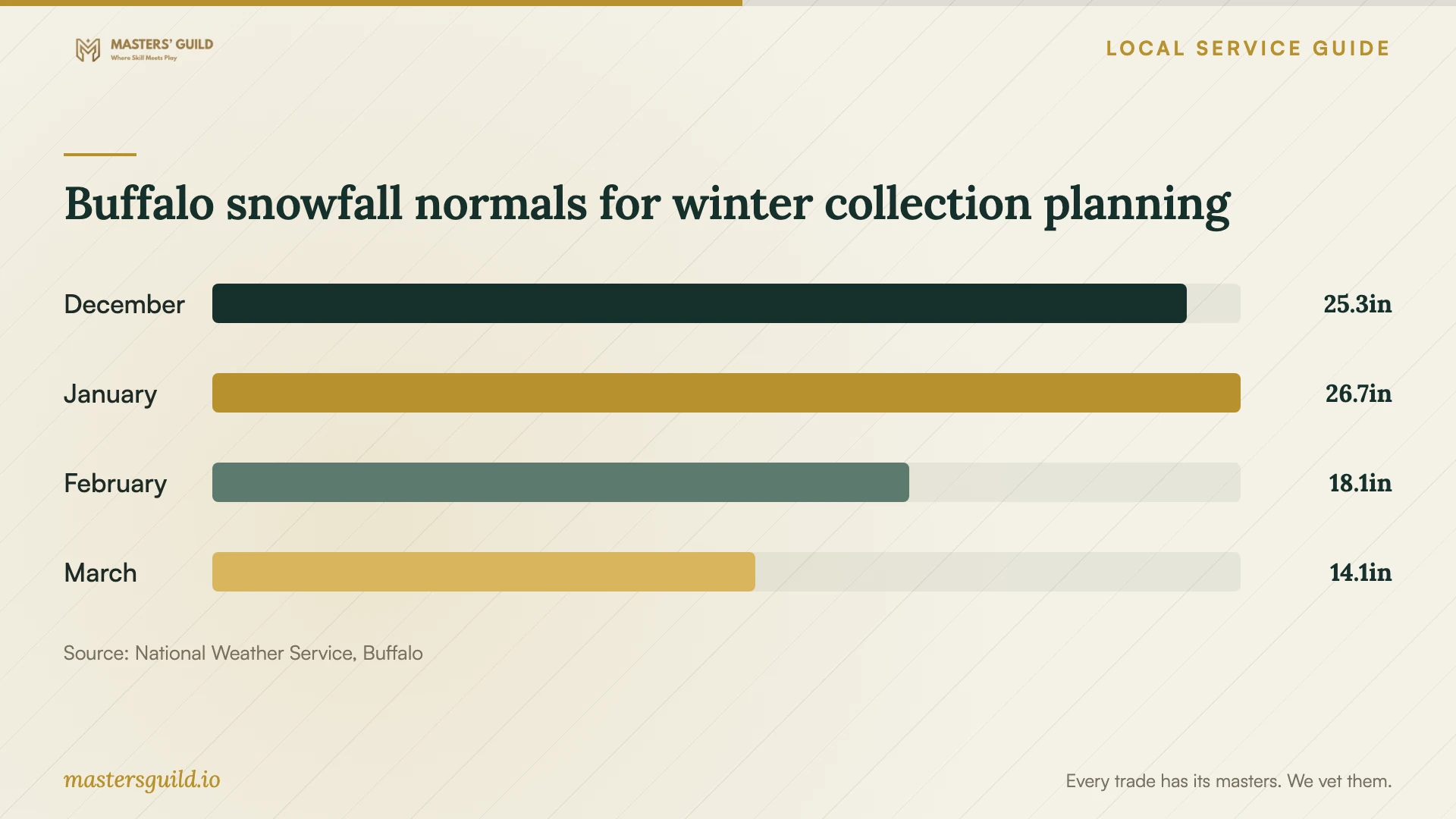
For work involving outdoor staging or collection vehicles, agree on covered holding space and a rescheduling decision. The National Weather Service presents Buffalo’s 1991–2020 snowfall normals, including 25.3 inches in December and 26.7 inches in January. Treat those historical station averages as planning context. [3]
Assign someone to check the forecast and loading route before the workday. Decide where staff will hold materials if a collection cannot proceed, and agree how they will protect and retrieve stock placed outside. Confirm whether postponing collection changes the crew’s scope or charges.
Buffalo snowfall normals for winter collection planning
Local details that affect your job
Confirm hazardous-waste eligibility and hauling with Erie County
Erie County’s program page, marked updated July 25, 2025, describes a disposal route for qualifying Western New York businesses and agencies. Its screening guidance lists generation below 1 kilogram per month of acute hazardous waste or 100 kilograms per month of listed or characteristic hazardous waste, and storage never exceeding 1,000 kilograms. Treat these as the county page’s screening guidance, not a complete legal eligibility test. Call 716-858-4805 for county confirmation of eligibility and waste-specific requirements. The page says participants transport their own waste and may haul up to 100 kilograms. The 1,000-kilogram storage threshold is not a transport allowance. Confirm permitted quantities and transport arrangements with the county before moving waste. The county describes certification, calculated costs, an assigned appointment after cost acceptance, and payment at drop-off; confirm those arrangements before scheduling the cleanout. [1]
Ask about pallet pickup within Buffalo
Erie County’s directory lists Buffalo Pallets at 534 Hopkins Street in Buffalo, with pickup and a direction to call about its pallet exchange program. Use that listing to investigate a separate route for surplus pallets. Ask about your pallet sizes, condition, quantity, charges, and collection date before including removal in the crew’s scope. The directory listing does not verify current acceptance or availability. [2]
Check a commercial cardboard route in Depew
The same county directory lists Cascades Recovery at 3241 Walden Avenue in Depew for commercial cardboard and paper recycling, with pickup and drop-off options. Ask whether it accepts your load and what preparation, quantity, and collection terms apply. Keep cardboard separate while you confirm the destination. This is a regional option outside Buffalo; the two county listings do not provide independent verification of either provider’s current service. [2]
Match the work to your warehouse problem
| Situation | Scope to request | Before booking |
|---|---|---|
| Stock needs clearer locations | Sorting, zones, labels, and a location-record handoff | Choose who approves the layout and updates records |
| Heavy stock or high shelves | A written equipment and access plan | Confirm equipment operators and insurance for the proposed work |
| Surplus pallets and cardboard | Separate material collection arrangements | Investigate the county-listed Buffalo pallet and Depew commercial cardboard options; confirm acceptance |
| Old chemicals awaiting disposal | Waste review and a county-confirmed disposal plan | Confirm eligibility, costs, appointment, permitted hauling quantity, and transport; the county page states up to 100 kilograms |
Your hiring checklist
- Photograph the work area and mark stock or fixtures the crew must leave in place.
- Provide quantities, known weights, shelf access, and your operating schedule.
- Name the person who can approve stock movement and disposal.
- Confirm equipment responsibilities, commercial insurance, and excluded tasks.
- Separate labor, supplies, hauling, and disposal in the quote.
- Have Erie County confirm hazardous-waste eligibility, permitted hauling quantities, and transport arrangements before moving waste.
- Confirm each recycling destination’s acceptance and collection arrangements.
- Test item retrieval and review unresolved stock before accepting completion.
Frequently Asked Questions
How much should I budget?
Request a site-specific estimate with labor, supplies, equipment, hauling, and disposal separated. Give bidders the same completion criteria. Erie County’s hazardous-waste page says the county calculates disposal costs after reviewing the certification form, so obtain that figure before setting a combined budget. [1]
Can the organization crew remove all unwanted materials?
Ask the crew to identify each material it proposes to remove and the receiving destination. Erie County lists material-specific recycling routes. Its hazardous-waste page describes participant self-transport and a hauling limit of up to 100 kilograms. Have the county confirm permitted quantities and transport arrangements before assigning that work. [1] [2]
Does the county’s storage threshold let me transport 1,000 kilograms?
The county page describes separate thresholds: storage never exceeding 1,000 kilograms and participant hauling up to 100 kilograms. The storage threshold is not a transport allowance. Ask the county to confirm your eligibility, waste-specific requirements, and transport arrangements before moving any waste. [1]
Can I keep operating during the work?
Discuss working by zone with your staff and the provider. Reserve receiving space, record stock movements, and ask which tasks require exclusive access. Put the agreed work windows and inventory responsibilities in the scope.
Sources and scope
This guide combines the sources below with practical planning guidance. Figures apply to the stated geography and period; request a written quote for your property.