
Local service guide
Long-Distance Moving in Buffalo: Hiring and Planning
For Long-Distance Moving from Buffalo, choose a mover after checking which authority covers your route, comparing written estimates for the same inventory, and agreeing on delivery and weather-delay arrangements. New York State DOT licenses movers operating within the state; shipments crossing a state line fall under federal jurisdiction. Ask each candidate to explain its authority for your route before you sign. [2]
Check the mover against your destination
Start with your origin and destination. NYSDOT regulates moves that start and finish within New York. If your shipment crosses a state line, NYSDOT directs you to the Federal Motor Carrier Safety Administration, including for moves that originate or terminate in New York. [2]
For a move within New York, contact NYSDOT at 518-457-6512 with the company's exact name and its NYDOT number if available. Ask the company to identify the carrier that will transport your belongings, and compare that name with your estimate and service documents. Resolve any mismatch before booking. [2]
For an interstate move, ask the candidate how you can verify its federal authority and which company will handle pickup, transport and delivery. If your destination is Canada, request an explanation of border paperwork and responsibility for clearance. Ask the mover to identify the applicable requirements before accepting its proposal.
Compare the same job in each estimate
For moves within New York, NYSDOT recommends at least three estimates and prefers a physical inspection of your home. The department cautions against assuming a phone or written estimate will equal the final cost. Give each mover the same inventory and request a written explanation of how it calculates the charge and handles changes. [2]
Walk through the whole shipment: furniture, packed boxes, basement storage and anything you expect to add before pickup. Show the mover stairs, doorways, the loading location and items that need special handling. Describe the destination with the same care. Ask whether the price includes packing, taking belongings out of boxes, storage, appliance work and carrying items from the truck to their intended rooms.
NYSDOT advises customers not to expect free packing supplies, cleanup, or appliance disconnection and reinstallation. Ask each mover to list included work and separate charges. If you plan to pack yourself, ask what preparation the mover expects and how that choice affects its responsibility for damage. [2]
Agree on delivery, payment and protection
For a move within New York, NYSDOT says the mover should give you an Order for Service before moving anything. The mover must state the amount you will need to pay at delivery to receive your goods. The department also advises having that amount available in cash or certified check. Confirm the required payment method before loading. [2]
NYSDOT recommends understanding the mover's liability and asking about additional coverage. Request the explanation in writing, including how the mover handles loss, damage and items you pack yourself. Make an inventory with box counts and furniture condition, and keep copies of the documents you sign. [2]
Ask for the pickup and delivery arrangements in writing. Identify your contact during transit and ask how the mover communicates a change. If you have a fixed lease start, closing date or building reservation, explain it before accepting the schedule. Decide where you and your essentials will stay if delivery shifts.
Plan loading access around Buffalo snow
The National Weather Service describes Buffalo-area lake-effect snowfall as localized and says areas south of Buffalo receive more than locations to the north. Ask the mover to consider conditions at your address, along the route and at the destination. Check forecasts for both loading locations when reviewing the plan. [3]
The Weather Service notes that many of Buffalo's greatest snowstorms have occurred in late November and early December. For a move in that period, agree on who will make the weather decision and ask about rescheduling, temporary storage and related charges. Assign responsibility for clearing the loading path and keeping it clear while the crew works. [3]
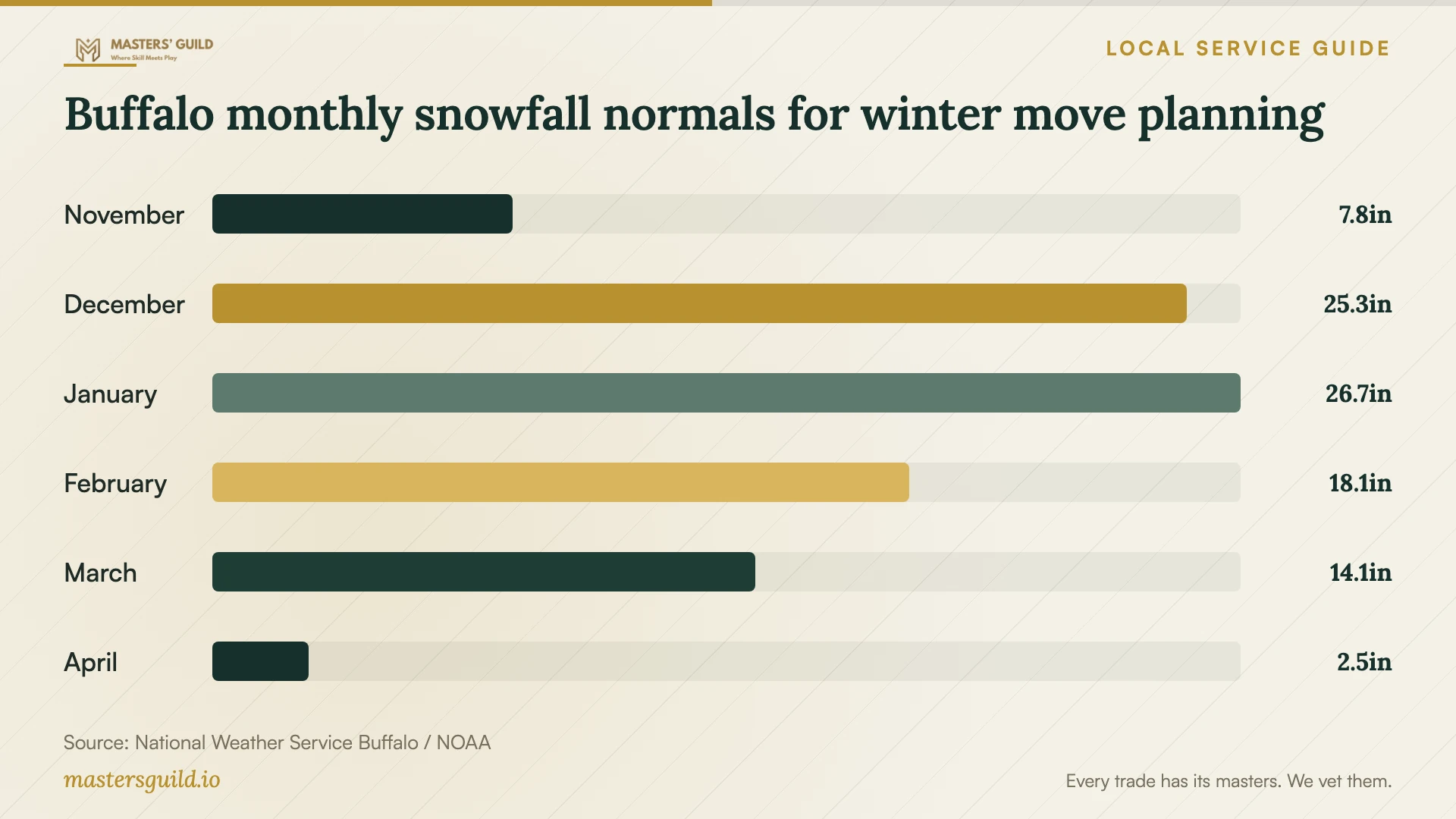
Buffalo's published monthly snowfall normals rise from 7.8 inches in November to 25.3 inches in December. Use the chart as a seasonal planning reference. Check the forecast near your moving date and ask the mover to confirm whether it can use the planned loading location. [1]
Buffalo monthly snowfall normals for winter move planning
Local details that affect your job
State verification for a Buffalo-to-New York move
For a move that starts in Buffalo and finishes within New York, verify the carrier with NYSDOT at 518-457-6512 using its exact name and, if available, NYDOT number. Do this before accepting the estimate. NYSDOT states that its moving regulation covers moves that start and finish within the state. [2]
Address-specific winter contingency
In the Buffalo region, the Weather Service reports more lake-effect snow south of the city than to the north, and identifies late November and early December as periods when major storms have occurred. If your pickup or route runs south of Buffalo, ask the mover to review that location when deciding whether to load. Agree on a fallback date and storage arrangements before committing to a fixed arrival plan. [3]
Choose the next step for your move
| Situation | Next step | Point to resolve |
|---|---|---|
| Origin and destination within New York | Verify the carrier with NYSDOT | Exact company name and available NYDOT number |
| Shipment crosses a state line | Use the federal jurisdiction identified by NYSDOT | Which carrier will transport your shipment |
| Quotes cover different inventories or services | Request revisions using one shared job description | Packing, access, storage and excluded work |
| Late November or early December pickup | Agree on a weather contingency | Rescheduling contact, clear loading access and storage |
| Damage after a move within New York | Notify the mover in writing as soon as possible | Inventory, photographs and supporting paperwork |
Your hiring checklist
- Record the origin, destination, inventory and dates you need before requesting estimates.
- Ask which company will transport the shipment and verify its authority for the route.
- Give each candidate the same inventory, access details and packing instructions.
- Request written inclusions, exclusions and the process for approving extra work.
- Confirm delivery arrangements, payment method and your contact during transit.
- Photograph furniture condition and keep an inventory and copies of signed documents.
- Assign snow-clearing responsibility and agree on a weather-delay plan.
- Keep medication, documents, keys and immediate-use belongings with you.
Frequently Asked Questions
Does a long-distance move within New York require a different licensing check?
NYSDOT licenses movers operating within New York and regulates moves that start and finish within the state. Distance alone does not change that distinction. Verify the mover with the department using its exact name and, if available, NYDOT number. [2]
How much should I budget for this move?
Request written estimates for your shipment and route. Ask each mover to explain the pricing method, included services and circumstances that could change the amount. Compare the same inventory and access requirements, and request separate amounts for optional work so you can decide what to include.
Can I rely on a December pickup date?
Ask the mover how it handles a weather disruption before you commit to the date. Buffalo's 1991–2020 December snowfall normal is 25.3 inches, and the Weather Service describes localized lake-effect snowfall. These historical observations do not predict conditions on your pickup day. [1] [3]
What should I do if belongings arrive damaged?
For moves within New York, NYSDOT advises notifying the mover in writing as soon as possible. It states that movers must acknowledge a written claim within 30 days and resolve it in writing within 120 days. Resolution may include payment, a compromise or denial; NYSDOT cannot adjudicate loss or damage claims. [2]
Sources and scope
This guide combines the sources below with practical planning guidance. Figures apply to the stated geography and period; request a written quote for your property.