
Local service guide
Long-Distance Moving in Brandon, MB
Arrange Long-Distance Moving from Brandon by comparing at least three written estimates for the same inventory and services. Identify the carrier, confirm delivery timing and protection, and agree on legal truck access before booking. For used household goods transported by vehicle on a highway, Manitoba's M.R. 16/2019 requires a bill of lading before shipment. Brandon's truck-route and parking rules also affect your loading plan. [1] [3] [4]
Compare estimates for the same work
Prepare a room-by-room inventory and show each mover everything you want transported, including garage contents and items needing special handling. Canada's Office of Consumer Affairs recommends estimates from at least three reputable movers and a written quote on company letterhead signed by a company representative. [4]
Give each company the same addresses, inventory and access photographs. Describe stairs, elevator bookings and the proposed truck position at both homes. Request separate prices for packing, storage and any smaller-truck transfer. Ask how the mover will price added items or changes to access, and compare totals for the same requested services.
Check the company's physical address and references. Federal consumer guidance identifies phone-only estimates, a missing physical address and large upfront deposits as warning signs. A broker arranges transport through subcontractors; ask who accepts responsibility from pickup through delivery and get that answer in writing. [4]
Review paperwork for used household goods
Manitoba's M.R. 16/2019 addresses used household goods, including used household furniture, appliances and personal effects forming part of a dwelling's contents. Section 4 requires a bill of lading before transport by vehicle on a highway. The province labels its HTML consolidation unofficial and directs readers to the bilingual PDF for an official copy. [3]
For that shipment category, the bill of lading must include an inventory, originating carrier and destination-agent contacts, connecting carriers, declared-value space, space for actual charges, and the agreed delivery date or period. Request a copy and compare it with your estimate before the truck leaves. Ask the carrier to explain any difference. [3]
Schedule C requires the original contracting carrier to determine shipment weight using a certified public scale, enter the weight on the bill of lading and attach the scale receipt. If no such scale is available at the origin or within 16 km, the regulation uses 112 kg per cubic metre of properly loaded van space. Ask which method the carrier will use. [3]
Understand payment and protection before signing
For used household goods under Schedule C, if the carrier requires payment before delivery and charges exceed 110% of the estimate, you pay 110% before delivery and the remainder within 15 days afterward, excluding Saturdays, Sundays and holidays. That extension does not apply if the carrier advised you of actual charges immediately after loading or you waived it in writing. This rule concerns payment timing; it does not cap the final bill. [3]
Ask your home insurer about transit and storage coverage. Federal consumer guidance recommends requesting the mover's Certificate of Insurance and cautions that this insurance does not apply to your goods unless you purchase replacement value protection from the mover. Get the protection terms, exclusions and claims procedure in writing. [4]
For used household goods, Schedule C limits carrier liability to the lesser of declared value, actual value and the applicable weight-based amount: $4.41 per kg if you paid for that coverage, or $1.32 per kg otherwise. Ask how the mover would calculate compensation for a valuable, lightweight item and what additional protection it offers. [3]
Discuss who will pack fragile belongings and prepare appliances or electronics. Schedule C contains exceptions for certain fragile-item and equipment damage, subject to carrier negligence. It also excludes damage to goods at pickup or delivery when neither you nor your representative attends. Arrange attendance at both homes. [3]
Confirm delivery and document any claim
For used household goods covered by Schedule C, the originating carrier must provide a delivery date and time period when accepting the contract. It must pay reasonable food and lodging expenses resulting from late delivery. If you fail to accept delivery during the agreed period, you must pay reasonable resulting storage, transit and redelivery fees. Keep receipts and written delivery communications. [3]
At unloading, check the inventory, record missing or damaged items and take photographs. Section 4 requires a statement that signing for receipt does not prevent later loss or damage claims within the prescribed time limits. Report concerns in writing as soon as you identify them. [3] [4]
Schedule C article 10 requires you to deliver written claim notice to the originating or delivering carrier. Include the shipment's origin, destination, shipment date and estimated claim amount. Deliver this notice within 60 days after delivery, or within nine months of shipment for nondelivery. Separately, file a statement of claim within nine months of shipment. Keep copies and proof of delivery; the carrier must acknowledge the notice within 30 days. [3]
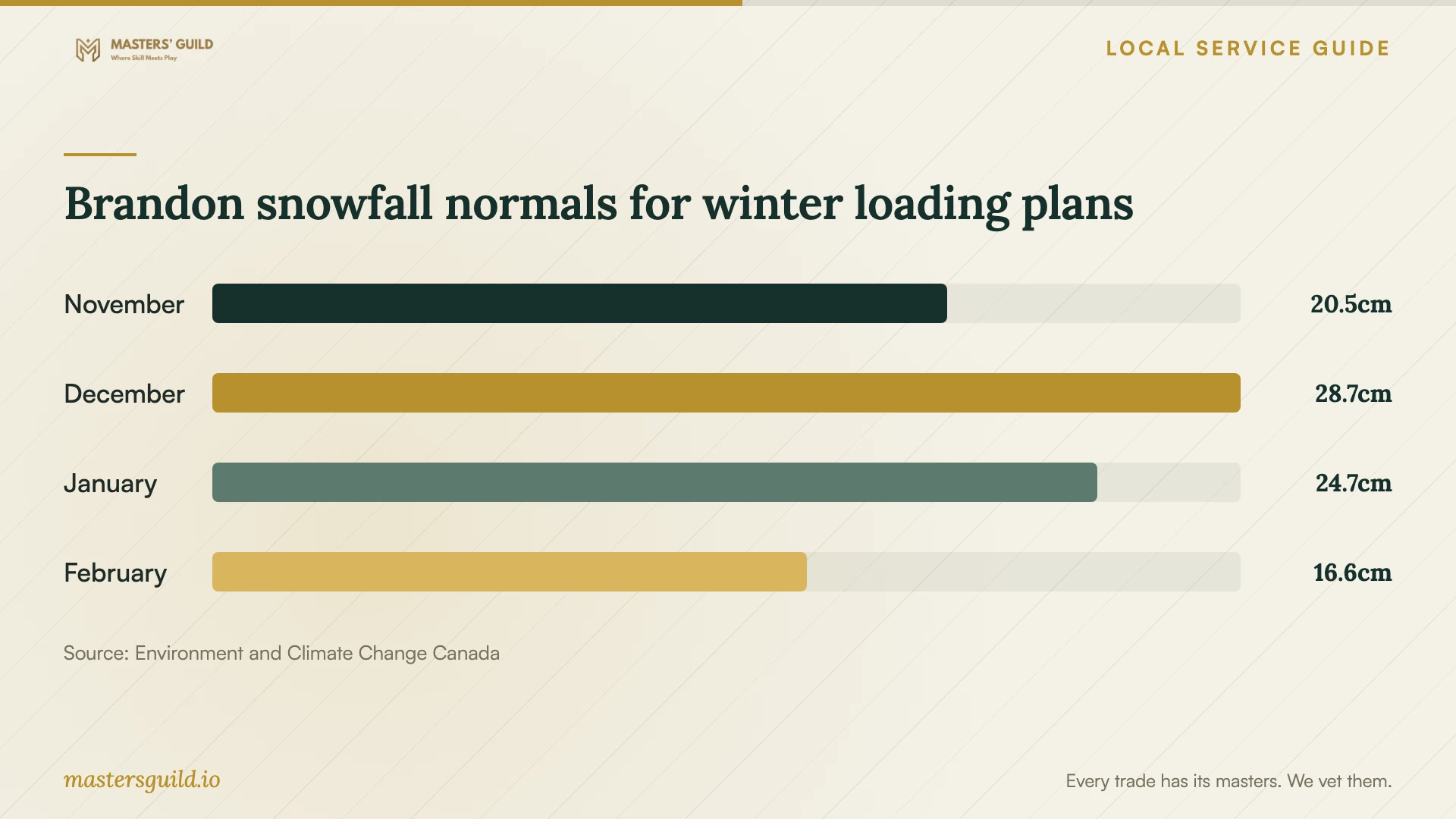
Brandon snowfall normals for winter loading plans
Local details that affect your job
Confirm the truck's approach
Brandon requires trucks to use designated truck routes, with an exception for vehicles below 5,773 kg gross vehicle weight. A truck accessing a business destination may use other streets when necessary, but must stay on truck routes until the intersection nearest that destination and return by the shortest route. Ask your mover to confirm the approach, vehicle size and any transfer arrangement before quoting. [1]
Choose a loading spot with enough clearance
Brandon prohibits stopping or parking within 3 metres of a lane or driveway entrance and within 9 metres of an intersection, unless a traffic control device indicates otherwise. Keep 3 metres clear on either side of a hydrant's projected position at the curb and obey no-stopping signs. Send photographs of the proposed space so the mover can assess access. [1]
Check active snow-route bans
Brandon's snow-route restriction season runs November 15 through March 31. Designated sections include Rosser Avenue, Princess Avenue, Ninth Street, Tenth Street and Louise Avenue, with listed hours of 23:00 to 08:00. The City may declare restrictions after significant snowfall or drifting and guarantees no minimum advance notice. Seasonal dates alone do not establish an active ban. Call 204-729-2500 before relying on overnight parking. [2]
Plan for a carrier handoff under Manitoba's rules
For used household goods under Schedule C, the originating and delivering carriers share joint and several liability for loss or damage while a connecting carrier holds the shipment. Section 4 also requires connecting-carrier names on the bill of lading. If your move involves a handoff, obtain those names and the delivery contact before departure, and retain the transport documents. [3]
Resolve these questions before booking
| Your situation | Ask the mover | Keep this record |
|---|---|---|
| A broker arranges transport | Who accepts responsibility for subcontracted services? | Written responsibility terms and carrier contacts |
| You ship used household goods from Manitoba | Which weighing method will you use under Schedule C? | Bill of lading and scale receipt where applicable |
| You will pack fragile belongings | Which packing exclusions affect my chosen protection? | Packing agreement and protection terms |
| The truck needs overnight snow-route parking | Where will you park if the City declares a ban? | Alternative parking arrangement |
| You need a delivery commitment | What date and time period will you record for my used household goods shipment? | Written delivery commitment |
Your hiring checklist
- Give each quoting company the same inventory, addresses and access details.
- Identify the carrier, destination agent and any broker or connecting carriers.
- Confirm services, extra charges, deposit refund terms and accepted payment methods.
- Review the bill of lading, delivery period and protection terms before loading.
- Agree on truck routing, legal parking and building access at both homes.
- Clear the winter walking path and check active snow-route bans.
- Carry valuables, medication, essential documents and overnight supplies with you.
- Check the delivery inventory and retain photographs, receipts and correspondence.
Frequently Asked Questions
How much should I budget?
Build your budget from written estimates for your inventory, destination and requested services. Ask movers to include packing, access arrangements, storage if needed and payment terms. Give each company the same details so you can compare the total for the same work. [4]
Can a moving truck park outside my home?
Confirm signs and clearances before promising curb access. Brandon restricts stopping or parking near hydrants, driveway and lane entrances, and intersections. If the truck needs overnight parking on a snow route during the restriction season, check for an active ban and agree on another location. [1] [2]
Does declaring value guarantee full reimbursement?
For used household goods, Manitoba's Schedule C also applies actual-value and weight-based liability limits. Ask the mover to explain your protection, exclusions and claim calculation. Check your household insurance for transit and storage coverage before selecting additional protection. [3] [4]
What should I send if belongings arrive damaged?
For used household goods under Schedule C, deliver written notice to the originating or delivering carrier within 60 days after delivery. Include origin, destination, shipment date and estimated claim amount. Also file a statement of claim within nine months of shipment. Retain photographs, inventory notes and proof that you delivered the notice. [3] [4]
Sources and scope
This guide combines the sources below with practical planning guidance. Figures apply to the stated geography and period; request a written quote for your property.