
Local service guide
HVAC Services in Atlanta: Hiring and Planning
For HVAC Services in Atlanta, ask for the contractor’s Georgia conditioned-air license number, a written diagnosis or equipment proposal, and a clear permit plan before approving work. Atlanta’s published guidance requires a permit to install, repair or replace HVAC equipment. If you are a Georgia Power residential customer, check rebate eligibility and installer requirements before choosing your scope. [1] [2] [3]
Choose a diagnostic visit or a replacement assessment
Describe the problem before asking for a price: no heating or cooling, a recurring shutdown, water near the indoor unit, noise, or rooms that feel different from the thermostat setting. Note when it started and any previous repairs. Ask the contractor to price the diagnostic visit and explain what you will receive after the assessment.
For a repair, request the identified fault, the proposed remedy, parts and labor, and the repair warranty. Ask whether the diagnostic fee counts toward approved work. Set a spending limit that requires your approval before the technician continues.
For replacement, ask the contractor to explain the proposed capacity, inspect the existing ducts, and address the comfort problems you reported. Request model numbers for the indoor and outdoor equipment, thermostat compatibility, and a list of any electrical or duct changes. Ask for the sizing calculation rather than approving a capacity based on the old unit alone.
Check the license against the proposed system
Georgia restricts Class I conditioned-air licenses to systems or equipment that do not exceed 175,000 BTU of heating and 60,000 BTU of cooling. Class II licenses are unrestricted. The state considers each complete system in a single installation an individual job for classification. Ask the contractor to identify the license class and show how it covers your proposed equipment. [2]
Georgia requires conditioned-air businesses to display a registration number using the qualifying licensee’s number, with GA. REG. before the CN or CR prefix. The requirement covers proposals and invoices. Ask for the qualifying licensee’s name and check current license status before signing; a number printed on a quote should be the start of that check. [2]
Request proof of insurance and ask who will perform the work. If the proposal includes electrical changes, ask who will handle that scope and include their responsibilities in the agreement. Keep the written proposal and final invoice together.
Put permits and inspection in the agreement
For properties within the City of Atlanta, ATL311 states that installing, repairing or replacing HVAC equipment requires a permit for residential and commercial projects. Before scheduling, give the contractor the exact address and scope. Ask who will submit the application, pay permit fees and coordinate any required inspection. [1]
Atlanta directs permit applications through Accela Citizen, with an exception for Express permits, which the city accepts in person. Homeowners can submit their own applications. If you take that responsibility, agree with the contractor on the information you need and how you will share permit status before work begins. [1]
For an unclear repair scope, contact the Office of Buildings Trades Work Stream at 404-865-8550. Describe the proposed work and confirm the application route. Use the city’s guidance for city properties; confirm the responsible permitting authority if your home is outside the city boundary. [1]
Compare the full price before counting rebates
Ask each contractor for a total price with separate entries for equipment, labor, duct changes, electrical work, removal, permit fees and optional upgrades. Request exclusions and payment milestones. For a replacement, ask how long you should plan to be without heating or cooling and whether equipment availability affects the schedule.
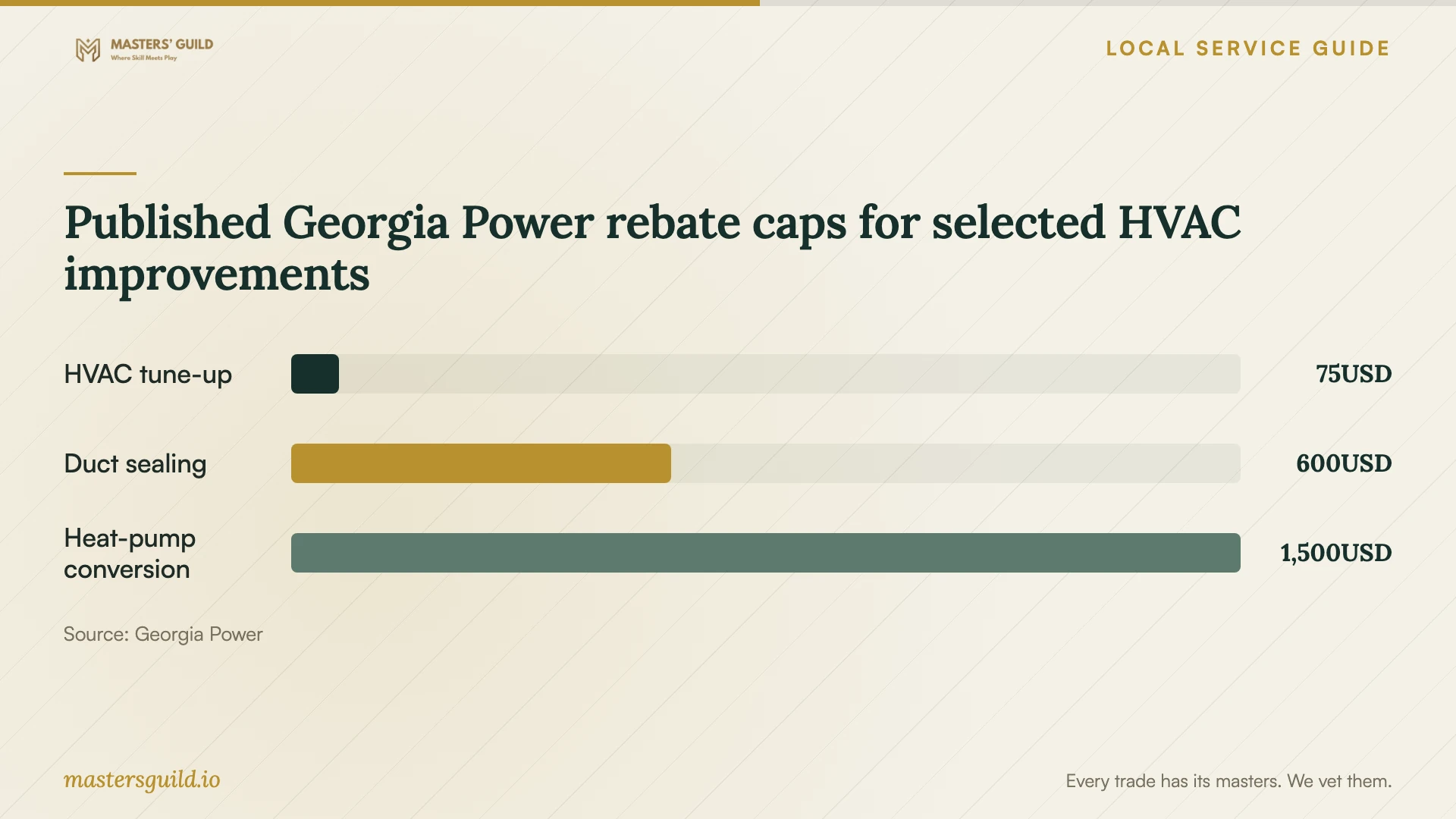
Georgia Power’s Home Energy Improvement Program lists rebates for qualifying residential improvements, including HVAC maintenance, duct sealing and heat-pump conversions. HVAC improvements require a licensed installer. Duct sealing requires a DET Verifier or Program Installer; air sealing and the Home Comfort Bundle require a Program Installer. Confirm the requirements for your selected improvement before hiring. [3]
Ask for the contract price before rebates and keep any expected rebate separate in your budget. Confirm customer eligibility, equipment requirements and application responsibility. Georgia Power requires applications within 60 days of the date on the paid-in-full invoice or receipt, so keep the invoice and prepare the application documents when the contractor finishes. [3]
Published Georgia Power rebate caps for selected HVAC improvements
Local details that affect your job
Atlanta lets homeowners control the application step
You can submit your own trade permit application instead of waiting for the contractor. Atlanta uses Accela Citizen for applications except Express permits, which require an in-person submission. The Trade Permits Division is at 55 Trinity Ave. SW, 3rd Floor, Suite 3900. Before choosing to apply yourself, agree who will supply the project details and handle inspection coordination. [1]
Georgia Power installer rules can affect your shortlist
For Georgia Power residential customers, the installer requirement depends on the improvement. A licensed installer can handle qualifying HVAC improvements, while duct sealing requires a DET Verifier or Program Installer. Ask about those credentials before combining duct work with equipment replacement. The utility also asks applicants for their meter number, improvement address and signed terms and conditions. [3]
Choose the next step for your project
| Your situation | Next step | Question to settle |
|---|---|---|
| A new heating or cooling fault | Arrange a diagnostic visit | What is the visit fee, and what needs approval before repair? |
| You are considering replacement | Request a written equipment and installation proposal | How did you choose the capacity, and which duct or electrical changes are included? |
| You plan an HVAC repair or replacement inside Atlanta | Resolve permit responsibility before scheduling | Who submits the application and coordinates inspection? |
| You want a Georgia Power duct-sealing rebate | Confirm a DET Verifier or Program Installer | Who checks eligibility and prepares the application documents? |
Your hiring checklist
- Record the symptoms, affected rooms, equipment model numbers and previous repair history.
- Confirm the diagnostic charge, approval limit and any credit toward repairs.
- Request the qualifying licensee’s name, registration number and proof of insurance.
- Agree who will submit permits, pay fees and coordinate inspections.
- Compare model numbers, installation scope, exclusions and warranty terms.
- Confirm rebate eligibility and required installer credentials before signing.
- Keep the paid invoice, permit records and equipment documents.
Frequently Asked Questions
Does Atlanta require a permit for an HVAC repair?
ATL311’s published guidance says a permit is required to install, repair or replace HVAC equipment. For your exact repair scope, confirm the process with the Office of Buildings Trades Work Stream at 404-865-8550 before scheduling. [1]
Can I submit the permit application myself?
Yes. Atlanta allows homeowners to submit their own permit applications. The city directs applications through Accela Citizen except Express permits, which it accepts in person. Agree with your contractor on who provides project details and coordinates inspection. [1]
Does an HVAC contractor need a Class II license for my home?
Match the license to the equipment capacity. Georgia permits Class I conditioned-air contractors to work on systems or equipment up to 175,000 BTU of heating and 60,000 BTU of cooling. Class II is unrestricted. Ask the contractor to identify the capacity of each complete proposed system. [2]
Can I use my chosen installer for a Georgia Power rebate?
It depends on the improvement. HVAC improvements require a licensed installer; duct sealing requires a DET Verifier or Program Installer. Check the selected rebate’s requirements before committing. Applications must reach the program within 60 days of the date on the paid-in-full invoice or receipt. [3]
Sources and scope
This guide combines the sources below with practical planning guidance. Figures apply to the stated geography and period; request a written quote for your property.