
Local service guide
Warehouse Organization in Anaheim, CA
Arrange Warehouse Organization in Anaheim by asking providers to quote a defined storage zone, inventory reconciliation, location labels and a staff handover. Separate stock handling from rack alterations and waste removal in the scope. Before anyone moves heavy inventory, confirm floor and rack capacities: California requires occupants to keep loads within allowable limits and prohibits loading racks beyond manufacturer design capacity. [5]
Define the work before requesting quotes
Start with the problem your staff needs to solve: misplaced stock, mixed returns, unreadable shelf labels or overflow in a receiving area. Describe the affected zone and specify which inventory stays, moves or needs your approval for disposal. Ask the provider to walk the space with the employee who handles receiving and picking.
Request a written scope covering sorting, counts, location assignments, labels, inventory-record updates and cleanup. Identify who supplies bins and labels, who operates handling equipment and who approves discrepancies. If you want rack installation, repair or relocation, request a separate scope and qualified assessment before including that work.
Set a concrete handover standard: staff can locate selected products using the new location list, counts match the agreed records, and the provider returns unresolved items to a designated review area. Ask for a marked layout and a short explanation of how staff should process incoming stock and returns.
Protect aisles and confirm storage capacity
California's workplace rules require permanent aisles and walkways to remain reasonably clear and in good repair. Employers must mark them when poor definition creates a hazard. Ask the provider to preserve the approved routes during temporary staging as well as after the reset. [1]
For industrial vehicles in customary use, Section 3272 specifies a single-vehicle traffic aisle at least two feet wider than the widest vehicle. For two-way traffic, it specifies at least three feet more than twice the widest vehicle's width. The rule includes a storage-access-aisle exception; these dimensions alone do not establish a suitable picking aisle or turning space. Have the person responsible for your site's layout confirm the applicable requirements. [1]
Collect product weights and manufacturer rack-capacity information before approving new storage positions. Section 3241 requires stable storage that prevents tipping, falling, collapse, rolling or spreading. It also requires owners to post commercial or industrial floor design loads and occupants to keep actual loads below allowable limits. Ask the provider to flag missing capacity information for resolution before redistribution. [5]
Compare labor, materials and downtime
Ask whether the quote uses a fixed project price or hourly billing. For hourly work, request crew size, expected billable hours, minimum charges and an approval point before extra work. Confirm whether the stated hours mean elapsed time or combined worker-hours. Keep labels, containers, equipment rental, hauling and disposal on separate lines.
Choose an operating window with your warehouse lead. Identify orders that must ship during the work, protect their stock from relocation and assign one employee to approve changes. For a larger reset, ask the provider to propose a sequence by zone and show where staff will receive deliveries while work continues.
Ask for evidence of insurance appropriate to the proposed work and examples of comparable commercial storage projects. Clarify responsibility for inventory damage, counting errors and subcontracted hauling in writing. Avoid accepting a general decluttering quote until the provider addresses your inventory records and equipment access.
Approve disposal before the crew loads waste
Separate reusable stock, recyclable material and waste awaiting classification before collection. For an Anaheim business, Orange County's free household hazardous waste centers are unavailable for business waste. Use the county's business referral page to identify a possible route, then contact the facility about your material, quantity, packaging, acceptance and charges. [3] [4]
For ordinary landfill disposal, ask the hauler to name the destination and provide disposal receipts. Orange County accepts only waste originating within the county and asks customers to show proof, such as a utility bill or contract identifying the waste's origin. Its public disposal sites are Olinda and Prima Deshecha. [2]
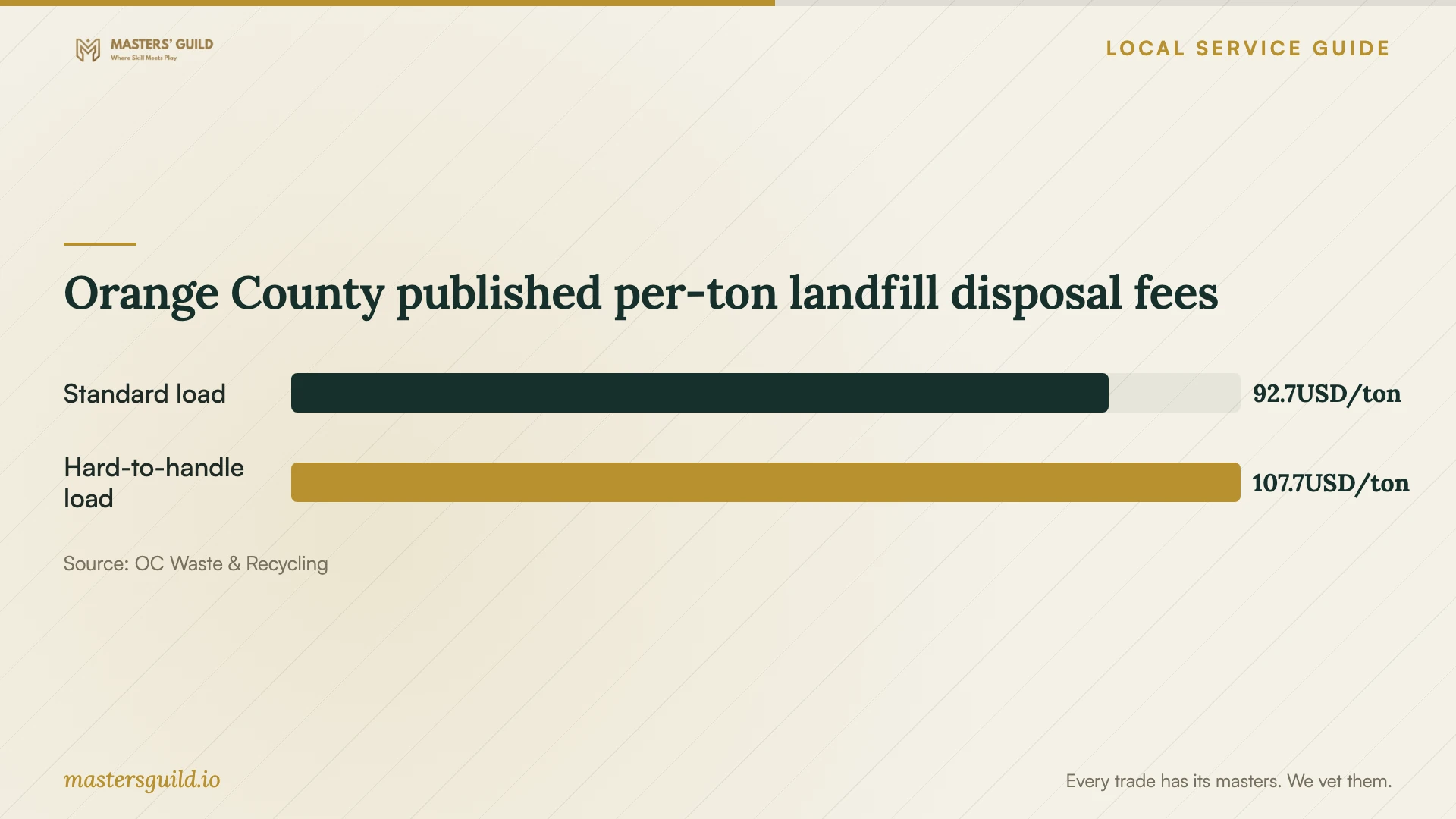
Orange County published per-ton landfill disposal fees
Local details that affect your job
Business waste cannot use the household program
Orange County excludes businesses from its household hazardous waste collection centers. Do not approve a cleanout plan that relies on free household drop-off for warehouse waste. Ask the provider to confirm a business acceptance route before removing batteries, chemicals or electronics. [3]
Anaheim referrals require an acceptance call
The county lists Kinsbursky Brothers in Anaheim for batteries, catalysts and electronic scrap, and Mars Environmental in Anaheim for hazardous waste disposal and marine flares. These are informational referrals, not county endorsements. Contact the relevant facility to confirm acceptance and terms for your specific waste before booking transport. [4]
Treated wood changes the landfill destination
The county fee page states that Olinda Alpha does not accept treated wood waste, while Prima Deshecha accepts it. If the reset includes discarded wood of uncertain treatment, ask the hauler to identify it and confirm the receiving site's requirements. Prepare proof that the waste originated at your Orange County premises. [2]
Choose the scope that matches your warehouse problem
| Situation | Work to request | Approval before starting |
|---|---|---|
| Light stock in existing bays | Sorting, labels and location-record updates | Zone boundaries, counting method and handover test |
| Heavy stock needs redistribution | Inventory moves with a capacity review | Stock weights and floor and rack limits; California prohibits overloading |
| Receiving or picking routes need changes | Layout assessment before relocation | Applicable aisle requirements, vehicle dimensions and temporary staging |
| Batteries, chemicals or electronic waste need removal | Separate business disposal arrangements | Facility acceptance; county household centers exclude business waste |
| Discarded wood may be treated | Material identification and destination confirmation | Olinda Alpha excludes treated wood; Prima Deshecha accepts it |
Your hiring checklist
- Photograph the work zone and identify inventory that must remain available for orders.
- Prepare a stock list, location records and a named employee to approve discrepancies.
- Collect stock weights and rack-capacity information for the planned storage positions.
- Agree on pedestrian routes, equipment access and temporary staging areas.
- Request separate prices for labor, labels, containers, equipment and disposal.
- Confirm business waste acceptance and the destination before authorizing removal.
- Agree on a handover test using selected products, counts and the new location list.
Frequently Asked Questions
How much should I budget for warehouse organization?
Get a site-specific quote for the agreed zone and deliverables. Ask bidders to separate worker-hours, supplies, equipment and disposal. The published county landfill rates cover disposal charges only; they do not establish organizing labor rates or the total cleanout cost. [2]
Can the organizer move or modify warehouse racks?
Ask the bidder to identify rack work as a separate scope and explain who will assess it. California requires racks to support their intended loads and prohibits loading above manufacturer design capacity. Do not approve new inventory positions without resolving capacity questions. [5]
Can our warehouse use free household hazardous waste disposal?
No. Orange County's household hazardous waste centers cannot accept business waste. Consult the county's business referrals and confirm acceptance with the facility for your waste type and quantity. [3] [4]
What should I receive when the work finishes?
Request a location list, agreed inventory corrections, a layout showing storage zones and routes, and disposal receipts for removed waste. Walk the space with your warehouse lead and test whether staff can find selected products before accepting the work.
Sources and scope
This guide combines the sources below with practical planning guidance. Figures apply to the stated geography and period; request a written quote for your property.