
Local service guide
Long-Distance Moving in Anaheim, CA
Arrange Long-Distance Moving in Anaheim by confirming whether your shipment stays within California or crosses a state line, checking the mover’s licenses, and comparing written estimates after a visual inspection. California’s Bureau of Household Goods and Services requires its license for household movers operating within, into, or out of California; movers crossing California’s state boundary also need federal licensing. Before booking, agree on the inventory, services, charges, and delivery arrangements. [1]
Check the company handling your shipment
Ask each company for its legal business name, California household mover license information, and insurance details. For an interstate shipment, request its federal licensing information too. Use the BHGS consumer guide’s license search to check the company, and match the name against your estimate and moving agreement. [1]
Ask who will collect your deposit, load your belongings, transport them, and deliver them. BHGS advises customers to examine deposit language for a different company name and to get a receipt. The bureau also warns about large deposits and electronic or digital transfer deposits. Resolve any mismatch before paying. [1]
Give the estimator a complete walkthrough, including closets, garage contents, outdoor furniture, and items you intend to add. BHGS recommends an in-person visual inspection; for moves within California, the mover must conduct a visual inspection with the estimate. Keep your own copy of the inventory used for pricing. [1]
Compare the estimate and the final price rules
For a move within California, BHGS says moves under 100 miles can use hourly charges, while moves over 100 miles must use weight and mileage. The mover must sign the estimate. The moving agreement should include a Not to Exceed Price, which sets the maximum charge unless you sign change orders. [1]
For a move into or out of California, you and the mover must sign the estimate. A binding estimate guarantees the total cost unless you request additional services. With a non-binding estimate, the mover determines the final cost using the shipment’s actual weight. Ask the estimator to explain the calculation before you choose. [1]
Request separate entries for packing, unpacking, furniture assembly, storage, stairs, elevator access, and any smaller truck needed to reach either address. Ask which services the quoted total includes and how the mover would price a change. Compare companies using the same list instead of comparing totals with different scopes.
If you add belongings after the inspection, complete the paperwork before loading. BHGS calls for a signed change order on a within-California move or an updated estimate on a move into or out of California. Ask for written coverage terms too, including which damage the mover covers and how you would submit a claim. [1]
Coordinate loading access and delivery
Walk the route from your front door to the proposed truck position. Tell the mover about steps, narrow turns, gates, overhead clearance, and the distance crews must carry items. Ask your property manager or homeowners association about loading access and elevator reservations, then give the mover those instructions before finalizing the estimate.
Request a pickup window and delivery window in writing. Ask whom you should contact during transit, how much notice the driver will give, and what happens if you cannot receive the shipment on the proposed date. If you need storage, clarify its location, access arrangements, charges, and responsibility for damage.
BHGS says the company must provide the moving agreement or Bill of Lading at least three days before the move, and both parties must sign before moving begins. Photograph your belongings before loading. For a move into or out of California, the mover must provide an itemized inventory for you to verify. Carry important documents, family photos, and jewelry yourself. [1]
Finish disposal before the final inventory
Sort belongings into items to ship, carry yourself, donate, or dispose of before the estimator’s visit. Ask the mover for its prohibited-item list rather than assuming it will accept garage chemicals or batteries. Schedule disposal separately so the crew receives a clear inventory on loading day.
Orange County offers free household hazardous waste and electronic waste disposal for county residents. Its Anaheim center accepts qualifying household materials at 1071 N. Blue Gum Street. The county lists paints, cleaners, oils, batteries, and pesticides among products requiring special disposal handling. Check the county’s item and quantity guidelines before taking a load. [2]
For ordinary waste, Orange County identifies Olinda and Prima Deshecha as its two public disposal sites. County landfills accept waste originating in Orange County and require proof of origin. Keep a current utility bill or another accepted document available if your license no longer shows the address where the waste originated. [3]
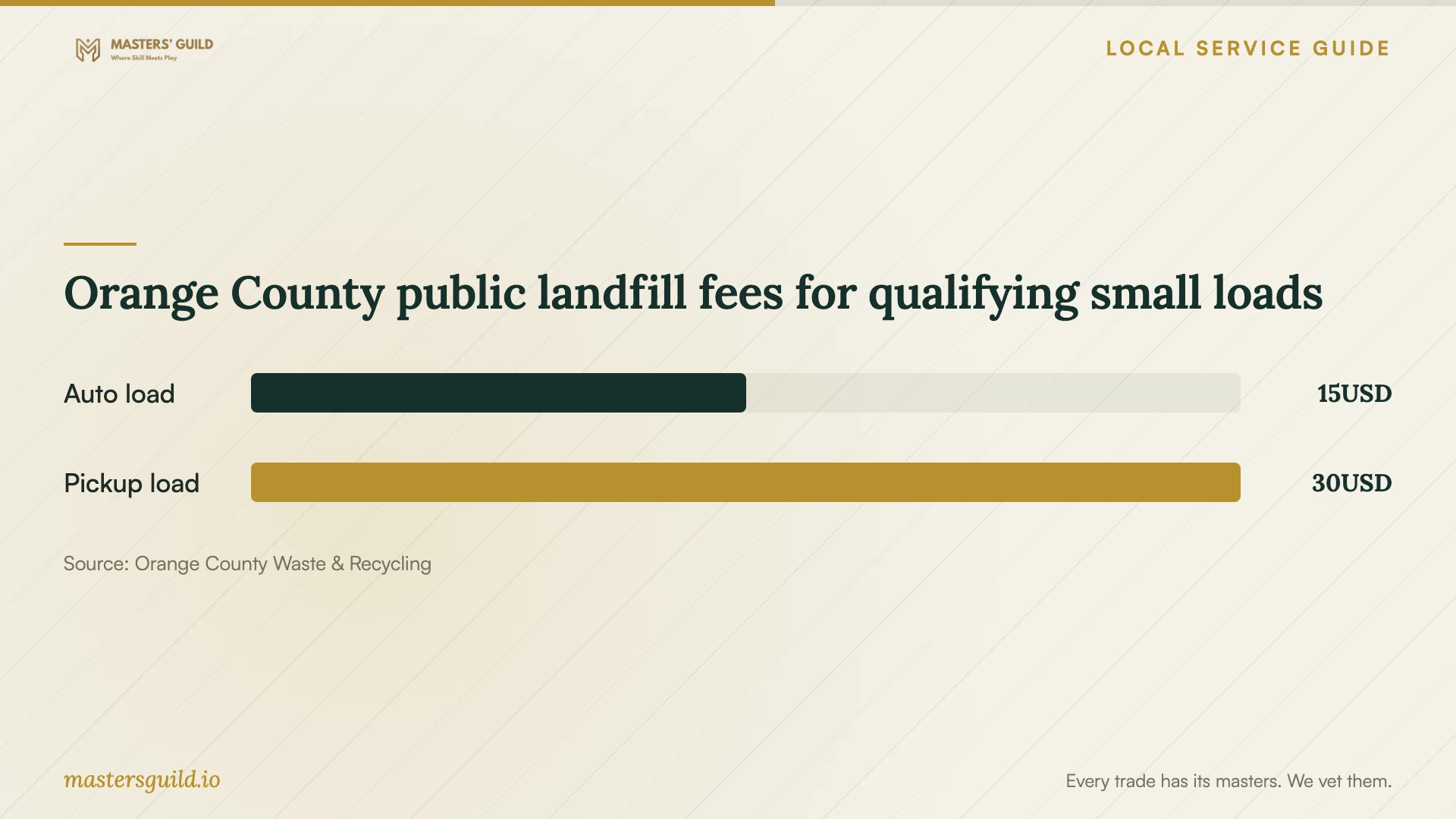
Orange County public landfill fees for qualifying small loads
Local details that affect your job
Plan the Blue Gum Street trip around closures
The Anaheim household hazardous waste collection center operates from 9 a.m. to 3 p.m., Tuesday through Saturday, and closes on major holidays and during rainy weather. County staff may request proof of Orange County residence. Arrange this trip before loading day and check operating conditions before leaving; call 714-834-4000 for questions about special disposal appointments or assistance. [2]
Choose the correct disposal program
The free county household hazardous waste centers exclude waste from businesses and residents outside Orange County. For an eligible household’s ordinary decluttering waste, public landfill fees depend on vehicle type and load weight. The county adds $15 for hard-to-handle items longer than six feet, including qualifying furniture or mattresses. Measure oversized items and check acceptance before choosing a disposal trip. [2] [3]
Choose your next step before booking
| Your situation | What to verify | Next step |
|---|---|---|
| Move stays in California and exceeds 100 miles | BHGS license; weight and mileage billing; Not to Exceed Price | Ask for the weight calculation and signed estimate. |
| Move crosses California’s state boundary | BHGS and federal licensing; binding or non-binding estimate | Confirm the estimate type and sign the complete inventory-based estimate. |
| You add items after the inspection | Change order within California or updated estimate for an interstate move | Finish the revised paperwork before loading. |
| You have household chemicals or discarded electronics | County residency, acceptance guidelines, and collection-center operating conditions | Plan a separate Anaheim collection-center trip. |
| You have ordinary waste or oversized furniture | Public landfill eligibility, proof of waste origin, and applicable fees | Check acceptance and measure items longer than six feet. |
Your hiring checklist
- Confirm the destination and whether the shipment crosses a state boundary.
- Match the mover’s legal name and license information to the estimate and agreement.
- Prepare one inventory and service list for all estimators.
- Describe loading access at both addresses and ask for any related charges in writing.
- Agree on pickup, delivery, transit contacts, and any storage arrangements.
- Complete disposal trips and remove items you will carry yourself.
- Read the agreement, photograph belongings, and verify the loading inventory.
Frequently Asked Questions
Does a long move within California need federal licensing?
BHGS distinguishes routes by whether they cross California’s boundary. Its guide requires California licensing for household movers operating within the state and additional federal licensing for companies moving household goods into or out of California. Distance alone does not make a within-state move interstate. [1]
Can I rely on an estimate given over the phone?
Arrange a visual inspection before choosing a mover. BHGS warns about estimates issued before an inspection, quotes missing inventory details, and prices far below competing estimates. For moves within California, a visual inspection is required with the estimate. [1]
How much should I budget for the move itself?
Request a written estimate for your route, inventory, and selected services. For interstate moves, check whether the estimate is binding or non-binding. Keep disposal, travel, and any temporary accommodation in separate budget entries so you can compare the movers’ transportation and service charges. [1]
Where can I report a problem with the mover?
BHGS accepts complaints about household moves within California or to or from California. Its guide identifies delivery delays, unanswered damage claims, and charges exceeding estimates among common complaints. Retain the estimate, agreement, inventory, receipts, photos, and correspondence when preparing a complaint. [1]
Sources and scope
This guide combines the sources below with practical planning guidance. Figures apply to the stated geography and period; request a written quote for your property.