
Local service guide
Long-Distance Moving in Albuquerque
Arrange Long-Distance Moving in Albuquerque by giving each bidder the same inventory, pickup and destination access details, and delivery requirements. Ask who will transport your belongings and request written charges before booking. Check your pickup street’s parking restrictions: Albuquerque requires online applications for moving-van permits through its residential permit-parking program. For a move within New Mexico, ask NMDOT’s Transportation Regulation Bureau about the carrier’s authority and applicable state requirements. [1] [3]
Start with the route and the company doing the work
Put the pickup address, destination address and requested dates at the top of your quote request. Ask the bidder to name the company that will collect, transport and deliver your belongings. If another company will participate, request its name and a contact person before you sign.
For a shipment staying within New Mexico, contact NMDOT’s Transportation Regulation Bureau about the carrier’s operating authority and which rules apply to your route. NMDOT’s FAQ identifies its Company Directory as the place to find approved individual and statewide tariffs. It also explains that existing certificates and warrants remained in force through the regulatory transfer and that existing NMPRC authority numbers stayed the same. [3]
For a destination outside New Mexico, ask the bidder to identify the applicable regulator and provide a way to verify its transport authority. The state paperwork guidance below concerns carriers under NMDOT jurisdiction. Do not assume that those provisions govern your interstate shipment. [2]
Get quotes for the same shipment
Prepare one inventory for all bidders. Include furniture, estimated box quantities, garage contents and items you want the crew to pack or dismantle. Mark anything you intend to carry yourself. Send photographs of large pieces and the route from your door to the proposed truck position.
The published New Mexico rule requires carriers under department jurisdiction to provide an estimate before loading that describes the shipment, requested services and maximum amount payable. It defines a binding estimate as an advance agreement guaranteeing the total for the listed quantities and services. A nonbinding estimate approximates charges using estimated weight and requested services; final charges depend on actual weight and tariff provisions. [2]
Ask each bidder to separate transport, packing, storage and any proposed extra labor or smaller vehicle. The state rule permits additional tariff charges for smaller equipment and labor when a carrier cannot reach the pickup or delivery point and the shipper gives permission. Send access details before the quote so you can discuss that possibility before loading. [2]
Compare the written scope beside the total. If one bidder leaves out packing or storage, request a revised quote before treating it as the cheaper option. Ask how the company will document additions if you change the inventory after accepting the estimate.
Arrange the Albuquerque loading position
Check the signs on your pickup block and ask your landlord or property manager about loading access. Albuquerque identifies restricted residential parking on some streets around Downtown, the State Fairgrounds and the University of New Mexico. These restrictions apply to particular streets; confirm your address rather than assuming that a whole neighborhood has the same rules. [1]
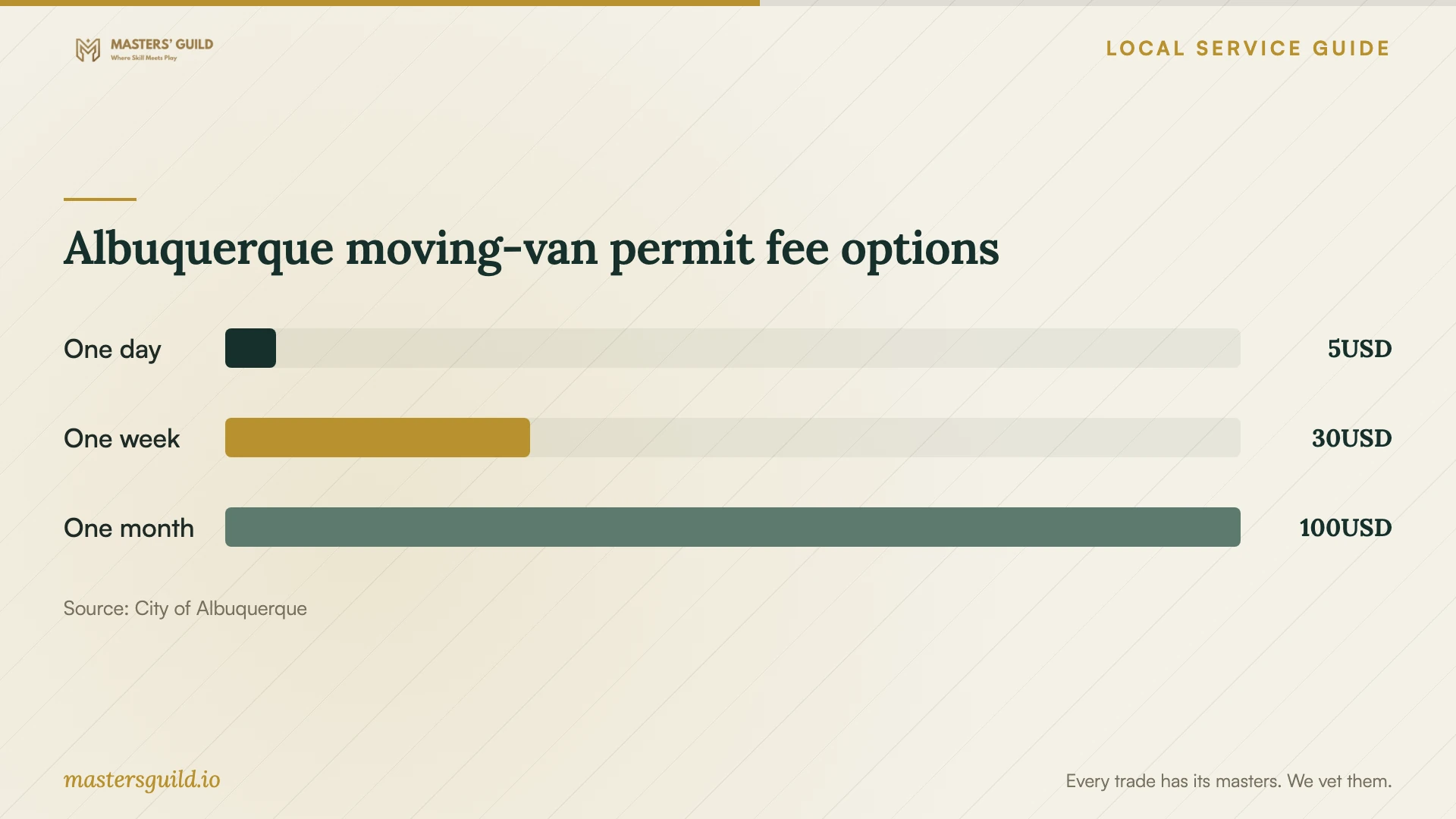
The city requires applicants seeking moving-van permits to use its online website and says its office cannot process those requests. Its published moving-van fee guideline lists $5 per day, $30 per week and $100 per month. Ask Parking Management which option applies to your address and truck, what documentation it needs, and whether you need a separate arrangement for the intended loading position. [1]
Do not treat a permit payment as confirmation of a reserved loading space. Ask the city about the proposed position and ask the mover to assess truck access. For an apartment, also confirm elevator booking, loading hours and the building contact who can admit the crew.
Write down delivery and storage arrangements
Tell the mover the earliest date you can accept delivery and who will meet the truck. Request the delivery window in writing. Ask whether the quote includes temporary storage, where the company would store the shipment, and what you would pay for another delivery attempt.
For carriers under department jurisdiction, the published state rule requires a bill of lading before the carrier accepts the goods. That document serves as the transportation contract and receipt. Required information includes origin, destination, participating carriers if known, and any agreed pickup and delivery date. [2]
The same rule directs the carrier to transport within the time specified in the bill of lading and notify the shipper when an anticipated delivery delay becomes apparent. It also allows storage and subsequent delivery charges when the recipient cannot accept delivery. Discuss a backup recipient or revised date before your move if your destination access remains uncertain. [2]
Review the inventory and damage protection
For a state-regulated shipment, the published rule requires an inventory describing articles, existing damage or wear, and who packed the containers. At delivery, the carrier must give you an opportunity to compare the shipment with that inventory and record new damage. Read the descriptions before signing and photograph anything you dispute. [2]
Ask the mover to explain its liability options in dollars for your shipment. The state rule describes released-value liability based on the damaged article’s weight and a tariffed rate, plus declared-value and replacement-value options. Request the applicable rate, shipment limit and treatment of valuable articles before selecting an option. [2]
Keep your estimate, bill of lading, inventory, photographs and payment records together. For a state-regulated loss, damage or overcharge claim, the published rule instructs the shipper to notify the carrier in writing upon discovery and allow inspection of the item and original packaging. NMDOT’s FAQ also provides a complaint-filing route through the Transportation Regulation Bureau. [2] [3]
Albuquerque moving-van permit fee options
Local details that affect your job
Moving-van permits require an online request
Albuquerque processes moving-van permit requests through its online parking website rather than its office. Before booking pickup on a restricted residential street, ask Parking Management at 505-924-3950 about your address, vehicle and loading plan. The city identifies some restricted streets around Downtown, the State Fairgrounds and UNM. [1]
Use NMDOT for state carrier questions
NMDOT’s Transportation Regulation Bureau handles the transportation-regulation function transferred from PRC on July 1, 2024. Its FAQ says existing NMPRC authority numbers stayed the same and directs readers to its Company Directory for approved tariffs. For a move within the state, ask the bureau at 505-827-4519 to help check the named carrier and applicable requirements. [3]
Resolve these arrangements before booking
| Your situation | Next step | Written confirmation to request |
|---|---|---|
| Destination within New Mexico | Ask NMDOT about the carrier and applicable state requirements | Carrier authority details and estimate type |
| Destination outside New Mexico | Ask which regulator governs transport and how to verify authority | Transporting company name and route-specific documents |
| Pickup on a restricted residential street | Check the city’s online moving-van permit process | Permit details and an agreed loading plan |
| Truck cannot reach the door | Have the mover assess smaller equipment and extra labor | Scope, permission and proposed additional charges |
| Destination unavailable at delivery | Discuss storage and another delivery attempt | Storage location, charges and recipient arrangements |
Your hiring checklist
- Send each bidder the same inventory, photographs, addresses and requested dates.
- Identify the company responsible for pickup, transport and delivery.
- Ask the applicable regulator to help verify the carrier’s authority for your route.
- Request written charges for packing, storage and proposed access arrangements.
- Confirm street restrictions, the permit process and the loading position before booking.
- Write down the delivery window, recipient contact and backup access plan.
- Review liability choices and photograph valuable or damaged items before loading.
- Keep shipment documents and record discrepancies before signing the delivery inventory.
Frequently Asked Questions
Does Albuquerque require every moving truck to have this permit?
The cited city page describes its residential permit-parking program and identifies restricted streets in specific areas. Check your pickup address with Parking Management. The page does not establish a blanket moving-truck permit requirement across the city. [1]
Should I reject a mover that gives me an NMPRC number?
NMDOT’s FAQ says existing NMPRC authority numbers stayed the same after the transfer to DOT. Ask the Transportation Regulation Bureau to check the company and authority for your shipment. [3]
Does a nonbinding estimate cap my final bill?
For carriers under department jurisdiction, the published New Mexico rule bases final charges on actual weight and tariff provisions. It limits payment at delivery to the original nonbinding estimate plus 10 percent, with remaining charges payable within 30 days. That delivery-payment limit is not a final-price cap. [2]
How much should I budget for the whole move?
Request shipment-specific written quotes using the same inventory and services. The city permit fees below cover parking administration only. These sources do not provide an Albuquerque long-distance moving price range, so use the mover’s documented transport, packing, access and storage charges to build your budget. [1]
Sources and scope
This guide combines the sources below with practical planning guidance. Figures apply to the stated geography and period; request a written quote for your property.